Institute of Information Science and Technologies A. Faedo (ISTI), CNR-National Research Council of Italy, Pisa, Italy.
Sensors (Basel). 2012;12(6):6802-24. doi: 10.3390/s120606802. Epub 2012 May 25.
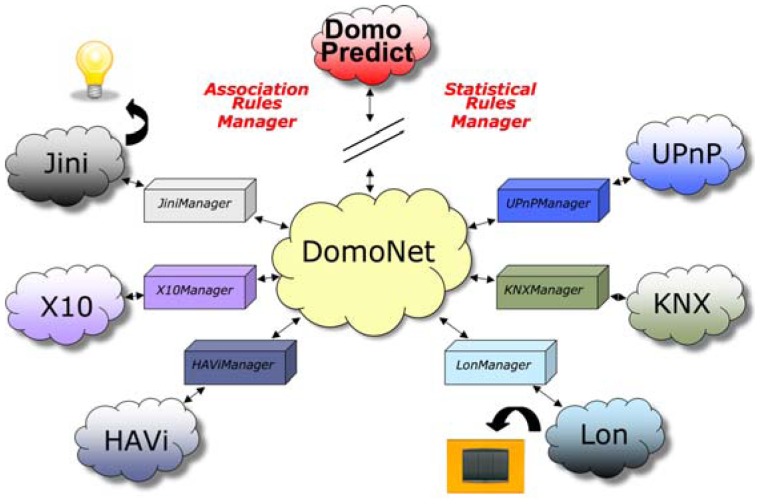
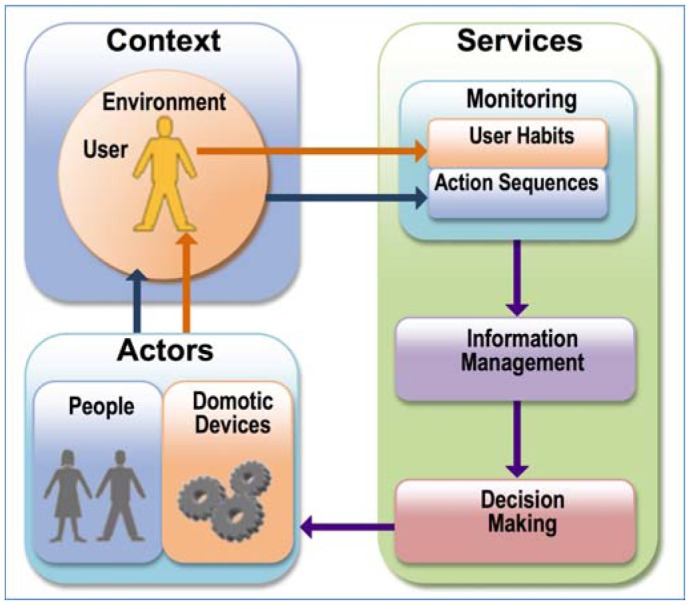
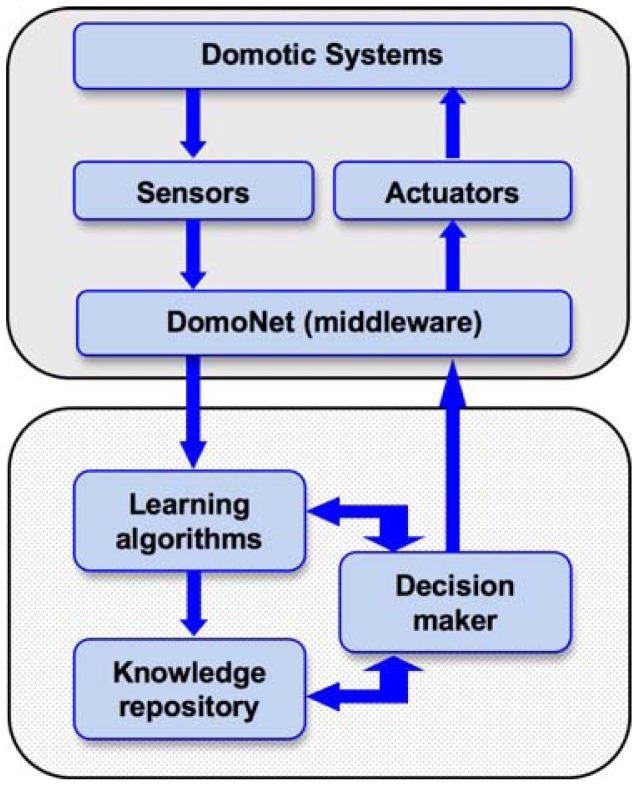
The key idea underlying many Ambient Intelligence (AmI) projects and applications is context awareness, which is based mainly on their capacity to identify users and their locations. The actual computing capacity should remain in the background, in the periphery of our awareness, and should only move to the center if and when necessary. Computing thus becomes 'invisible', as it is embedded in the environment and everyday objects. The research project described herein aims to realize an Ambient Intelligence-based environment able to improve users' quality of life by learning their habits and anticipating their needs. This environment is part of an adaptive, context-aware framework designed to make today's incompatible heterogeneous domotic systems fully interoperable, not only for connecting sensors and actuators, but for providing comprehensive connections of devices to users. The solution is a middleware architecture based on open and widely recognized standards capable of abstracting the peculiarities of underlying heterogeneous technologies and enabling them to co-exist and interwork, without however eliminating their differences. At the highest level of this infrastructure, the Ambient Intelligence framework, integrated with the domotic sensors, can enable the system to recognize any unusual or dangerous situations and anticipate health problems or special user needs in a technological living environment, such as a house or a public space.
许多 智能环境(AmI)项目和应用程序的核心思想是上下文感知,这主要基于它们识别用户及其位置的能力。实际的计算能力应该保持在后台,在我们意识的边缘,如果有必要,只需要移动到中心。这样,计算就变得“不可见”了,因为它嵌入在环境和日常物品中。本文所描述的研究项目旨在实现一个基于智能环境的环境,通过学习用户的习惯和预测他们的需求来提高用户的生活质量。这个环境是一个自适应的、上下文感知的框架的一部分,旨在使今天不兼容的异构家庭自动化系统完全互操作,不仅用于连接传感器和执行器,而且用于为用户提供设备的全面连接。该解决方案是一个基于开放和广泛认可的标准的中间件架构,能够抽象出底层异构技术的特点,使它们能够共存和互操作,而不消除它们的差异。在这个基础设施的最高层,与家庭自动化传感器集成的智能环境框架可以使系统能够识别任何异常或危险情况,并在技术生活环境(如房屋或公共场所)中预测健康问题或特殊用户需求。