Lopez Lucía, Piegari Estefanía, Sigaut Lorena, Ponce Dawson Silvina
Departamento de Física FCEN-UBA and IFIBA, Ciudad Universitaria, Pabellón I Buenos Aires, Argentina.
Front Physiol. 2012 Sep 3;3:350. doi: 10.3389/fphys.2012.00350. eCollection 2012.
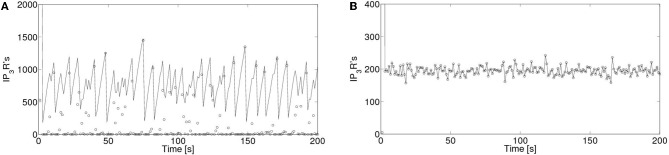
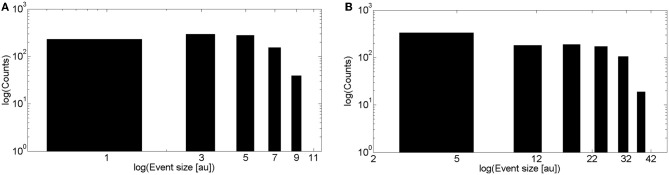
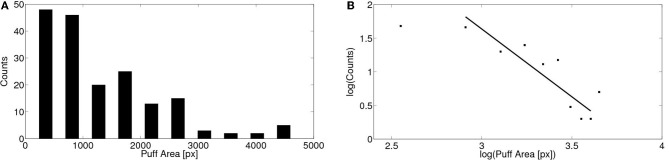
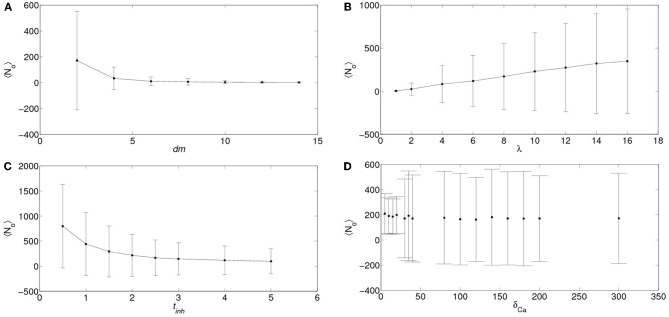
Many natural phenomena display "self-organized criticality" (SOC), (Bak et al., 1987). This refers to spatially extended systems for which patterns of activity characterized by different lengthscales can occur with a probability density that follows a power law with pattern size. Differently from power laws at phase transitions, systems displaying SOC do not need the tuning of an external parameter. Here we analyze intracellular calcium (Ca(2+)) signals, a key component of the signaling toolkit of almost any cell type. Ca(2+) signals can either be spatially restricted (local) or propagate throughout the cell (global). Different models have suggested that the transition from local to global signals is similar to that of directed percolation. Directed percolation has been associated, in turn, to the appearance of SOC. In this paper we discuss these issues within the framework of simple models of Ca(2+) signal propagation. We also analyze the size distribution of local signals ("puffs") observed in immature Xenopus Laevis oocytes. The puff amplitude distribution obtained from observed local signals is not Gaussian with a noticeable fraction of large size events. The experimental distribution of puff areas in the spatio-temporal record of the image has a long tail that is approximately log-normal. The distribution can also be fitted with a power law relationship albeit with a smaller goodness of fit. The power law behavior is encountered within a simple model that includes some coupling among individual signals for a wide range of parameter values. An analysis of the model shows that a global elevation of the Ca(2+) concentration plays a major role in determining whether the puff size distribution is long-tailed or not. This suggests that Ca(2+)-clearing from the cytosol is key to determine whether IP(3)-mediated Ca(2+) signals can display a SOC-like behavior or not.
许多自然现象呈现出“自组织临界性”(SOC)(巴克等人,1987年)。这指的是空间扩展系统,在该系统中,以不同长度尺度为特征的活动模式能够以一种概率密度出现,这种概率密度随模式大小遵循幂律。与相变时的幂律不同,呈现SOC的系统不需要外部参数的调节。在此,我们分析细胞内钙(Ca(2+))信号,它是几乎任何细胞类型信号传导工具包的关键组成部分。Ca(2+)信号既可以在空间上受限(局部),也可以在整个细胞中传播(全局)。不同模型表明,从局部信号到全局信号的转变类似于定向渗流。反过来,定向渗流又与SOC的出现相关。在本文中,我们在Ca(2+)信号传播的简单模型框架内讨论这些问题。我们还分析了在未成熟非洲爪蟾卵母细胞中观察到的局部信号(“钙瞬变”)的大小分布。从观察到的局部信号获得的钙瞬变幅度分布不是高斯分布,存在相当一部分大尺寸事件。图像时空记录中钙瞬变区域的实验分布有一个长尾巴,近似对数正态分布。该分布也可以用幂律关系拟合,尽管拟合优度较小。在一个简单模型中,对于广泛的参数值,在单个信号之间存在一些耦合时会遇到幂律行为。对该模型的分析表明,Ca(2+)浓度的全局升高在决定钙瞬变大小分布是否为长尾分布方面起主要作用。这表明从细胞质中清除Ca(2+)是决定IP(3)介导的Ca(2+)信号是否能呈现类似SOC行为的关键。