Bernstein Center for Computational Neuroscience, Institute of Physics III - Biophysics, Georg-August Universität, Göttingen, Germany.
PLoS Comput Biol. 2010 Dec 2;6(12):e1001013. doi: 10.1371/journal.pcbi.1001013.
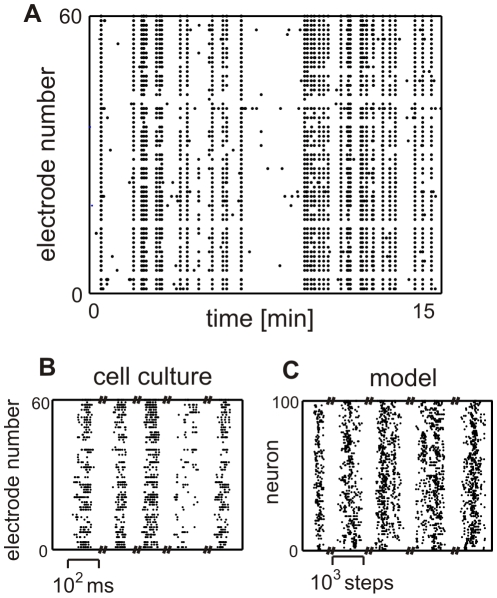
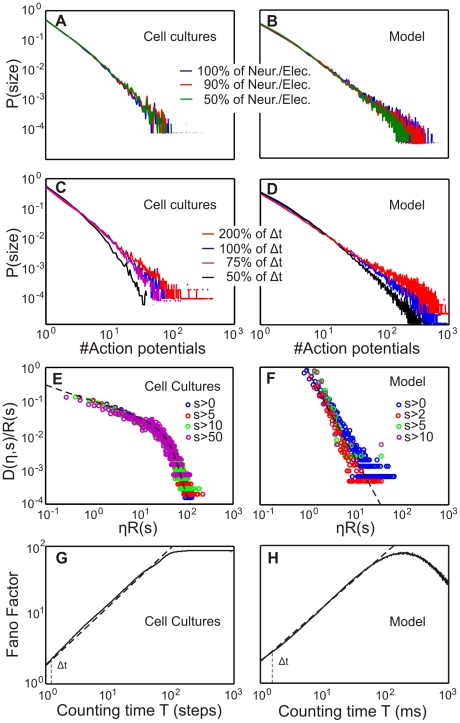
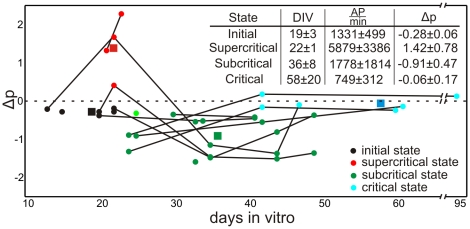
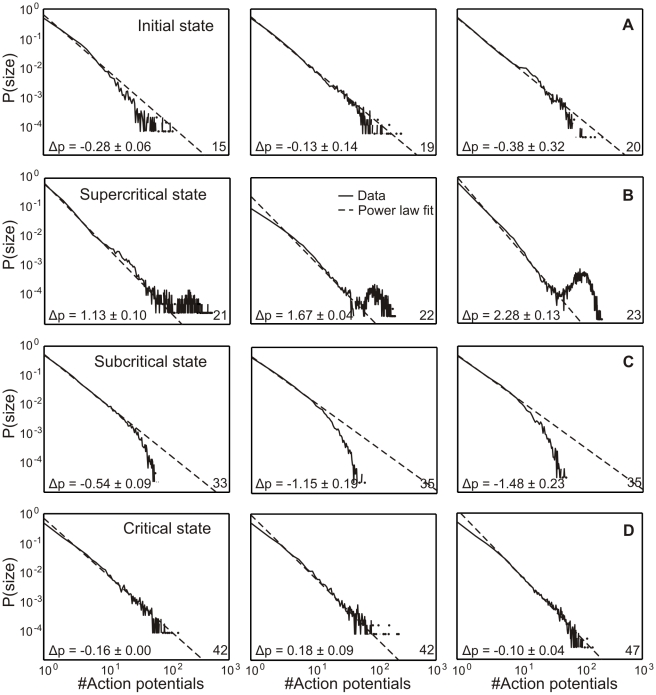
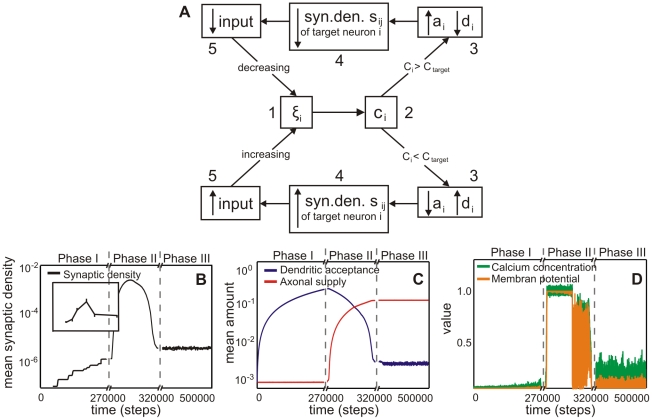
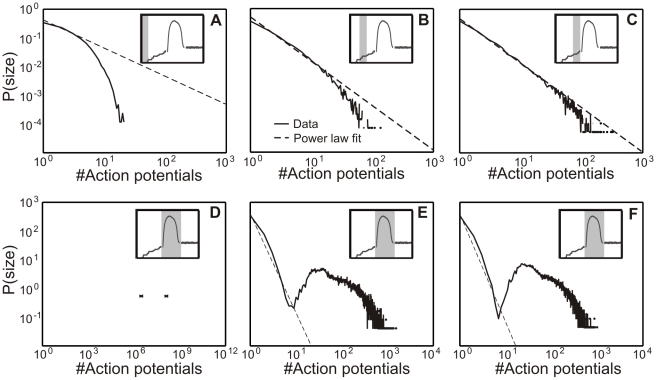
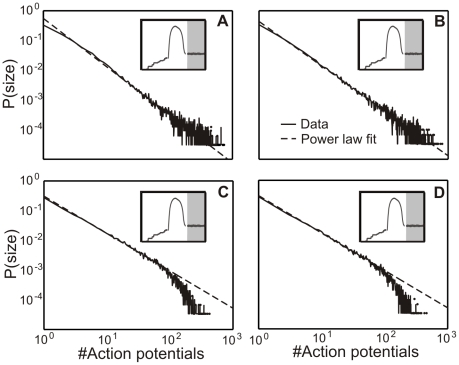
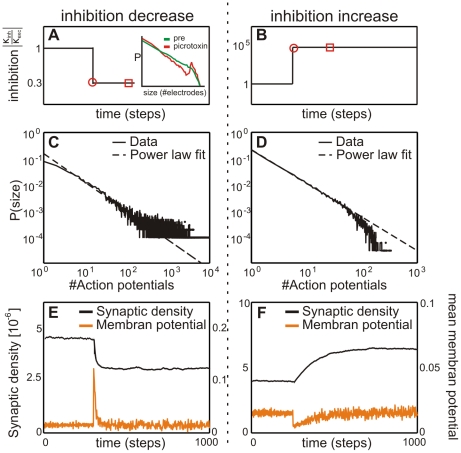
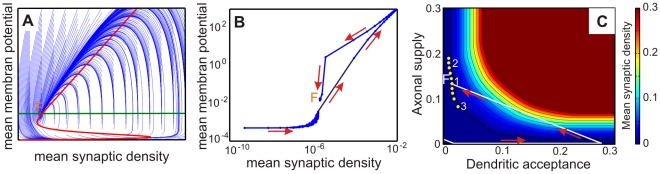
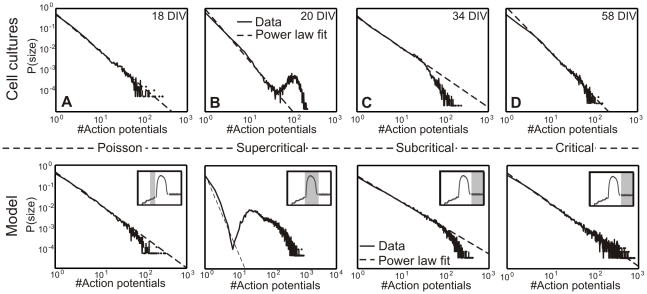
Recently evidence has accumulated that many neural networks exhibit self-organized criticality. In this state, activity is similar across temporal scales and this is beneficial with respect to information flow. If subcritical, activity can die out, if supercritical epileptiform patterns may occur. Little is known about how developing networks will reach and stabilize criticality. Here we monitor the development between 13 and 95 days in vitro (DIV) of cortical cell cultures (n = 20) and find four different phases, related to their morphological maturation: An initial low-activity state (≈19 DIV) is followed by a supercritical (≈20 DIV) and then a subcritical one (≈36 DIV) until the network finally reaches stable criticality (≈58 DIV). Using network modeling and mathematical analysis we describe the dynamics of the emergent connectivity in such developing systems. Based on physiological observations, the synaptic development in the model is determined by the drive of the neurons to adjust their connectivity for reaching on average firing rate homeostasis. We predict a specific time course for the maturation of inhibition, with strong onset and delayed pruning, and that total synaptic connectivity should be strongly linked to the relative levels of excitation and inhibition. These results demonstrate that the interplay between activity and connectivity guides developing networks into criticality suggesting that this may be a generic and stable state of many networks in vivo and in vitro.
最近的证据表明,许多神经网络表现出自组织临界性。在这种状态下,活动在时间尺度上相似,这有利于信息流。如果是亚临界的,活动可能会消失,如果是超临界的癫痫样模式可能会发生。对于发育中的网络如何达到并稳定临界状态,我们知之甚少。在这里,我们监测了体外培养的皮质细胞(n = 20)在 13 到 95 天之间的发育过程,并发现了四个与形态成熟相关的不同阶段:初始低活动状态(≈19 天)后是超临界状态(≈20 天),然后是亚临界状态(≈36 天),直到网络最终达到稳定的临界状态(≈58 天)。使用网络建模和数学分析,我们描述了这种发育系统中新兴连接的动力学。基于生理观察,模型中的突触发育由神经元的驱动决定,以调整其连接,以达到平均放电率的平衡。我们预测了抑制成熟的特定时间过程,具有强烈的起始和延迟修剪,并且总突触连接性应该与兴奋和抑制的相对水平密切相关。这些结果表明,活动和连接性之间的相互作用指导着发育中的网络进入临界状态,这表明这可能是体内和体外许多网络的一种通用和稳定状态。