Division of Cellular and Molecular Biology, Department of Cancer Biology, Institute of Medical Science, University of Tokyo Tokyo, Japan.
Front Immunol. 2012 Sep 4;3:278. doi: 10.3389/fimmu.2012.00278. eCollection 2012.
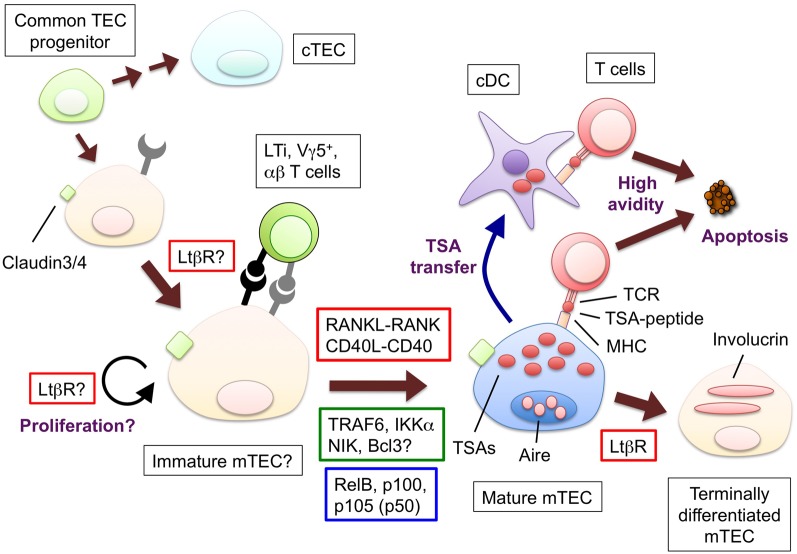
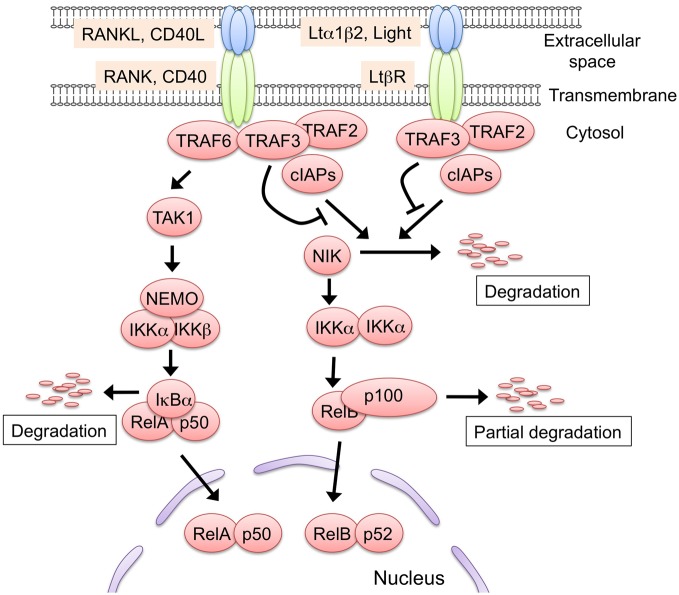
Thymic epithelial cells (TECs) provide the microenvironment required for the development of T cells in the thymus. A unique property of medullary thymic epithelial cells (mTECs) is their expression of a wide range of tissue-restricted self-antigens, critically regulated by the nuclear protein AIRE, which contributes to the selection of the self-tolerant T cell repertoire, thereby suppressing the onset of autoimmune diseases. The TNF receptor family (TNFRF) protein receptor activator of NF-κB (RANK), CD40 and lymphotoxin β receptor (LtβR) regulate the development and functions of mTECs. The engagement of these receptors with their specific ligands results in the activation of the NF-κB family of transcription factors. Two NF-κB activation pathways, the classical and non-classical pathways, promote the development of mature mTECs induced by these receptors. Consistently, TNF receptor-associated factor (TRAF6), the signal transducer of the classical pathway, and NF-κB inducing kinase (NIK), the signal transducer of the non-classical pathway, are essential for the development of mature mTECs. This review summarizes the current understanding of how the signaling by the TNF receptor family controls the development and functions of mTEC.
胸腺上皮细胞 (TECs) 为胸腺中 T 细胞的发育提供所需的微环境。 髓质胸腺上皮细胞 (mTECs) 的一个独特特性是其表达广泛的组织特异性自身抗原,这一特性受到核蛋白 AIRE 的严格调控,AIRE 有助于自身耐受 T 细胞库的选择,从而抑制自身免疫性疾病的发生。 肿瘤坏死因子受体家族 (TNFRF) 蛋白受体激活物 NF-κB (RANK)、CD40 和淋巴毒素 β 受体 (LtβR) 调节 mTECs 的发育和功能。 这些受体与其特定配体的结合导致 NF-κB 转录因子家族的激活。 两种 NF-κB 激活途径,即经典途径和非经典途径,促进这些受体诱导的成熟 mTECs 的发育。 一致地,TNF 受体相关因子 (TRAF6),经典途径的信号转导子,和 NF-κB 诱导激酶 (NIK),非经典途径的信号转导子,对于成熟 mTECs 的发育是必不可少的。 这篇综述总结了目前对 TNF 受体家族信号如何控制 mTEC 发育和功能的理解。