Biology Department, San Diego State University, San Diego, California, United States of America.
PLoS One. 2012;7(9):e43233. doi: 10.1371/journal.pone.0043233. Epub 2012 Sep 7.
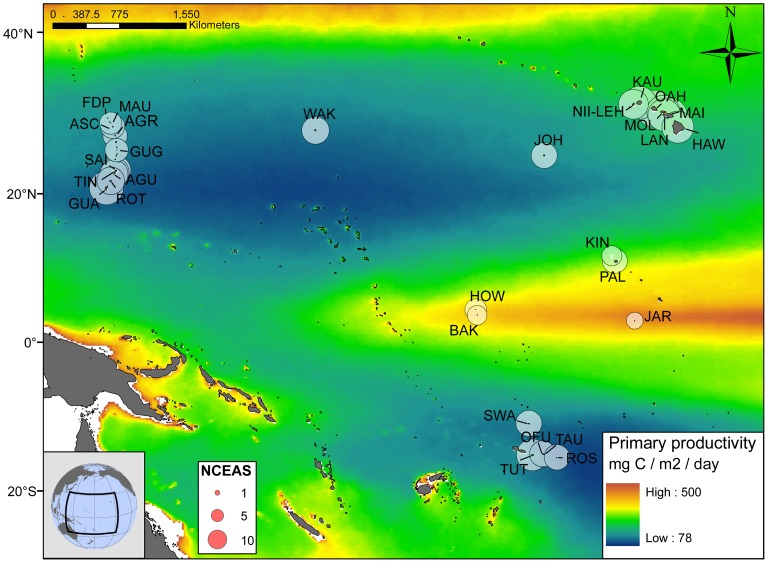
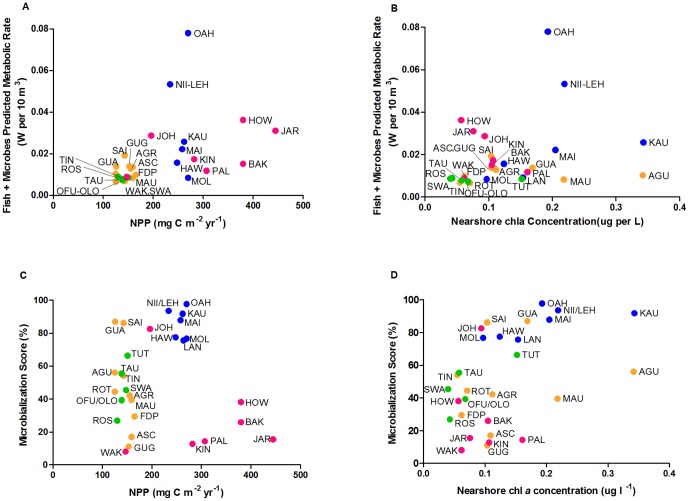
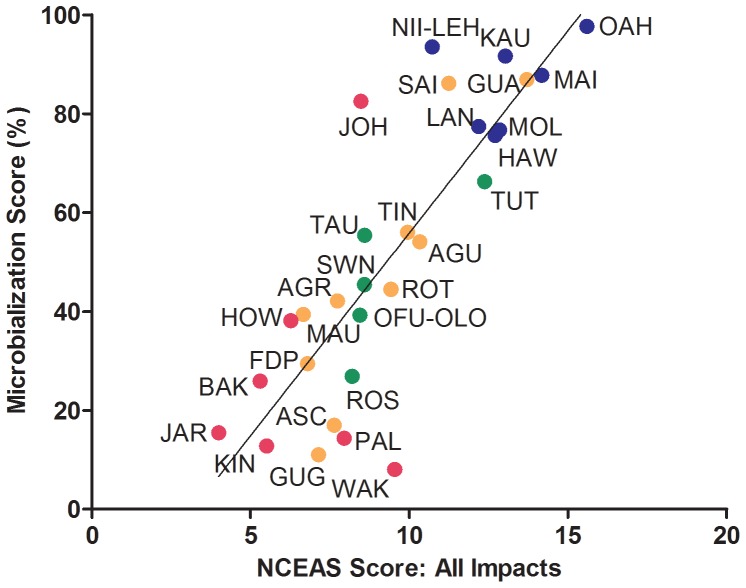
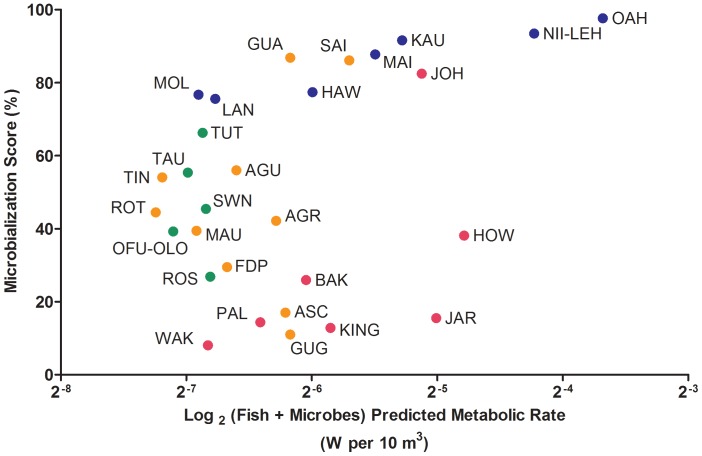
The majority of the world's coral reefs are in various stages of decline. While a suite of disturbances (overfishing, eutrophication, and global climate change) have been identified, the mechanism(s) of reef system decline remain elusive. Increased microbial and viral loading with higher percentages of opportunistic and specific microbial pathogens have been identified as potentially unifying features of coral reefs in decline. Due to their relative size and high per cell activity, a small change in microbial biomass may signal a large reallocation of available energy in an ecosystem; that is the microbialization of the coral reef. Our hypothesis was that human activities alter the energy budget of the reef system, specifically by altering the allocation of metabolic energy between microbes and macrobes. To determine if this is occurring on a regional scale, we calculated the basal metabolic rates for the fish and microbial communities at 99 sites on twenty-nine coral islands throughout the Pacific Ocean using previously established scaling relationships. From these metabolic rate predictions, we derived a new metric for assessing and comparing reef health called the microbialization score. The microbialization score represents the percentage of the combined fish and microbial predicted metabolic rate that is microbial. Our results demonstrate a strong positive correlation between reef microbialization scores and human impact. In contrast, microbialization scores did not significantly correlate with ocean net primary production, local chla concentrations, or the combined metabolic rate of the fish and microbial communities. These findings support the hypothesis that human activities are shifting energy to the microbes, at the expense of the macrobes. Regardless of oceanographic context, the microbialization score is a powerful metric for assessing the level of human impact a reef system is experiencing.
世界上大多数珊瑚礁都处于不同程度的衰退中。虽然已经确定了一系列干扰因素(过度捕捞、富营养化和全球气候变化),但珊瑚礁系统衰退的机制仍然难以捉摸。随着机会性病原体和特定微生物病原体比例的增加,微生物和病毒负荷的增加已被认为是衰退中的珊瑚礁的潜在统一特征。由于微生物的相对大小和高细胞活性,微生物生物量的微小变化可能预示着生态系统中可用能量的大量重新分配;也就是说,珊瑚礁的微生物化。我们的假设是,人类活动改变了珊瑚礁系统的能量预算,特别是通过改变微生物和大型生物之间代谢能量的分配。为了确定这种情况是否在区域范围内发生,我们使用先前建立的比例关系,在太平洋的 29 个珊瑚岛的 99 个地点计算了鱼类和微生物群落的基础代谢率。根据这些代谢率预测,我们得出了一个新的指标来评估和比较珊瑚礁的健康状况,称为微生物化得分。微生物化得分代表鱼类和微生物组合预测代谢率中微生物所占的百分比。我们的研究结果表明,珊瑚礁的微生物化得分与人类影响之间存在很强的正相关关系。相比之下,微生物化得分与海洋净初级生产力、局部 chla 浓度或鱼类和微生物群落的综合代谢率没有显著相关性。这些发现支持了人类活动正在将能量转移到微生物身上,而牺牲了大型生物的假设。无论海洋学背景如何,微生物化得分都是评估珊瑚礁系统所经历的人类影响水平的有力指标。