Spatial Ecology and Epidemiology Group, Department of Zoology, University of Oxford, Oxford, United Kingdom.
PLoS Negl Trop Dis. 2012;6(9):e1814. doi: 10.1371/journal.pntd.0001814. Epub 2012 Sep 6.
Current understanding of the spatial epidemiology and geographical distribution of Plasmodium vivax is far less developed than that for P. falciparum, representing a barrier to rational strategies for control and elimination. Here we present the first systematic effort to map the global endemicity of this hitherto neglected parasite.
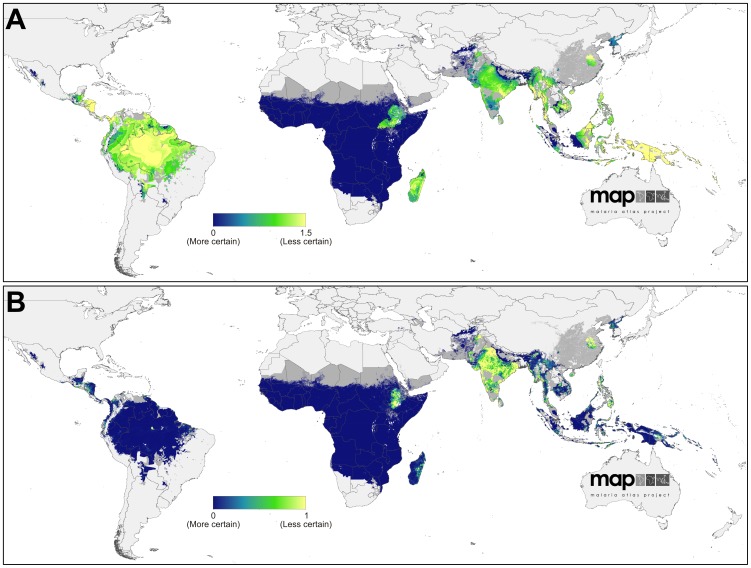
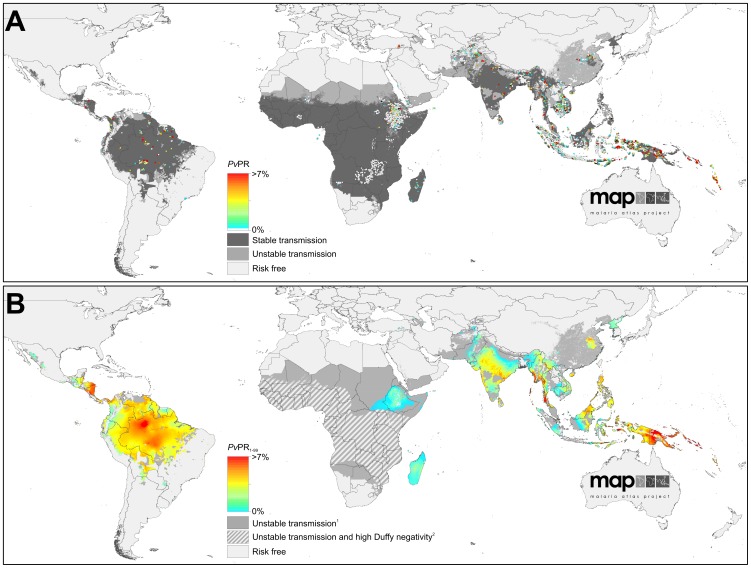
We first updated to the year 2010 our earlier estimate of the geographical limits of P. vivax transmission. Within areas of stable transmission, an assembly of 9,970 geopositioned P. vivax parasite rate (PvPR) surveys collected from 1985 to 2010 were used with a spatiotemporal Bayesian model-based geostatistical approach to estimate endemicity age-standardised to the 1-99 year age range (PvPR(1-99)) within every 5×5 km resolution grid square. The model incorporated data on Duffy negative phenotype frequency to suppress endemicity predictions, particularly in Africa. Endemicity was predicted within a relatively narrow range throughout the endemic world, with the point estimate rarely exceeding 7% PvPR(1-99). The Americas contributed 22% of the global area at risk of P. vivax transmission, but high endemic areas were generally sparsely populated and the region contributed only 6% of the 2.5 billion people at risk (PAR) globally. In Africa, Duffy negativity meant stable transmission was constrained to Madagascar and parts of the Horn, contributing 3.5% of global PAR. Central Asia was home to 82% of global PAR with important high endemic areas coinciding with dense populations particularly in India and Myanmar. South East Asia contained areas of the highest endemicity in Indonesia and Papua New Guinea and contributed 9% of global PAR.
This detailed depiction of spatially varying endemicity is intended to contribute to a much-needed paradigm shift towards geographically stratified and evidence-based planning for P. vivax control and elimination.
目前人们对间日疟原虫的空间流行病学和地理分布的了解远不如恶性疟原虫,这是制定合理控制和消除疟疾策略的障碍。本研究首次对这一长期被忽视的寄生虫的全球流行情况进行了系统的绘制。
我们首先更新了我们之前对间日疟原虫传播地理范围的估计,更新至 2010 年。在稳定传播的地区,我们利用一个时空贝叶斯模型的地统计学方法,对 1985 年至 2010 年收集的 9970 个定位寄生虫率(PvPR)调查数据进行了整合。该模型纳入了 Duffy 阴性表型频率的数据,以抑制在非洲等地区的流行情况预测。在流行地区,流行范围预测较为狭窄,估计点很少超过 1-99 岁年龄范围的 7%。美洲占全球有感染风险地区的 22%,但高流行地区的人口密度通常较低,该地区仅占全球 25 亿感染风险人口(PAR)的 6%。在非洲,Duffy 阴性意味着稳定的传播受到限制,仅限于马达加斯加和非洲之角的部分地区,仅占全球 PAR 的 3.5%。中亚是全球 PAR 的 82%的所在地,印度和缅甸等地区的人口密集,存在着重要的高流行区。东南亚的印度尼西亚和巴布亚新几内亚存在着高流行区,占全球 PAR 的 9%。
本研究详细描述了空间变化的流行情况,旨在为间日疟原虫控制和消除的地理分层和基于证据的规划提供急需的范式转变。