Department of Geography and Emerging Pathogens Institute, University of Florida, Gainesville, FL, USA.
Malar J. 2012 Dec 5;11:403. doi: 10.1186/1475-2875-11-403.
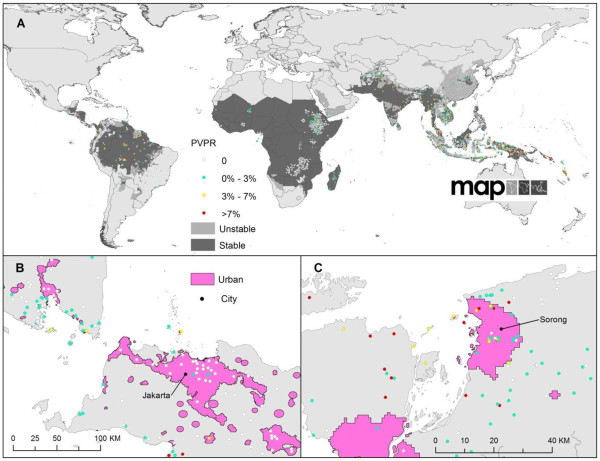
Many recent studies have examined the impact of urbanization on Plasmodium falciparum malaria endemicity and found a general trend of reduced transmission in urban areas. However, none has examined the effect of urbanization on Plasmodium vivax malaria, which is the most widely distributed malaria species and can also cause severe clinical syndromes in humans. In this study, a set of 10,003 community-based P. vivax parasite rate (PvPR) surveys are used to explore the relationships between PvPR in urban and rural settings.
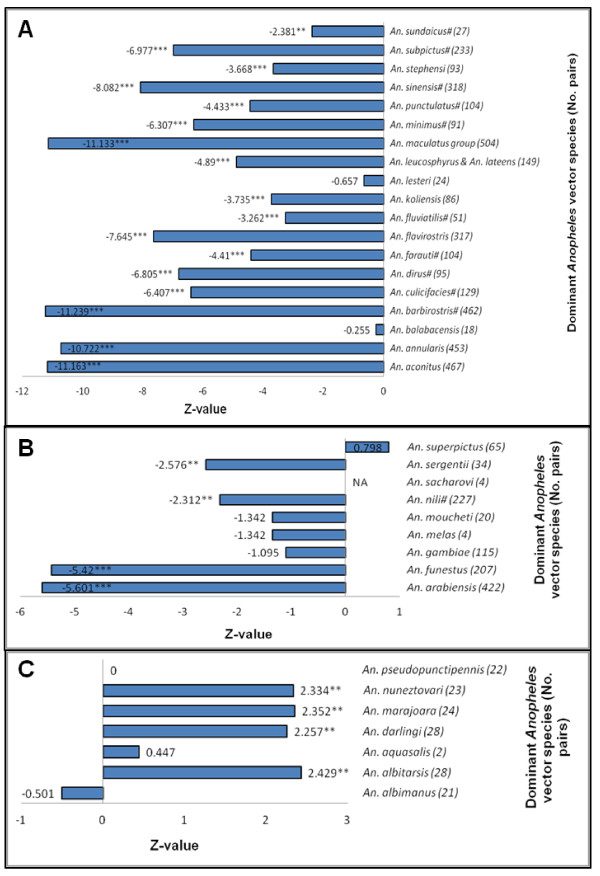
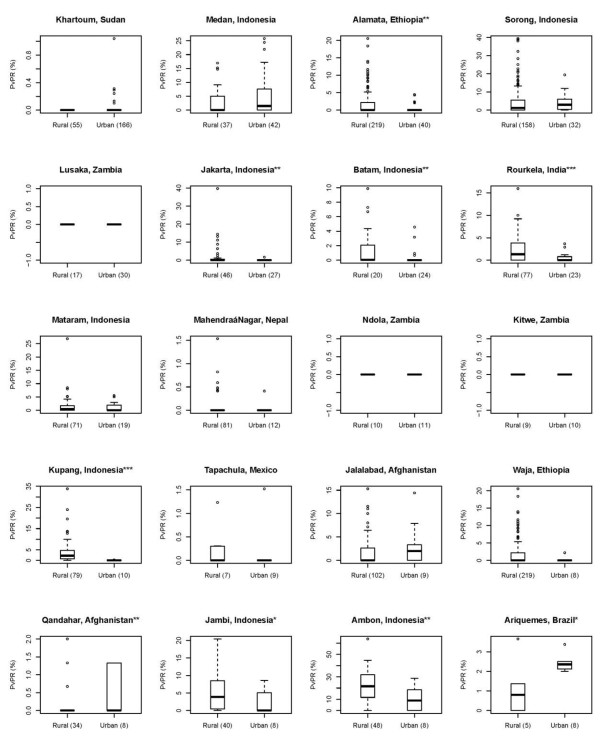
The PvPR surveys were overlaid onto a map of global urban extents to derive an urban/rural assignment. The differences in PvPR values between urban and rural areas were then examined. Groups of PvPR surveys inside individual city extents (urban) and surrounding areas (rural) were identified to examine the local variations in PvPR values. Finally, the relationships of PvPR between urban and rural areas within the ranges of 41 dominant Anopheles vectors were examined.
Significantly higher PvPR values in rural areas were found globally. The relationship was consistent at continental scales when focusing on Africa and Asia only, but in the Americas, significantly lower values of PvPR in rural areas were found, though the numbers of surveys were small. Moreover, except for the countries in the Americas, the same trends were found at national scales in African and Asian countries, with significantly lower values of PvPR in urban areas. However, the patterns at city scales among 20 specific cities where sufficient data were available were less clear, with seven cities having significantly lower PvPR values in urban areas and two cities showing significantly lower PvPR in rural areas. The urban-rural PvPR differences within the ranges of the dominant Anopheles vectors were generally, in agreement with the regional patterns found.
Except for the Americas, the patterns of significantly lower P. vivax transmission in urban areas have been found globally, regionally, nationally and by dominant vector species here, following trends observed previously for P. falciparum. To further understand these patterns, more epidemiological, entomological and parasitological analyses of the disease at smaller spatial scales are needed.
许多近期的研究已经考察了城市化对恶性疟原虫疟疾流行程度的影响,发现城市地区的传播普遍呈下降趋势。然而,目前还没有研究城市化对间日疟原虫疟疾的影响,间日疟原虫是分布最广的疟疾物种,也会在人类中引发严重的临床综合征。在这项研究中,我们使用了一组 10003 项基于社区的间日疟原虫寄生虫率(PvPR)调查,以探讨城市和农村环境中 PvPR 之间的关系。
将 PvPR 调查结果叠加到全球城市范围图上,以得出城市/农村的分配情况。然后,检查了城市和农村地区之间 PvPR 值的差异。确定了在单个城市范围内(城市)和周围地区(农村)内的 PvPR 调查小组,以检查 PvPR 值的局部变化。最后,检查了 41 种主要按蚊属传播媒介范围内的城市和农村地区之间的 PvPR 关系。
全球范围内农村地区的 PvPR 值明显更高。当仅关注非洲和亚洲时,这种关系在大陆范围内是一致的,但在美洲,农村地区的 PvPR 值明显较低,尽管调查数量较少。此外,除了美洲国家外,在非洲和亚洲国家的国家范围内也发现了相同的趋势,城市地区的 PvPR 值明显较低。然而,在有足够数据的 20 个特定城市的城市范围内,模式不太清晰,其中 7 个城市的城市地区的 PvPR 值明显较低,而 2 个城市的农村地区的 PvPR 值明显较低。在主要按蚊属传播媒介范围内的城乡 PvPR 差异通常与发现的区域模式一致。
除了美洲以外,在全球范围内、区域内、国家内以及主要按蚊属物种范围内,我们发现了间日疟原虫传播明显较低的模式,这与之前观察到的恶性疟原虫的趋势一致。为了进一步了解这些模式,需要在更小的空间尺度上对该疾病进行更多的流行病学、昆虫学和寄生虫学分析。