Chol Changkuoth Jock, Belay Denekew Bitew, Fenta Haile Mekonnen, Chen Ding-Geng
Department of Statistics, College of Science, Bahir Dar University, Bahir Dar, Ethiopia.
Department of Statistics, College of Natural and Computational Science, Gambella University, Gambella, Ethiopia.
Infect Dis Poverty. 2025 Jul 11;14(1):66. doi: 10.1186/s40249-025-01320-w.
Malaria is a major worldwide health concern that impacts many individuals worldwide. P. falciparum is Africa's main malaria cause. However, P. vivax share a large number in Ethiopia than any other countries in Africa, followed by the closest countries. This research aims to examine the spatiotemporal trends in the risk of malaria caused by P. falciparum and P. vivax in Ethiopia and other countries that share borders between 2011 and 2020.
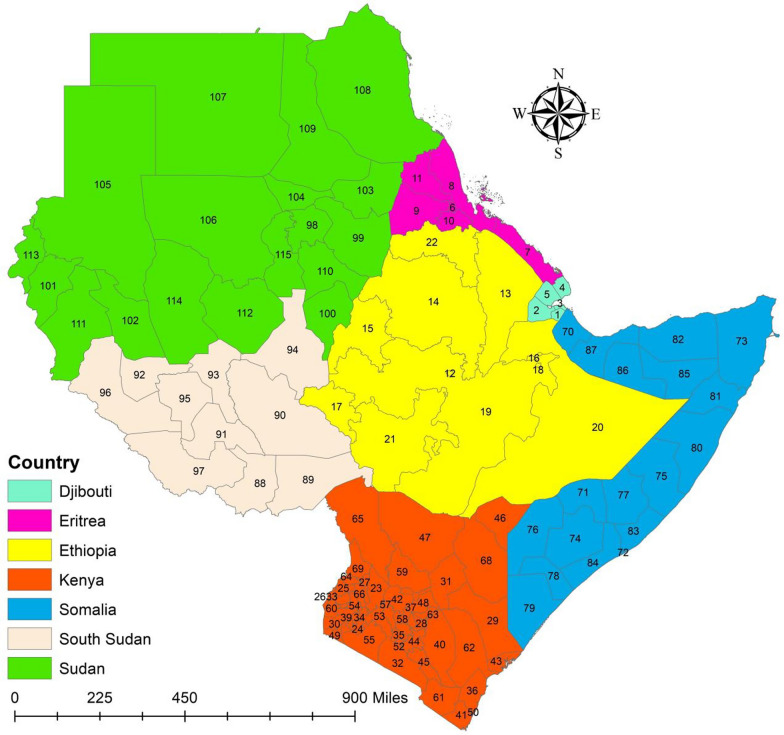
This study was carried-out in seven East African countries in 115 administration level 1 (region) settings. We used secondary data on two plasmodium parasites, P. falciparum, and P. vivax, between 2011 and 2020 from the Malaria Atlas Project. This study used a Bayesian setup with an integrated nested Laplace approximation to adopt spatiotemporal models.
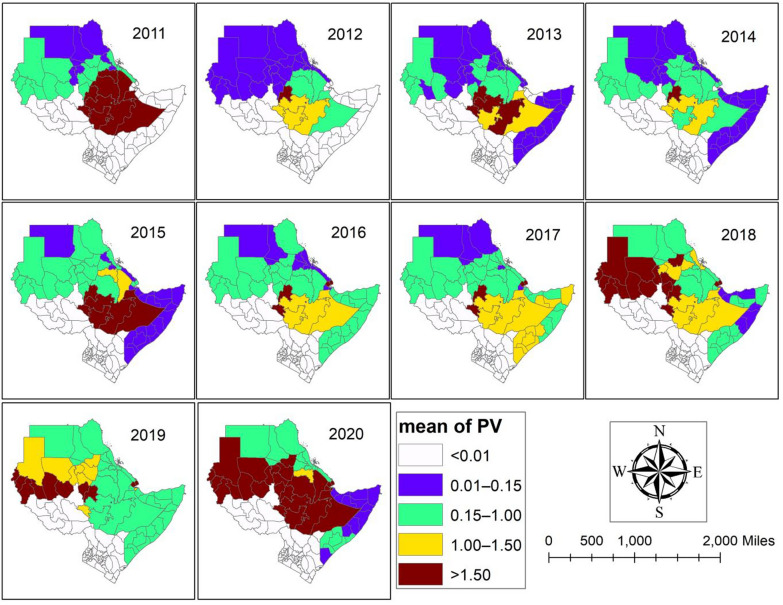
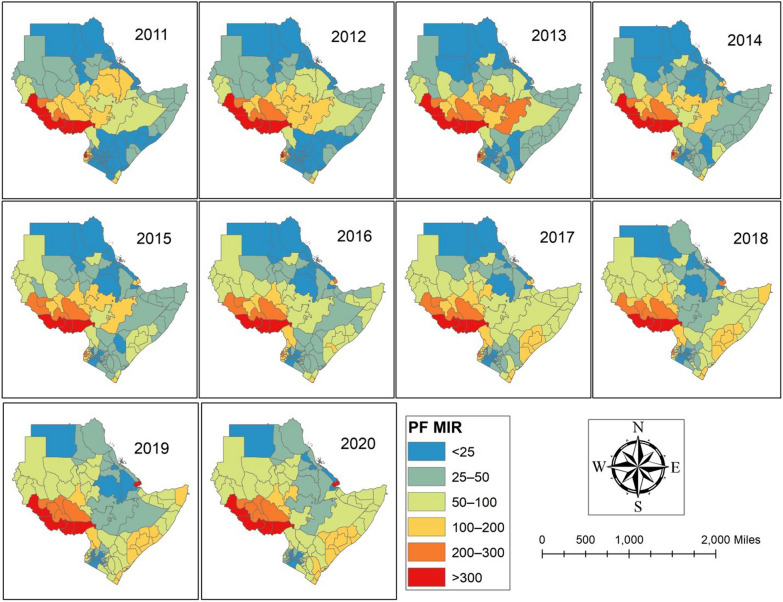
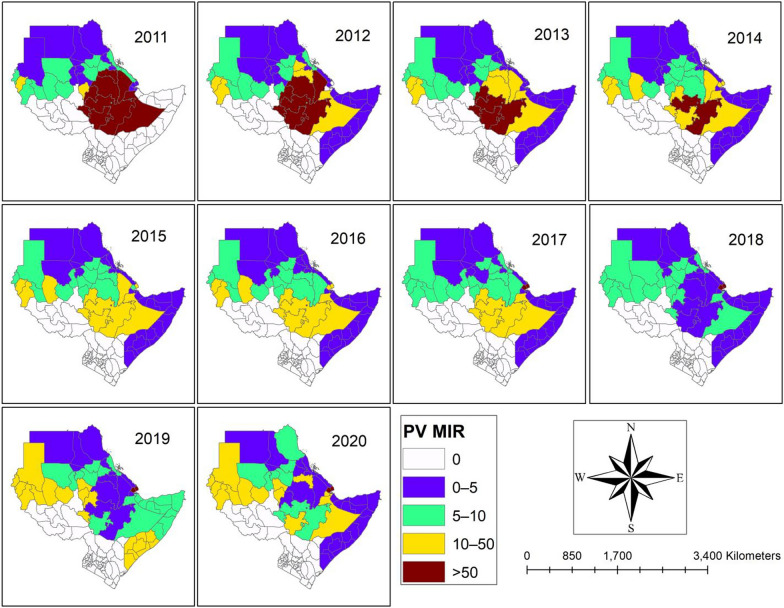
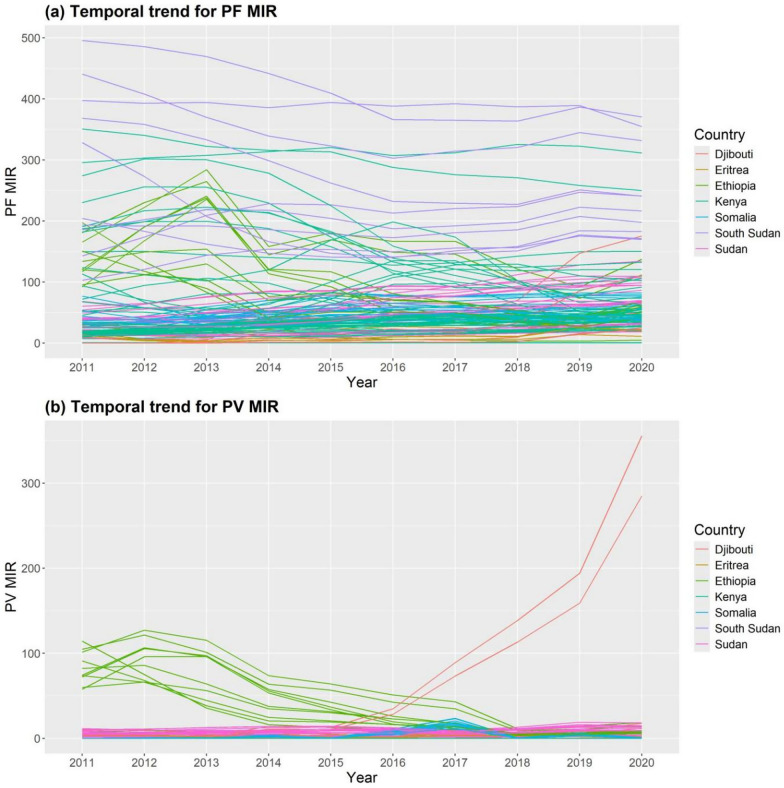
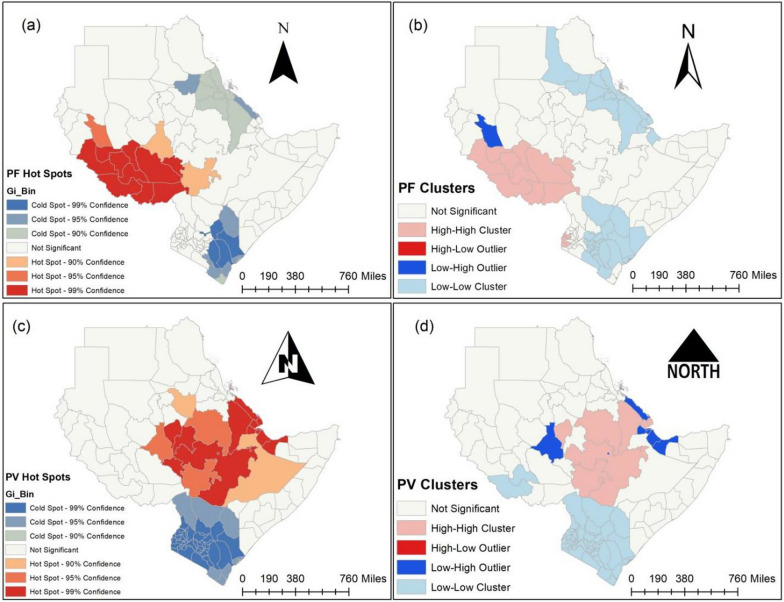
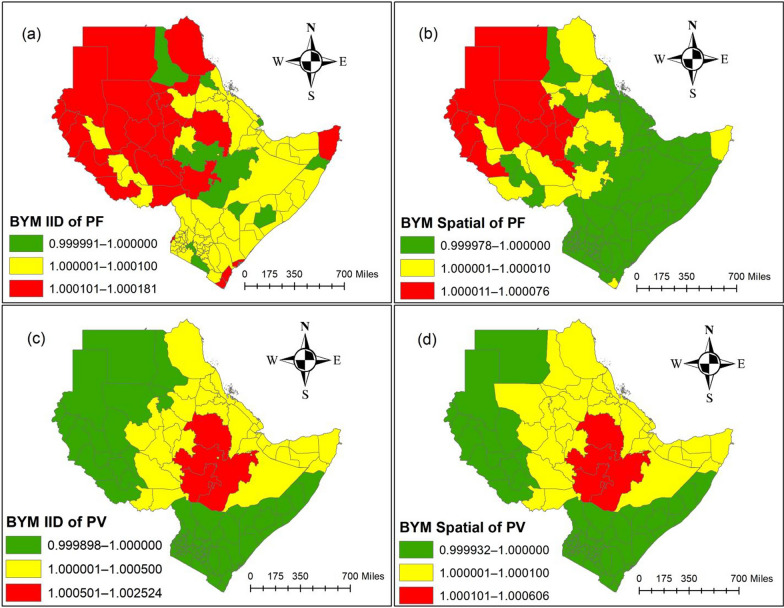
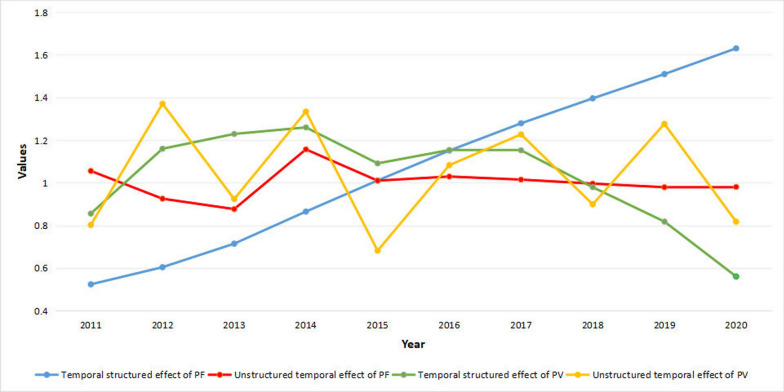
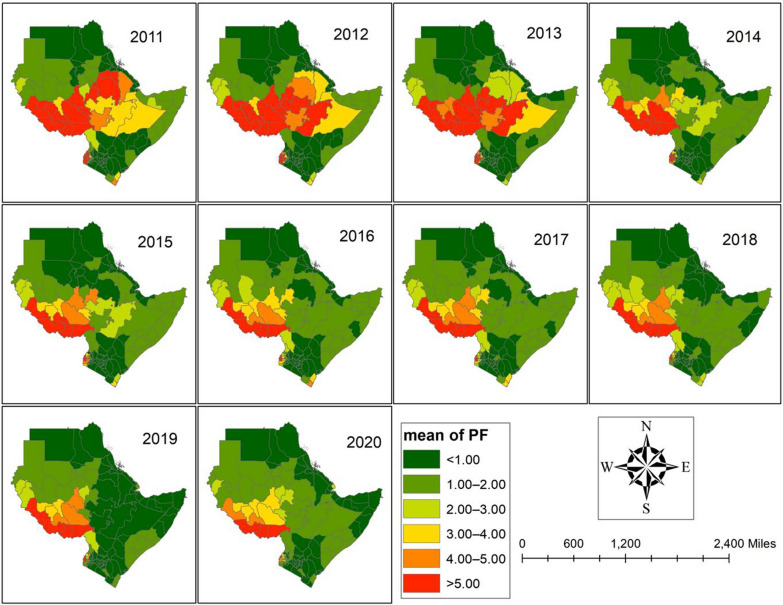
We analyzed P. falciparum and P. vivax malaria incidence data from 2011 to 2020 in 115 regions. Between 2011 and 2020, all of South Sudan's areas, Ethiopia's Gambella region, and Kenya's Homa Bay, Siaya, Busia, Kakamega, and Vihita regions were at a higher risk of contracting P. falciparum malaria than their neighbors in seven East African nations. However, the Southern Nations, nationalities, and people, as well as the Oromia, Harari, Afar, and Amhara areas in Ethiopia, and the Blue Nile in Sudan, are the regions with a higher risk of P. vivax malaria than their bordering regions. For both P. falciparum and P. vivax, the spatially coordinated main effect and the unstructured spatial effect show minimal fluctuation across and within 115 regions during the study period. Through a random walk across 115 regions, the time-structured effect of P. falciparum malaria risk shows linear increases, whereas the temporally structured effect of P. vivax shows increases from 2011 to 2014 and decreases from 2017 to 2020.
The global malaria control and eradication effort should concentrate particularly on the South Sudan and Ethiopia regions to provide more intervention control to lower the risk of malaria incidence in East African countries, as both countries have high levels of P. falciparum and P. vivax, respectively.
疟疾是全球主要的健康问题,影响着世界各地的许多人。恶性疟原虫是非洲疟疾的主要病因。然而,间日疟原虫在埃塞俄比亚的占比高于非洲其他任何国家,其次是与其接壤的国家。本研究旨在调查2011年至2020年期间埃塞俄比亚以及其他接壤国家由恶性疟原虫和间日疟原虫引起的疟疾风险的时空趋势。
本研究在东非的七个国家的115个一级行政区(地区)开展。我们使用了疟疾地图项目2011年至2020年期间关于两种疟原虫(恶性疟原虫和间日疟原虫)的二手数据。本研究采用贝叶斯设置和集成嵌套拉普拉斯近似法来采用时空模型。
我们分析了115个地区2011年至2020年期间的恶性疟原虫和间日疟原虫疟疾发病率数据。2011年至2020年期间,南苏丹的所有地区、埃塞俄比亚的甘贝拉地区以及肯尼亚的霍马湾、锡亚、布西亚、卡卡梅加和维希塔地区感染恶性疟原虫疟疾的风险高于东非七个国家的邻国。然而,埃塞俄比亚的南方民族、民族和人民地区以及奥罗米亚、哈拉里、阿法尔和阿姆哈拉地区,以及苏丹的青尼罗地区,是感染间日疟原虫疟疾风险高于其周边地区的区域。对于恶性疟原虫和间日疟原虫,在研究期间,空间协调主效应和非结构化空间效应在115个地区之间和内部的波动都很小。通过对115个地区的随机游走,恶性疟原虫疟疾风险的时间结构效应呈线性增加,而间日疟原虫的时间结构效应在2011年至2014年增加,在2017年至2020年下降。
全球疟疾控制和消除工作应特别关注南苏丹和埃塞俄比亚地区,以便提供更多干预控制措施,降低东非国家疟疾发病风险,因为这两个国家分别有高水平的恶性疟原虫和间日疟原虫。