Beijing National Laboratory for Condensed Matter Physics, Institute of Physics, Chinese Academy of Sciences, P O Box 603-146, Beijing, 100190, People's Republic of China.
Sci Rep. 2012;2:647. doi: 10.1038/srep00647. Epub 2012 Sep 11.
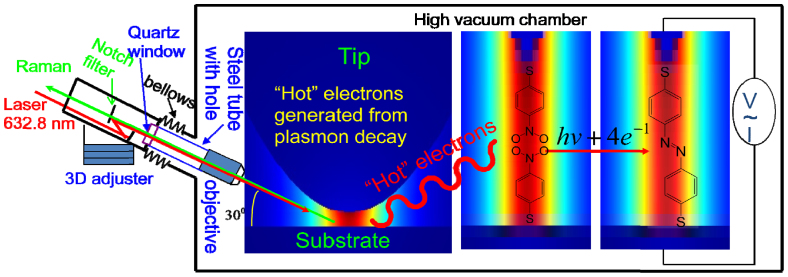
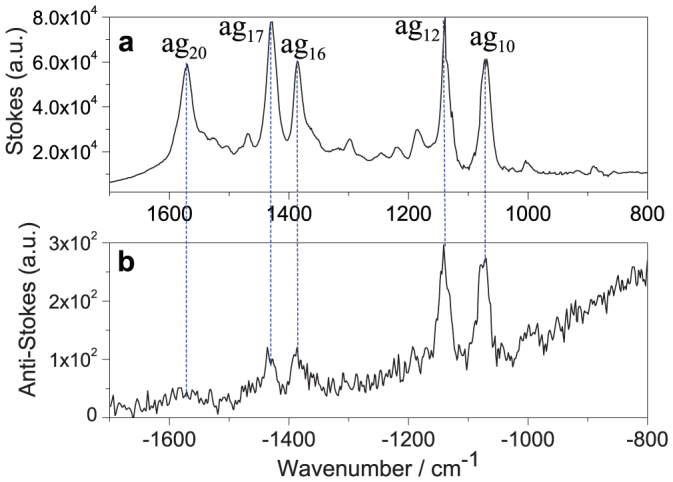
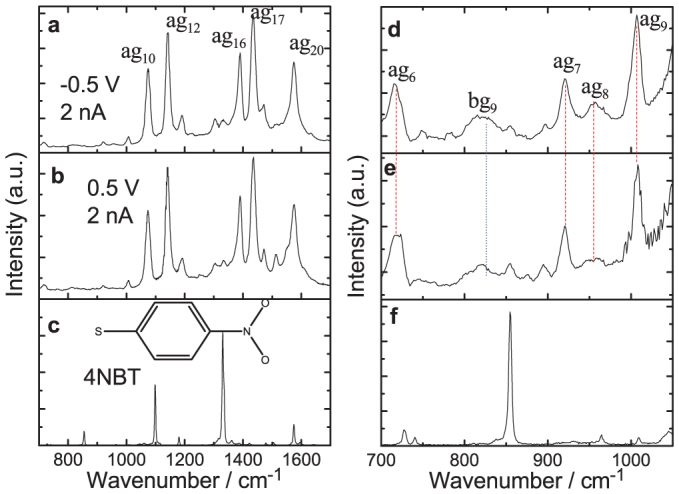
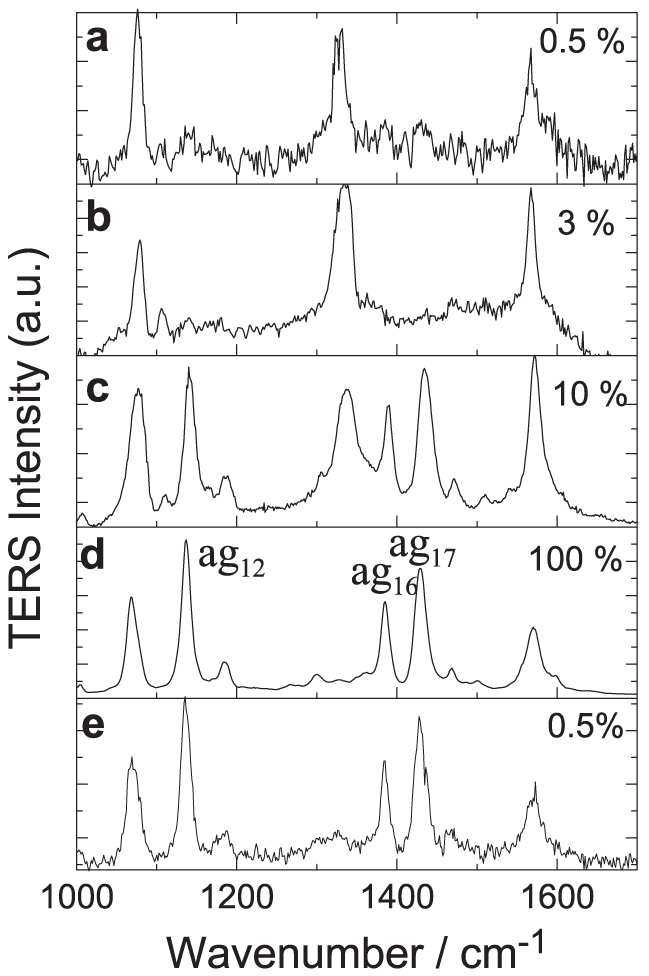
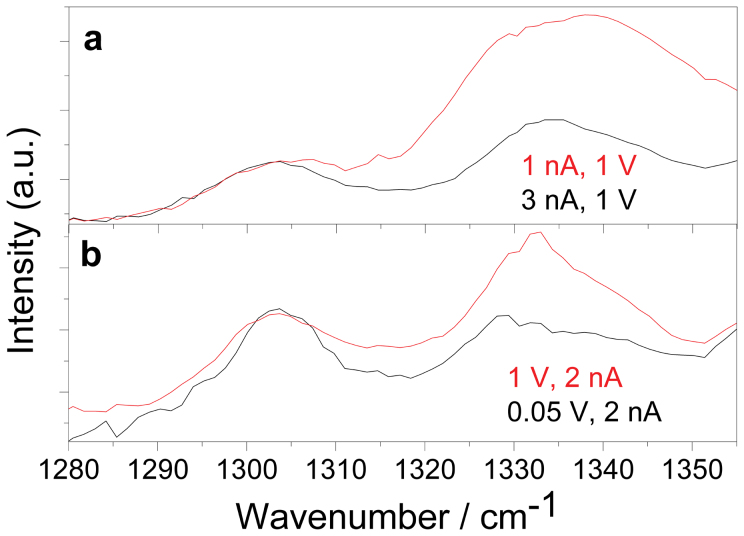
With strong surface plasmons excited at the metallic tip, tip-enhanced Raman spectroscopy (TERS) has both high spectroscopic sensitivity and high spatial resolution, and is becoming an essential tool for chemical analysis. It is a great challenge to combine TERS with a high vacuum system due to the poor optical collection efficiency. We used our innovatively designed home-built high vacuum TERS (HV-TERS) to investigate the plasmon-driven in-situ chemical reaction of 4-nitrobenzenethiol dimerizing to dimercaptoazobenzene. The chemical reactions can be controlled by the plasmon intensity, which in turn can be controlled by the incident laser intensity, tunneling current and bias voltage. The temperature of such a chemical reaction can also be obtained by the clearly observed Stokes and Anti-Stokes HV-TERS peaks. Our findings offer a new way to design a highly efficient HV-TERS system and its applications to chemical catalysis and synthesis of molecules, and significantly extend the studies of chemical reactions.
利用金属尖端激发的强表面等离激元,针尖增强拉曼光谱(TERS)具有高光谱灵敏度和高空间分辨率,正成为化学分析的重要工具。由于光收集效率差,将 TERS 与高真空系统结合是一个巨大的挑战。我们使用自主设计的高真空 TERS(HV-TERS)研究了 4-巯基苯硫醇二聚化为二巯基偶氮苯的等离子体驱动的原位化学反应。化学反应可以通过等离子体强度来控制,而等离子体强度又可以通过入射激光强度、隧道电流和偏置电压来控制。这种化学反应的温度也可以通过明显观察到的斯托克斯和反斯托克斯 HV-TERS 峰来获得。我们的发现为设计高效的 HV-TERS 系统及其在化学催化和分子合成中的应用提供了一种新方法,并极大地扩展了化学反应的研究。