Amano Yasuo, Tachi Masaki, Tani Hitomi, Mizuno Kyoichi, Kobayashi Yasuhiro, Kumita Shinichiro
Department of Radiology, Nippon Medical School, 1-1-5 Senadagi, Bunkyo-ku, Tokyo 113-8603, Japan.
ScientificWorldJournal. 2012;2012:194069. doi: 10.1100/2012/194069. Epub 2012 Sep 2.
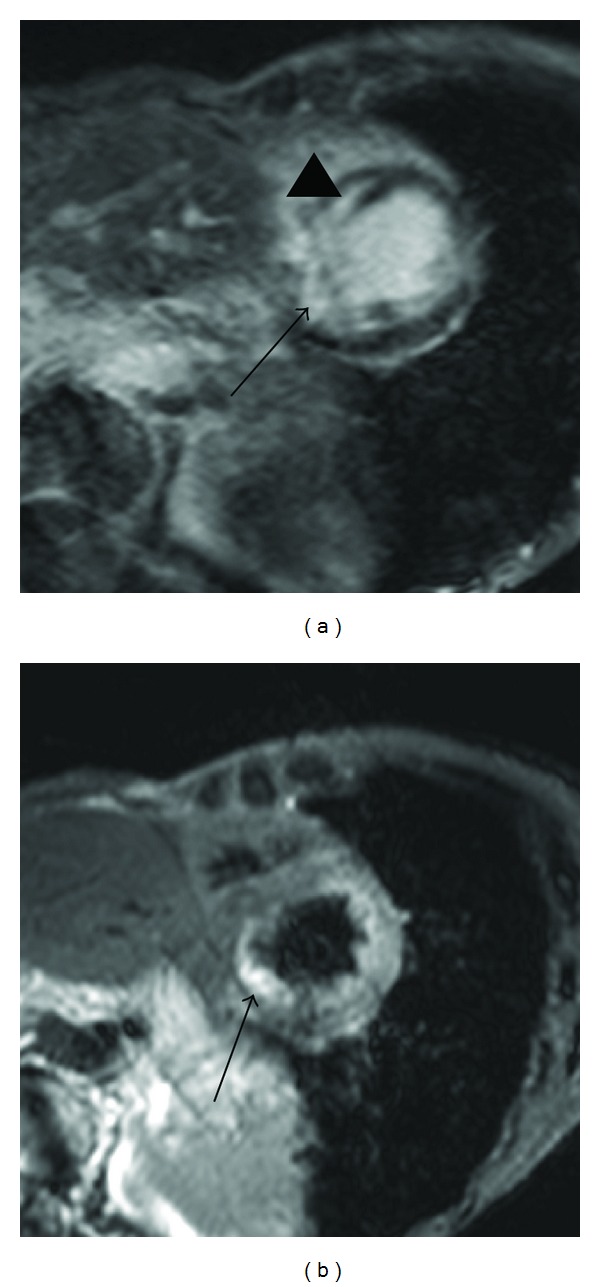
The purpose of this paper is to describe imaging techniques and findings of T2-weighted magnetic resonance imaging (MRI) of edema in myocardial diseases. T2-weighted cardiac MRI is acquired by combining acceleration techniques with motion and signal suppression techniques. The MRI findings should be interpreted based on coronary artery supply, intramural distribution, and comparison with delayed-enhancement MRI. In acute myocardial diseases, such as acute myocardial infarction and myocarditis, the edema is larger than myocardial scarring, whereas the edema can be smaller than the scarring in some types of nonischemic cardiomyopathy, including hypertrophic cardiomyopathy. T2-weighted MRI of edema identifies myocardial edema associated with ischemia, inflammation, vasculitis, or intervention in the myocardium and provides information complementary to delayed-enhancement MRI.
本文旨在描述心肌疾病水肿的T2加权磁共振成像(MRI)技术及表现。T2加权心脏MRI通过将加速技术与运动和信号抑制技术相结合来获取。MRI表现应根据冠状动脉供血、壁内分布以及与延迟强化MRI的比较来解读。在急性心肌疾病中,如急性心肌梗死和心肌炎,水肿范围大于心肌瘢痕,而在某些类型的非缺血性心肌病(包括肥厚型心肌病)中,水肿范围可能小于瘢痕。水肿的T2加权MRI可识别与心肌缺血、炎症、血管炎或心肌干预相关的心肌水肿,并提供与延迟强化MRI互补的信息。