Smith David Roy
Department of Botany, Canadian Institute for Advanced Research, University of British Columbia Vancouver, British Columbia, Canada.
Front Genet. 2012 Sep 11;3:175. doi: 10.3389/fgene.2012.00175. eCollection 2012.
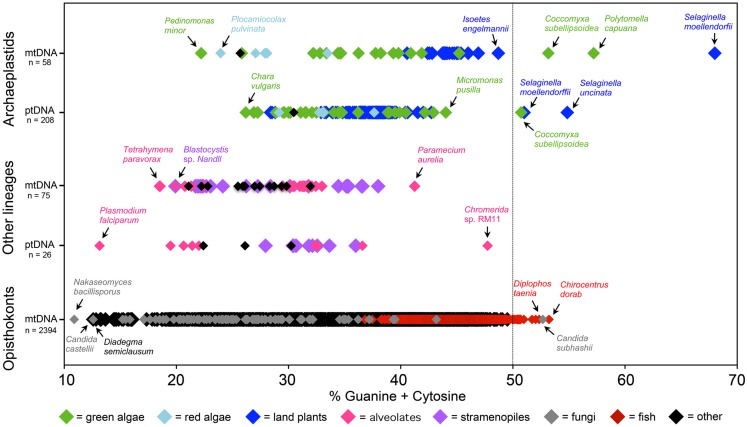
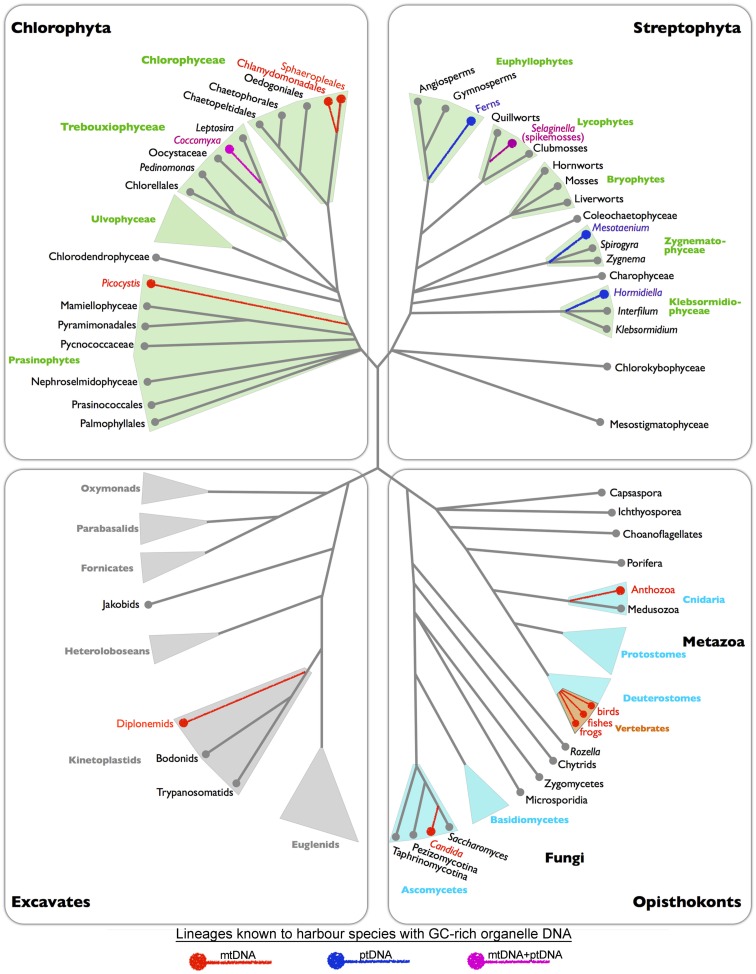
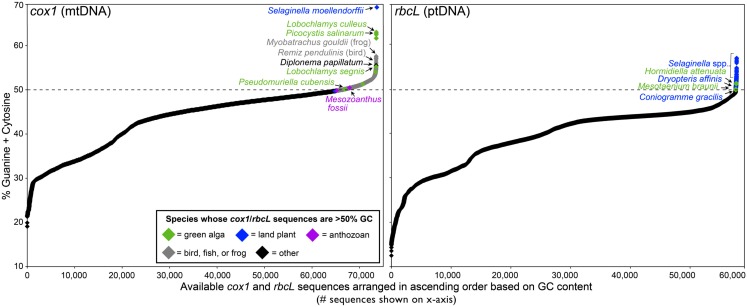
Organelle genomes show remarkable variation in architecture and coding content, yet their nucleotide composition is relatively unvarying across the eukaryotic domain, with most having a high adenine and thymine (AT) content. Recent studies, however, have uncovered guanine and cytosine (GC)-rich mitochondrial and plastid genomes. These sequences come from a small but eclectic list of species, including certain green plants and animals. Here, I review GC-rich organelle DNAs and the insights they have provided into the evolution of nucleotide landscape. I emphasize that GC-biased mitochondrial and plastid DNAs are more widespread than once thought, sometimes occurring together in the same species, and suggest that the forces biasing their nucleotide content can differ both among and within lineages, and may be associated with specific genome architectural features and life history traits.
细胞器基因组在结构和编码内容上表现出显著的差异,然而它们的核苷酸组成在真核生物域中相对稳定,大多数具有较高的腺嘌呤和胸腺嘧啶(AT)含量。然而,最近的研究发现了富含鸟嘌呤和胞嘧啶(GC)的线粒体和质体基因组。这些序列来自一小部分种类多样的物种,包括某些绿色植物和动物。在这里,我回顾了富含GC的细胞器DNA及其为核苷酸景观进化提供的见解。我强调,偏向GC的线粒体和质体DNA比我们曾经认为的更为普遍,有时会在同一物种中同时出现,并表明影响其核苷酸含量的因素在不同谱系之间以及谱系内部可能有所不同,并且可能与特定的基因组结构特征和生活史特征相关。