Department of Biomedical Engineering, Stony Brook University, Stony Brook, NY 11794-5281, USA.
Ultrasound Med Biol. 2012 Dec;38(12):2198-207. doi: 10.1016/j.ultrasmedbio.2012.07.020. Epub 2012 Sep 10.
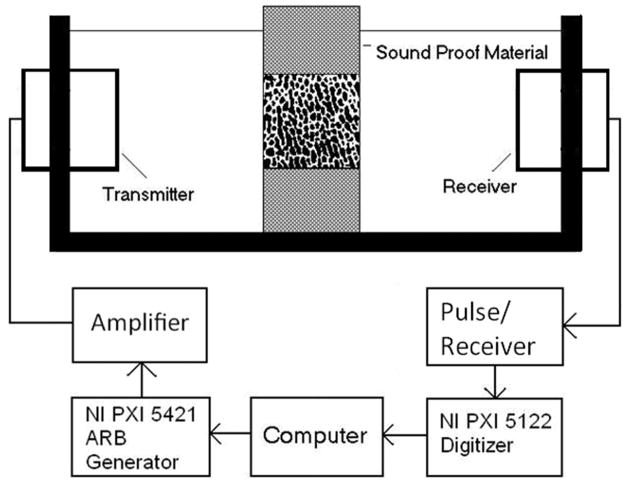
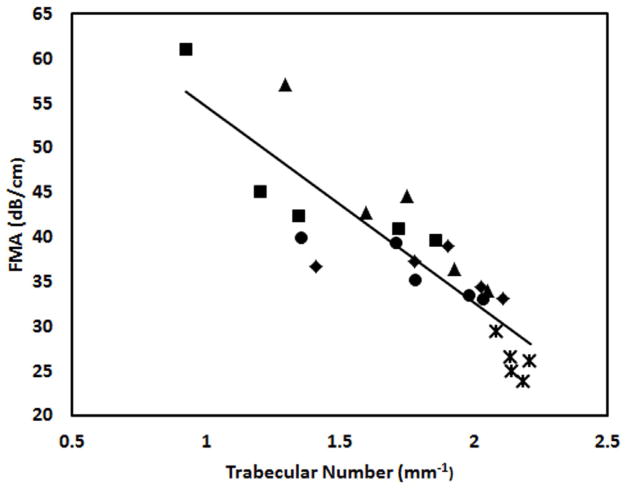
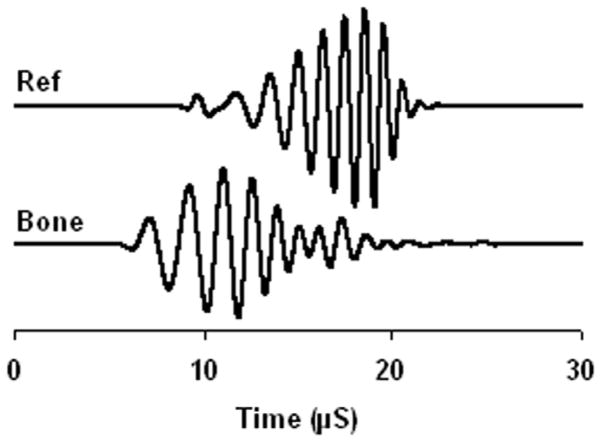
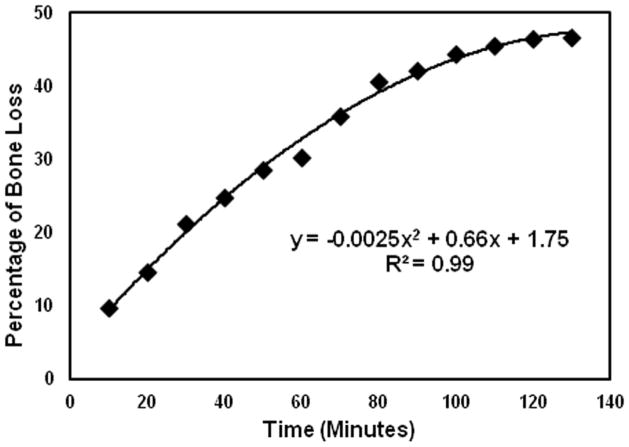
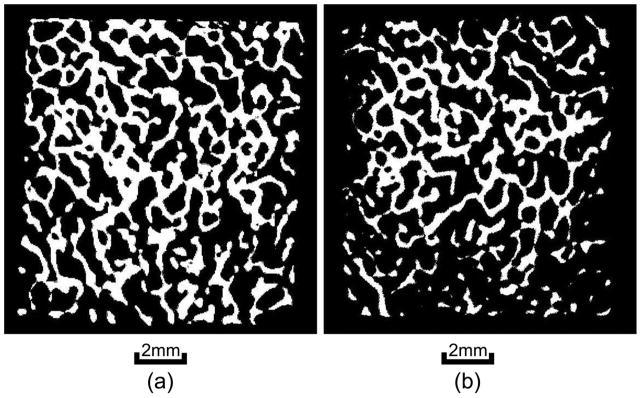
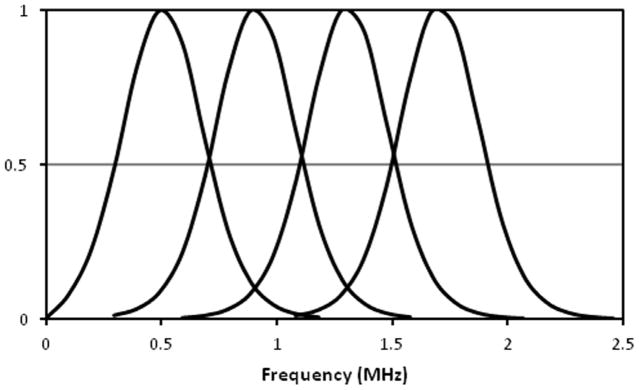
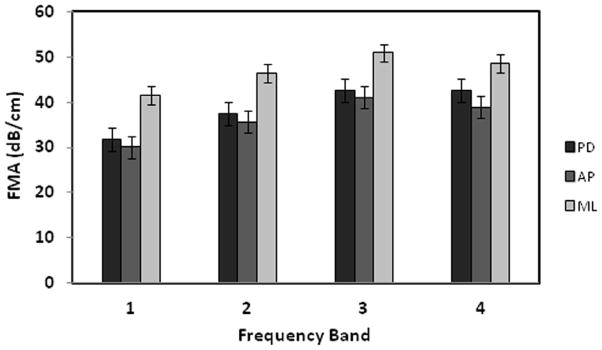
This study investigated the efficacy of frequency modulated ultrasound attenuation in the assessment of the trabecular structural properties. Four frequency modulated signals were created to represent four frequency bands centered at 500 kHz, 900 kHz, 1.3 MHz and 1.7 MHz with the bandwidth of 400 kHz. Five 1-cm trabecular cubes were harvested from fresh bovine distal femur. The cubes underwent four steps of demineralization process to expand the sample size to 25 with the greater variations of the structural properties for the better correlation study. Pearson correlation study was performed between the ultrasound attenuation in four frequency bands and the trabecular structural properties. The results showed that correlations of frequency modulated ultrasound attenuation to the trabecular structural properties are dependent on frequency bands. The attenuation in proximal-distal orientation had the highest correlation to BV/TV (R(2) = 0.73, p < 0.001) and trabecular thickness (R(2) = 0.50, p < 0.001) at the frequency band centered at 1.7 MHz. It was equivalent in the four frequency bands in correlation to the trabecular number (average R(2) = 0.80, p < 0.001) and to the trabecular separation (average R(2) = 0.83, p < 0.001). The attenuation in anterio-posterial orientation had the highest correlation to BV/TV (R(2) = 0.80, p < 0.001) and trabecular thickness (R(2) = 0.71, p < 0.001) at the frequency band centered at 1.3 MHz. The attenuation in the first frequency band was the most sensitive to the trabecular number (R(2) = 0.71, p < 0.001) and trabecular separation (R(2) = 0.80, p < 0.001). No significant correlation was observed for the attenuation in medial-lateral orientation across the four frequency bands.
本研究旨在探讨调制超声衰减在评估小梁结构特性中的作用。为此,我们生成了四个调制信号,分别代表中心频率为 500 kHz、900 kHz、1.3 MHz 和 1.7 MHz、带宽为 400 kHz 的四个频率带宽。我们从新鲜牛股骨远端采集了五个 1 cm 的小梁立方块。这些立方块经历了四个脱矿化步骤,将样本量扩大到 25 个,以便更好地研究结构特性的变化。我们对四个频率带宽下的超声衰减与小梁结构特性进行了 Pearson 相关性研究。结果表明,超声衰减与小梁结构特性的相关性取决于频率带宽。在 1.7 MHz 中心频率带宽下,近-远轴方向的衰减与骨体积分数(BV/TV)(R(2) = 0.73,p < 0.001)和小梁厚度(R(2) = 0.50,p < 0.001)相关性最高。在四个频率带宽中,它与小梁数量(平均 R(2) = 0.80,p < 0.001)和小梁分离(平均 R(2) = 0.83,p < 0.001)相关性相当。前-后轴方向的衰减与 BV/TV(R(2) = 0.80,p < 0.001)和小梁厚度(R(2) = 0.71,p < 0.001)相关性最高,中心频率带宽为 1.3 MHz。第一频率带宽对小梁数量(R(2) = 0.71,p < 0.001)和小梁分离(R(2) = 0.80,p < 0.001)最为敏感。在四个频率带宽中,中-外侧方向的衰减与其他结构特性之间没有显著相关性。