Division of Endocrinology, John, Stroger Jr Hospital of Cook County and Rush University, Chicago, IL, USA.
Diabetes Metab Syndr Obes. 2012;5:313-27. doi: 10.2147/DMSO.S22545. Epub 2012 Aug 31.
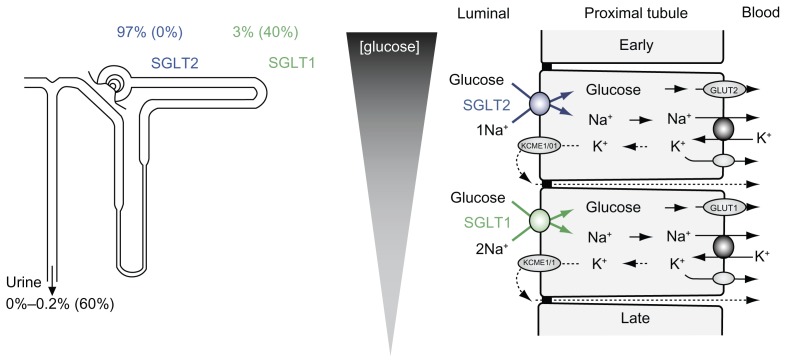
The kidney plays an important role in glucose metabolism, and has been considered a target for therapeutic intervention. The sodium-glucose cotransporter type 2 (SGLT2) mediates most of the glucose reabsorption from the proximal renal tubule. Inhibition of SGLT2 leads to glucosuria and provides a unique mechanism to lower elevated blood glucose levels in diabetes. The purpose of this review is to explore the physiology of SGLT2 and discuss several SGLT2 inhibitors which have clinical data in patients with type 2 diabetes.
We performed a PubMed search using the terms "SGLT2" and "SGLT2 inhibitor" through April 10, 2012. Published articles, press releases, and abstracts presented at national and international meetings were considered.
SGLT2 inhibitors correct a novel pathophysiological defect, have an insulin-independent action, are efficacious with glycosylated hemoglobin reduction ranging from 0.5% to 1.5%, promote weight loss, have a low incidence of hypoglycemia, complement the action of other antidiabetic agents, and can be used at any stage of diabetes. They are generally well tolerated. However, due to side effects, such as repeated urinary tract and genital infections, increased hematocrit, and decreased blood pressure, appropriate patient selection for drug initiation and close monitoring after initiation will be important. Results of ongoing clinical studies of the effect of SGLT2 inhibitors on diabetic complications and cardiovascular safety are crucial to determine the risk-benefit ratio. A recent decision by the Committee for Medicinal Products for Human Use of the European Medicines Agency has recommended approval of dapagliflozin for the treatment of type 2 diabetes as an adjunct to diet and exercise, in combination with other glucose-lowering medicinal products, including insulin, and as a monotherapy for metformin-intolerant patients. Clinical research also remains to be carried out on the long-term effects of glucosuria and other potential effects of SGLT2 inhibitors, especially in view of the observed increase in the incidence of bladder and breast cancer. SGLT2 inhibitors represent a promising approach for the treatment of diabetes, and could potentially be an addition to existing therapies.
肾脏在葡萄糖代谢中起着重要作用,一直被认为是治疗干预的靶点。钠-葡萄糖协同转运蛋白 2(SGLT2)介导了大部分来自近端肾小管的葡萄糖重吸收。SGLT2 的抑制导致糖尿,并提供了一种独特的机制来降低糖尿病患者的血糖水平。本文旨在探讨 SGLT2 的生理学,并讨论几种在 2 型糖尿病患者中具有临床数据的 SGLT2 抑制剂。
我们使用术语“SGLT2”和“SGLT2 抑制剂”在 PubMed 上进行了搜索,截至 2012 年 4 月 10 日。考虑了已发表的文章、新闻稿和在国内外会议上提交的摘要。
SGLT2 抑制剂纠正了一种新的病理生理学缺陷,具有胰岛素非依赖性作用,糖化血红蛋白降低 0.5%至 1.5%,可有效降低血糖,促进体重减轻,低血糖发生率低,与其他抗糖尿病药物的作用互补,可在糖尿病的任何阶段使用。它们通常耐受性良好。然而,由于副作用,如反复尿路感染和生殖器感染、血细胞比容增加和血压降低,因此对于药物起始的适当患者选择和起始后的密切监测将非常重要。正在进行的 SGLT2 抑制剂对糖尿病并发症和心血管安全性影响的临床研究结果对于确定风险效益比至关重要。欧洲药品管理局人用药品委员会最近的一项决定建议批准达格列净用于治疗 2 型糖尿病,与饮食和运动相结合,与其他降糖药物(包括胰岛素)联合使用,以及作为不耐受二甲双胍患者的单一疗法。关于 SGLT2 抑制剂的葡萄糖尿和其他潜在作用的长期影响的临床研究也仍在进行中,特别是鉴于观察到膀胱癌和乳腺癌发病率的增加。SGLT2 抑制剂是治疗糖尿病的一种有前途的方法,可能是现有治疗方法的补充。