Department of Gastroenterology and Hepatology, Zhongshan hospital, Fudan University, 180# Fenglin Road, Shanghai, 200032, People's Republic of China.
BMC Complement Altern Med. 2012 Sep 16;12:156. doi: 10.1186/1472-6882-12-156.
At present there is no effective and accepted therapy for hepatic fibrosis. Transforming growth factor (TGF)-β1 signaling pathway contributes greatly to hepatic fibrosis. Reducing TGF-β synthesis or inhibiting components of its complex signaling pathway represent important therapeutic targets. The aim of the study was to investigate the effect of curcumin on liver fibrosis and whether curcumin attenuates the TGF-β1 signaling pathway.
Sprague-Dawley rat was induced liver fibrosis by carbon tetrachloride (CCl4) for six weeks together with or without curcumin, and hepatic histopathology and collagen content were employed to quantify liver necro-inflammation and fibrosis. Moreover, the mRNA and protein expression levels of TGF-β1, Smad2, phosphorylated Smad2, Smad3, Smad7 and connective tissue growth factor (CTGF) were determined by quantitative real time-PCR, Western blot, or immunohistochemistry.
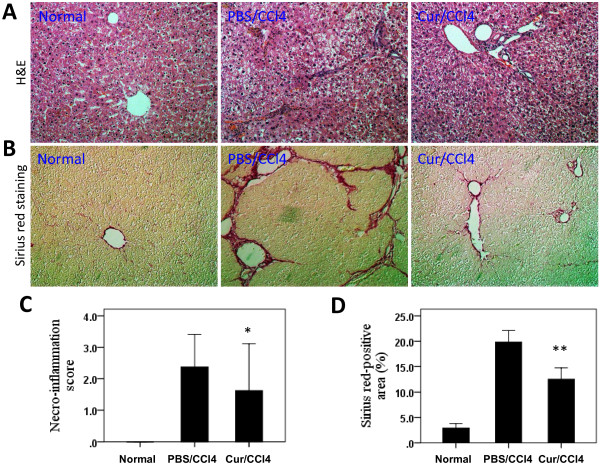
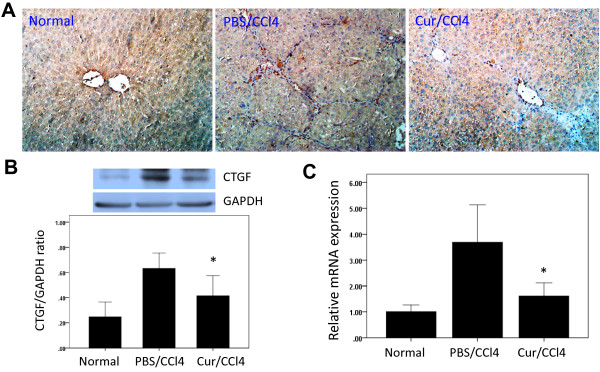
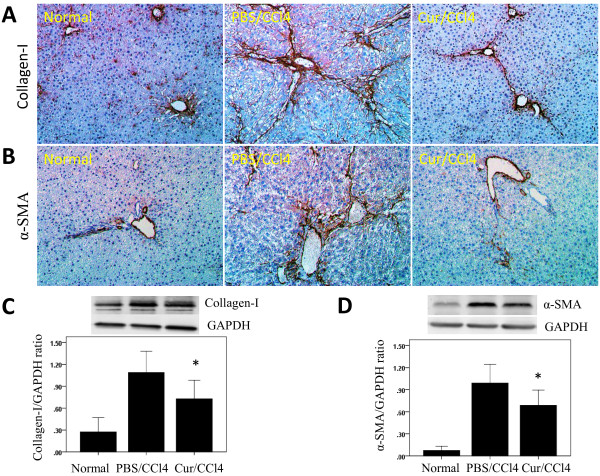
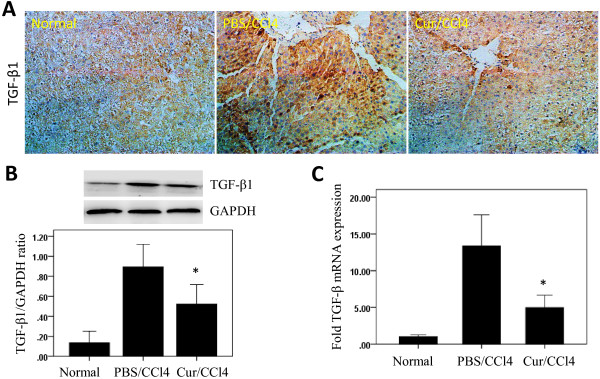
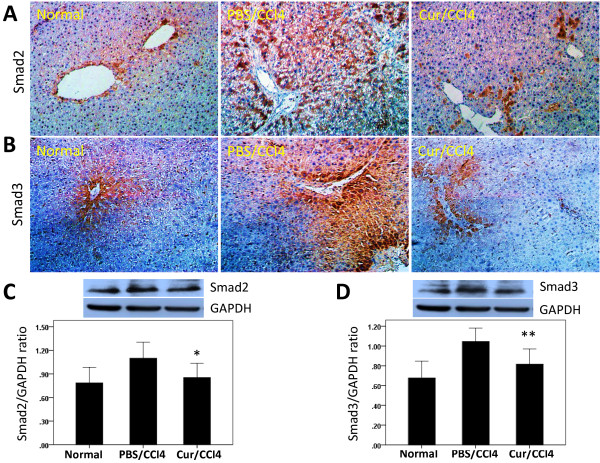
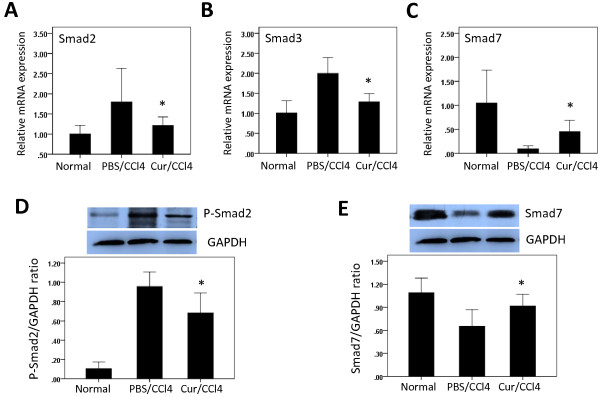
Rats treated with curcumin improved liver necro-inflammation, and reduced liver fibrosis in association with decreased α-smooth muscle actin expression, and decreased collagen deposition. Furthermore, curcumin significantly attenuated expressions of TGFβ1, Smad2, phosphorylated Smad2, Smad3, and CTGF and induced expression of the Smad7.
Curcumin significantly attenuated the severity of CCl4-induced liver inflammation and fibrosis through inhibition of TGF-β1/Smad signalling pathway and CTGF expression. These data suggest that curcumin might be an effective antifibrotic drug in the prevention of liver disease progression.
目前,肝纤维化尚无有效且被广泛接受的治疗方法。转化生长因子(TGF)-β1 信号通路对肝纤维化有很大影响。减少 TGF-β 的合成或抑制其复杂信号通路的成分是重要的治疗靶点。本研究旨在探讨姜黄素对肝纤维化的影响,以及姜黄素是否能减弱 TGF-β1 信号通路。
采用四氯化碳(CCl4)诱导 Sprague-Dawley 大鼠六周肝纤维化,同时给予或不给予姜黄素,并通过肝组织病理学和胶原含量来定量评估肝坏死炎症和纤维化程度。此外,采用实时定量 PCR、Western blot 或免疫组织化学法检测 TGF-β1、Smad2、磷酸化 Smad2、Smad3、Smad7 和结缔组织生长因子(CTGF)的 mRNA 和蛋白表达水平。
姜黄素治疗可改善肝坏死炎症,并减轻肝纤维化,同时降低α-平滑肌肌动蛋白的表达和胶原沉积。此外,姜黄素显著降低了 TGFβ1、Smad2、磷酸化 Smad2、Smad3 和 CTGF 的表达,并诱导了 Smad7 的表达。
姜黄素通过抑制 TGF-β1/Smad 信号通路和 CTGF 的表达,显著减轻了 CCl4 诱导的肝炎症和纤维化的严重程度。这些数据表明,姜黄素可能是预防肝病进展的一种有效的抗纤维化药物。