Rautio Nina, Jokelainen Jari, Oksa Heikki, Saaristo Timo, Peltonen Markku, Vanhala Mauno, Puolijoki Hannu, Moilanen Leena, Tuomilehto Jaakko, Keinänen-Kiukaanniemi Sirkka, Uusitupa Matti
Pirkanmaa Hospital District, Tampere, Finland.
BMJ Open. 2012 Sep 13;2(5). doi: 10.1136/bmjopen-2012-001472. Print 2012.
To examine whether the use of statins is associated with the incidence of type 2 diabetes (T2D) and changes in glucose metabolism among individuals at high risk for T2D participating in 1-year lifestyle intervention in primary healthcare setting.
Prospective follow-up study.
In all, 400 primary healthcare centres and occupational healthcare clinics in Finland.
We screened altogether 10 149 individuals at increased risk for T2D; of these, 2798 non-diabetic individuals verified by a 2 h glucose tolerance test participated in the 1-year follow-up.
Lifestyle intervention (individual and/or group-based counselling).
Incidence of T2D and fasting and 2 h glucose measured at baseline and follow-up.
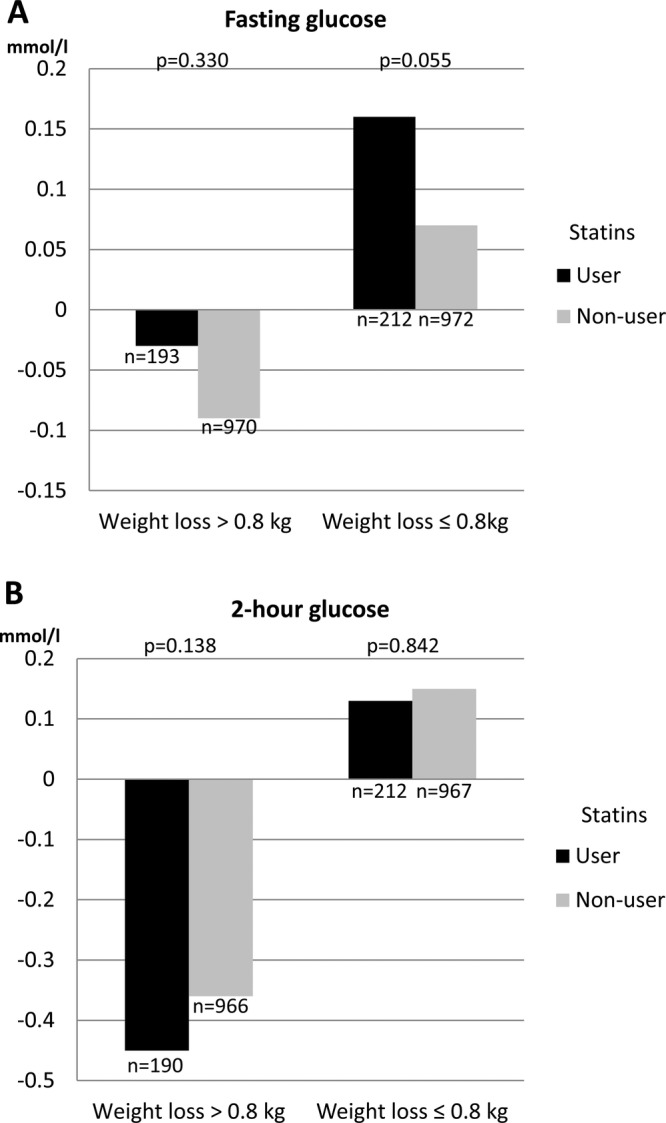
A total of 484 individuals (17.3%) used statins at the baseline. Of them 31 (7.5%) developed T2D during the follow-up, compared to 126 (6.5%) of statin non-users (OR 1.17, 95% CI 0.78 to 1.76, p=0.442). Interestingly, fasting glucose increased by 0.08 mmol/l in statin users, but remained unchanged in non-users, the difference being 0.074 mmol/l (95% CI 0.014 to 0.134) and remained significant even after adjustment for age, sex, baseline fasting glucose, the presence of cardiovascular disease (CVD), use of antihypertensive and/or coronary artery disease medication, weight and 1-year weight change (adjusted p=0.042).
The incidence of T2D did not differ between the statin users and non-users. The finding that fasting glucose slightly increased in statin users in spite of lifestyle interventions suggests the view that the use of statins might have unfavourable effects on glucose metabolism and that statins might hamper beneficial effects of lifestyle intervention in people at high risk of T2D.
在基层医疗环境中,研究参与为期1年生活方式干预的2型糖尿病(T2D)高危个体使用他汀类药物是否与T2D发病率及糖代谢变化相关。
前瞻性随访研究。
芬兰的400家基层医疗中心和职业健康诊所。
共筛查了10149名T2D风险增加的个体;其中,2798名经2小时葡萄糖耐量试验证实为非糖尿病的个体参与了为期1年的随访。
生活方式干预(个体和/或基于小组的咨询)。
T2D发病率以及基线和随访时测量的空腹血糖和2小时血糖。
共有484名个体(17.3%)在基线时使用他汀类药物。其中31名(7.5%)在随访期间患T2D,而未使用他汀类药物的个体中有126名(6.5%)患T2D(比值比1.17,95%置信区间0.78至1.76,p = 0.442)。有趣的是,他汀类药物使用者的空腹血糖升高了0.08 mmol/l,而未使用者保持不变,差异为0.074 mmol/l(95%置信区间0.014至0.134),即使在调整年龄、性别、基线空腹血糖、心血管疾病(CVD)的存在、使用抗高血压和/或冠状动脉疾病药物、体重以及1年体重变化后,差异仍具有统计学意义(调整后p = 0.042)。
他汀类药物使用者和非使用者之间T2D发病率无差异。尽管进行了生活方式干预,但他汀类药物使用者的空腹血糖略有升高,这一发现表明,使用他汀类药物可能对糖代谢有不利影响,并且他汀类药物可能会阻碍T2D高危人群生活方式干预的有益效果。