Child Study Center and Department of Psychiatry, Yale University School of Medicine, New Haven, CT 06510, USA.
Science. 2012 Sep 14;337(6100):1301-3. doi: 10.1126/science.1224989.
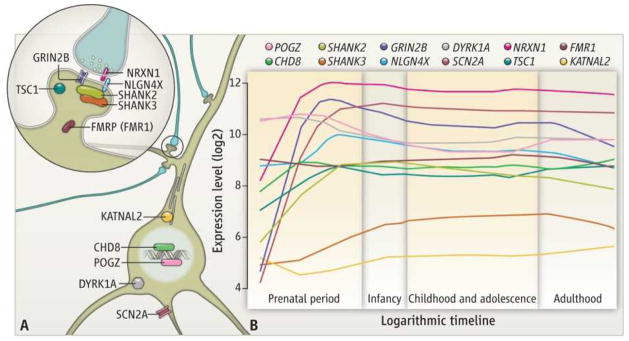
Autism spectrum disorders (ASD) are a genetically and phenotypically heterogeneous group of syndromes defined by fundamental impairments in social reciprocity and language development accompanied by highly restrictive interests and/or repetitive behaviors. Recent advances in genetics, genomics, developmental neurobiology, systems biology, monogenic neurodevelopment syndromes, and induced pluripotent stem cells (iPSC) are now offering remarkable insights into their etiologies and converging to provide a clear and immediate path forward from the bench to the bedside.
自闭症谱系障碍(ASD)是一组具有遗传和表型异质性的综合征,其特征是社会互惠和语言发育方面的基本障碍,同时伴有高度受限的兴趣和/或重复行为。遗传学、基因组学、发育神经生物学、系统生物学、单基因神经发育综合征和诱导多能干细胞(iPSC)的最新进展,现在为它们的病因提供了显著的见解,并趋于为从实验室到临床提供明确而直接的途径。