Swiss Vaccine Research Institute and Division of Immunology and Allergy, Department of Medicine, Lausanne University Hospital (CHUV), 1011 Lausanne, Switzerland.
J Exp Med. 2012 Sep 24;209(10):1769-79. doi: 10.1084/jem.20120905. Epub 2012 Sep 17.
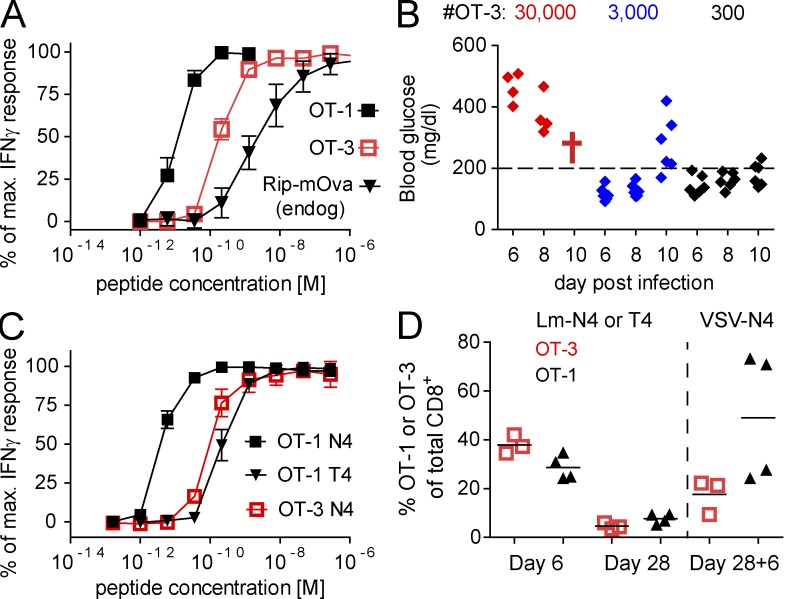
Central and peripheral tolerance prevent autoimmunity by deleting the most aggressive CD8(+) T cells but they spare cells that react weakly to tissue-restricted antigen (TRA). To reveal the functional characteristics of these spared cells, we generated a transgenic mouse expressing the TCR of a TRA-specific T cell that had escaped negative selection. Interestingly, the isolated TCR matches the affinity/avidity threshold for negatively selecting T cells, and when developing transgenic cells are exposed to their TRA in the thymus, only a fraction of them are eliminated but significant numbers enter the periphery. In contrast to high avidity cells, low avidity T cells persist in the antigen-positive periphery with no signs of anergy, unresponsiveness, or prior activation. Upon activation during an infection they cause autoimmunity and form memory cells. Unexpectedly, peptide ligands that are weaker in stimulating the transgenic T cells than the thymic threshold ligand also induce profound activation in the periphery. Thus, the peripheral T cell activation threshold during an infection is below that of negative selection for TRA. These results demonstrate the existence of a level of self-reactivity to TRA to which the thymus confers no protection and illustrate that organ damage can occur without genetic predisposition to autoimmunity.
中枢和外周耐受通过删除最具攻击性的 CD8(+) T 细胞来预防自身免疫,但它们会保留对组织限制性抗原 (TRA) 反应较弱的细胞。为了揭示这些保留细胞的功能特征,我们生成了一种表达逃避负选择的 TRA 特异性 T 细胞 TCR 的转基因小鼠。有趣的是,分离出的 TCR 与负选择 T 细胞的亲和力/亲合力阈值相匹配,当发育中的转基因细胞在胸腺中暴露于其 TRA 时,只有一部分被消除,但大量细胞进入外周。与高亲和力细胞不同,低亲和力 T 细胞在外周抗原阳性部位持续存在,没有失能、无反应或先前激活的迹象。在感染期间被激活后,它们会引起自身免疫并形成记忆细胞。出乎意料的是,比胸腺阈值配体刺激转基因 T 细胞弱的肽配体也会在外周引起强烈的激活。因此,感染期间外周 T 细胞的激活阈值低于 TRA 的负选择。这些结果表明存在对 TRA 的自身反应性水平,而胸腺对此没有提供保护,并表明即使没有自身免疫的遗传倾向,也可能发生器官损伤。