Department of Cancer Immunology and AIDS, Dana Farber Cancer Institute Boston, MA, USA ; Division of Medical Sciences, Harvard Medical School Boston, MA, USA.
Front Immunol. 2012 Sep 12;3:283. doi: 10.3389/fimmu.2012.00283. eCollection 2012.
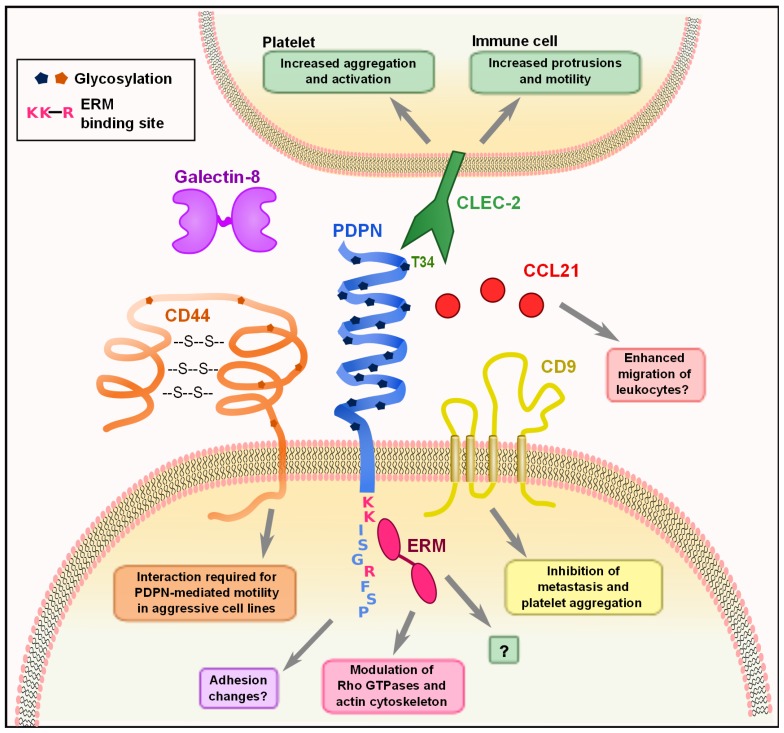
Podoplanin (PDPN) is a well-conserved, mucin-type transmembrane protein expressed in multiple tissues during ontogeny and in adult animals, including the brain, heart, kidney, lungs, osteoblasts, and lymphoid organs. Studies of PDPN-deficient mice have demonstrated that this molecule plays a critical role in development of the heart, lungs, and lymphatic system. PDPN is widely used as a marker for lymphatic endothelial cells and fibroblastic reticular cells of lymphoid organs and for lymphatics in the skin and tumor microenvironment. Much of the mechanistic insight into PDPN biology has been gleaned from studies of tumor cells; tumor cells often upregulate PDPN as they undergo epithelial-mesenchymal transition and this upregulation is correlated with increased motility and metastasis. The physiological role of PDPN that has been most studied is its ability to aggregate and activate CLEC-2-expressing platelets, as PDPN is the only known endogenous ligand for CLEC-2. However, more recent studies have revealed that PDPN also plays crucial roles in the biology of immune cells, including T cells and dendritic cells. This review will provide a comprehensive overview of the diverse roles of PDPN in development, immunology, and cancer.
足突蛋白(PDPN)是一种高度保守的黏蛋白型跨膜蛋白,在个体发生过程中以及在成年动物的多种组织中表达,包括脑、心脏、肾脏、肺、成骨细胞和淋巴器官。对 PDPN 缺陷型小鼠的研究表明,该分子在心脏、肺和淋巴系统的发育中起着关键作用。PDPN 被广泛用作淋巴管内皮细胞和淋巴器官成纤维网状细胞以及皮肤和肿瘤微环境中淋巴管的标志物。对 PDPN 生物学的大部分机制见解来自于对肿瘤细胞的研究;肿瘤细胞在经历上皮-间充质转化时经常上调 PDPN,这种上调与增加的迁移性和转移相关。研究最多的 PDPN 的生理作用是其聚集和激活表达 CLEC-2 的血小板的能力,因为 PDPN 是 CLEC-2 的唯一已知内源性配体。然而,最近的研究揭示了 PDPN 也在免疫细胞的生物学中发挥着关键作用,包括 T 细胞和树突状细胞。这篇综述将全面概述 PDPN 在发育、免疫学和癌症中的多种作用。