Department of Molecular Pharmacology, Tohoku University Graduate School of Medicine, 2-1 Seiryo-machi, Aoba-ku, Sendai 980-8575, Japan.
Department of Antibody Drug Development, Tohoku University Graduate School of Medicine, 2-1 Seiryo-machi, Aoba-ku, Sendai 980-8575, Japan.
Cells. 2022 Feb 7;11(3):575. doi: 10.3390/cells11030575.
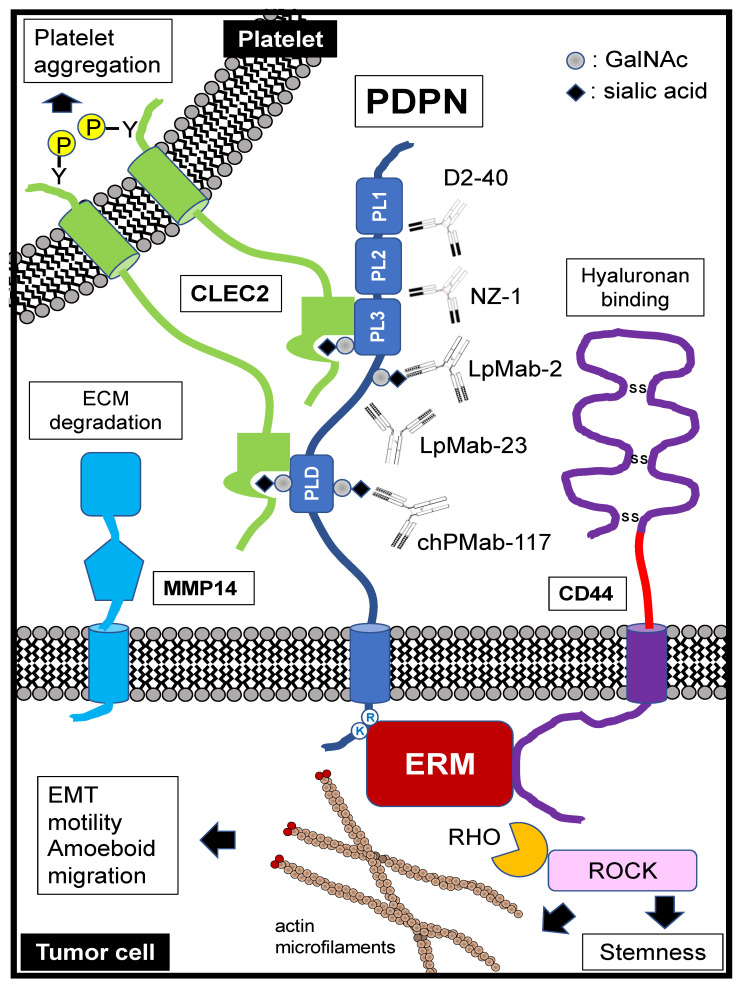
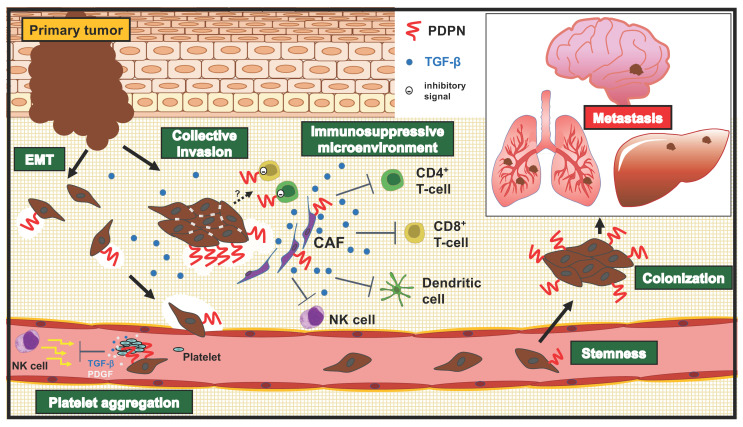
Podoplanin (PDPN) is a cell-surface mucin-like glycoprotein that plays a critical role in tumor development and normal development of the lung, kidney, and lymphatic vascular systems. PDPN is overexpressed in several tumors and is involved in their malignancy. PDPN induces platelet aggregation through binding to platelet receptor C-type lectin-like receptor 2. Furthermore, PDPN modulates signal transductions that regulate cell proliferation, differentiation, migration, invasion, epithelial-to-mesenchymal transition, and stemness, all of which are crucial for the malignant progression of tumor. In the tumor microenvironment (TME), PDPN expression is upregulated in the tumor stroma, including cancer-associated fibroblasts (CAFs) and immune cells. CAFs play significant roles in the extracellular matrix remodeling and the development of immunosuppressive TME. Additionally, PDPN functions as a co-inhibitory molecule on T cells, indicating its involvement with immune evasion. In this review, we describe the mechanistic basis and diverse roles of PDPN in the malignant progression of tumors and discuss the possibility of the clinical application of PDPN-targeted cancer therapy, including cancer-specific monoclonal antibodies, and chimeric antigen receptor T technologies.
足蛋白(PDPN)是一种细胞表面粘蛋白样糖蛋白,在肿瘤的发生发展以及肺、肾和淋巴血管系统的正常发育中起着关键作用。PDPN 在几种肿瘤中过表达,并参与其恶性转化。PDPN 通过与血小板受体 C 型凝集素样受体 2 结合诱导血小板聚集。此外,PDPN 调节信号转导,调节细胞增殖、分化、迁移、侵袭、上皮间质转化和干性,所有这些都对肿瘤的恶性进展至关重要。在肿瘤微环境(TME)中,肿瘤基质中的 PDPN 表达上调,包括癌相关成纤维细胞(CAF)和免疫细胞。CAF 在细胞外基质重塑和免疫抑制性 TME 的发展中起着重要作用。此外,PDPN 作为 T 细胞上的共抑制分子发挥作用,表明其参与免疫逃逸。在这篇综述中,我们描述了 PDPN 在肿瘤恶性进展中的作用机制和多种作用,并讨论了 PDPN 靶向癌症治疗的临床应用的可能性,包括肿瘤特异性单克隆抗体和嵌合抗原受体 T 技术。