Hatton Jennifer L, Janssen Renée M, Stapells David R
School of Audiology and Speech Sciences, The University of British Columbia, Vancouver, BC, Canada V6T 1Z3 ; Audiology Department, Britsh Columbia's Children' Hospital, Vancouver, BC, Canada V6H 3V4 ; British Columbia Early Hearing Program, Provicial Health Services Authority Victoria, BC, Canada V8V 3K3.
Int J Otolaryngol. 2012;2012:284864. doi: 10.1155/2012/284864. Epub 2012 Sep 4.
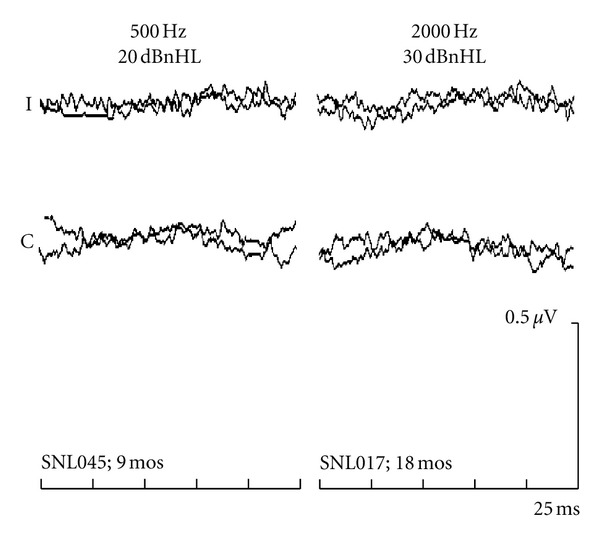
The bone-conduction (BC) tone ABR has been used clinically for over 20 years. The current study formally evaluated the test performance of the BC tone-evoked ABR in infants with hearing loss. Method. By comparing BC-ABR results to follow-up behavioural results, this study addressed two questions: (i) whether the BC tone ABR was successful in differentiating children with conductive versus sensorineural hearing loss (Study A; conductive: 68 ears; SNHL: 129 ears) and (ii) the relationship between BC ABR and behavioural hearing loss severity (Study B: 2000 Hz: 104 ears; 500 Hz: 47 ears). Results. Results demonstrate that the "normal" BC-ABR levels accurately differentiated normal versus elevated cochlear sensitivity (accuracy: 98% for 2000 Hz; 98% for 500 Hz). A subset of infants in Study A with elevated BC-ABR (i.e., no response at normal level) had additional testing at higher intensities, which allowed for categorization of the degree of cochlear impairment. Study B results indicate that the BC ABR accurately categorizes the degree of cochlear hearing loss for 2000 Hz (accuracy = 95.2%). A preliminary dBnHL-to-dBHL correction factor of "0 dB" was determined for 2000 Hz BC ABR. Conclusions. These findings further support the use of BC tone ABR for diagnostic ABR testing.
骨导(BC)纯音听性脑干反应(ABR)已在临床应用20多年。本研究正式评估了BC纯音诱发ABR在听力损失婴儿中的测试性能。方法。通过将BC-ABR结果与随访行为结果进行比较,本研究解决了两个问题:(i)BC纯音ABR能否成功区分传导性听力损失与感音神经性听力损失儿童(研究A;传导性:68耳;感音神经性听力损失:129耳),以及(ii)BC ABR与行为性听力损失严重程度之间的关系(研究B:2000Hz:104耳;500Hz:47耳)。结果。结果表明,“正常”的BC-ABR水平能准确区分正常与升高的耳蜗敏感性(2000Hz时准确率为98%;500Hz时准确率为98%)。研究A中BC-ABR升高(即正常水平无反应)的一部分婴儿在更高强度下进行了额外测试,这有助于对耳蜗损伤程度进行分类。研究B结果表明,BC ABR能准确对2000Hz时的耳蜗听力损失程度进行分类(准确率=95.2%)。确定了2000Hz BC ABR的初步“0dB”dBnHL-to-dBHL校正因子。结论。这些发现进一步支持将BC纯音ABR用于诊断性ABR测试。