IBM Almaden Research Center, San Jose, CA 95120, USA.
Malar J. 2012 Sep 18;11:331. doi: 10.1186/1475-2875-11-331.
The role of the Anopheles vector in malaria transmission and the effect of climate on Anopheles populations are well established. Models of the impact of climate change on the global malaria burden now have access to high-resolution climate data, but malaria surveillance data tends to be less precise, making model calibration problematic. Measurement of malaria response to fluctuations in climate variables offers a way to address these difficulties. Given the demonstrated sensitivity of malaria transmission to vector capacity, this work tests response functions to fluctuations in land surface temperature and precipitation.
This study of regional sensitivity of malaria incidence to year-to-year climate variations used an extended Macdonald Ross compartmental disease model (to compute malaria incidence) built on top of a global Anopheles vector capacity model (based on 10 years of satellite climate data). The predicted incidence was compared with estimates from the World Health Organization and the Malaria Atlas. The models and denominator data used are freely available through the Eclipse Foundation's Spatiotemporal Epidemiological Modeller (STEM).
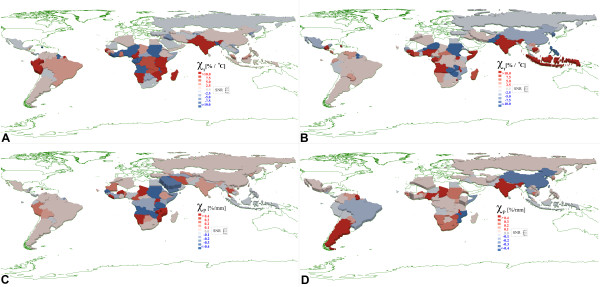
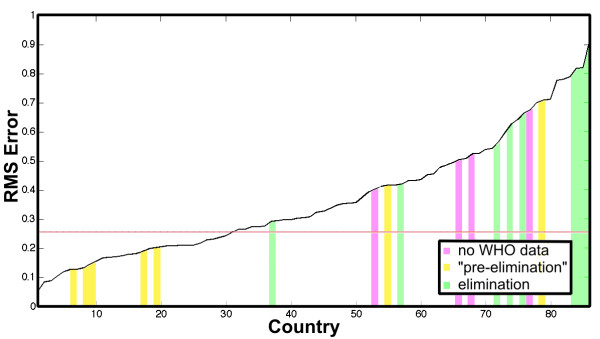
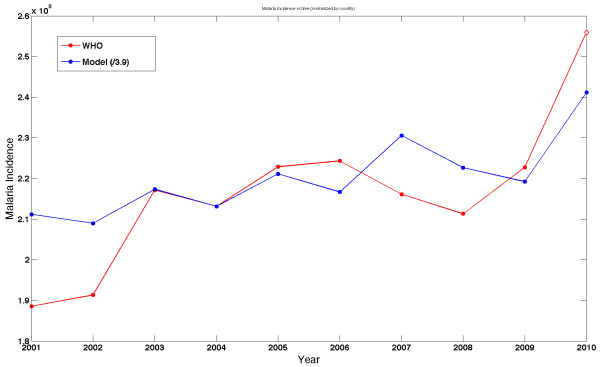
Although the absolute scale factor relating reported malaria to absolute incidence is uncertain, there is a positive correlation between predicted and reported year-to-year variation in malaria burden with an averaged root mean square (RMS) error of 25% comparing normalized incidence across 86 countries. Based on this, the proposed measure of sensitivity of malaria to variations in climate variables indicates locations where malaria is most likely to increase or decrease in response to specific climate factors. Bootstrapping measures the increased uncertainty in predicting malaria sensitivity when reporting is restricted to national level and an annual basis. Results indicate a potential 20x improvement in accuracy if data were available at the level ISO 3166-2 national subdivisions and with monthly time sampling.
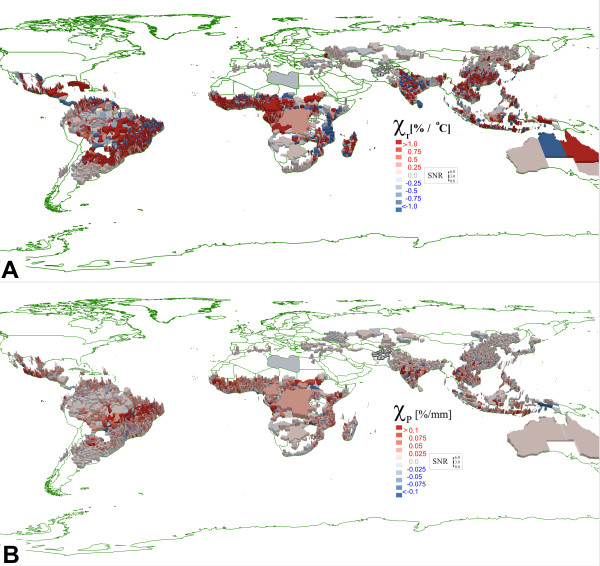
The high spatial resolution possible with state-of-the-art numerical models can identify regions most likely to require intervention due to climate changes. Higher-resolution surveillance data can provide a better understanding of how climate fluctuations affect malaria incidence and improve predictions. An open-source modelling framework, such as STEM, can be a valuable tool for the scientific community and provide a collaborative platform for developing such models.
疟蚊作为疟疾传播的媒介,以及气候对疟蚊种群的影响,这些都已经得到了充分证实。目前,气候变化对全球疟疾负担影响的模型已经可以获取高分辨率的气候数据,但疟疾监测数据往往不够精确,这使得模型校准变得复杂。衡量疟疾对气候变量波动的反应为解决这些困难提供了一种方法。鉴于疟疾传播对媒介容量的敏感性已得到证实,本研究测试了疟疾发病率对地表温度和降水波动的响应函数。
本研究通过扩展的 MacDonald Ross compartmental 疾病模型(用于计算疟疾发病率),利用基于 10 年卫星气候数据的全球疟蚊媒介容量模型,研究了疟疾发病率对年际气候变化的区域敏感性。将预测的发病率与世界卫生组织和疟疾地图集的估计值进行了比较。模型和分母数据可通过 Eclipse 基金会的 Spatiotemporal Epidemiological Modeller (STEM) 免费获取。
虽然报告的疟疾与绝对发病率之间的绝对比例因子不确定,但疟疾负担的预测和报告的年际变化之间存在正相关,在比较 86 个国家的归一化发病率时,平均均方根(RMS)误差为 25%。基于此,气候变化变量对疟疾敏感性的度量表明,在特定气候因素的作用下,疟疾最有可能增加或减少的地方。自举法衡量了在报告仅限于国家级和年度基础时,预测疟疾敏感性的不确定性增加。结果表明,如果数据可在 ISO 3166-2 国家细分级别获得,并且具有每月时间采样,则准确性可能会提高 20 倍。
最先进的数值模型的高空间分辨率可以确定最有可能因气候变化而需要干预的地区。更高分辨率的监测数据可以更好地了解气候波动如何影响疟疾发病率,并提高预测能力。开源建模框架,如 STEM,可以成为科学界的宝贵工具,并为开发此类模型提供协作平台。