Institute of Physiology, RWTH Aachen University, Aachen, Germany.
Channels (Austin). 2012 Nov-Dec;6(6):409-13. doi: 10.4161/chan.22154. Epub 2012 Sep 18.
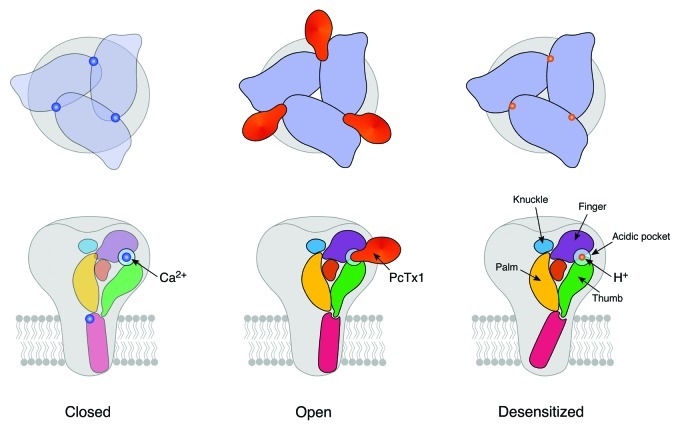
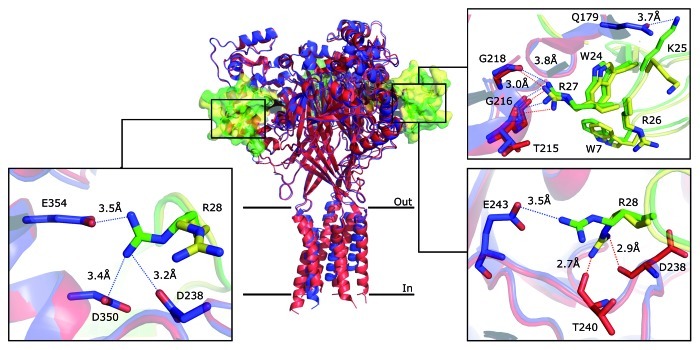
Of the three principal conformations of acid-sensing ion channels (ASICs)--closed, open and desensitized--only the atomic structure of the desensitized conformation had been known. Two recent papers report the crystal structure of chicken ASIC1 in complex with the spider toxin psalmotoxin 1, and one of these studies finds that, depending on the pH, channels are in two different open conformations. Compared with the desensitized conformation, toxin binding induces only subtle structural changes in the lower part of the large extracellular domain but a complete rearrangement of the two transmembrane domains (TMDs), suggesting that desensitization gating (the transition from open to desensitized) is mainly associated with conformational rearrangements of the TMDs. Moreover, the study reveals how two different arrangements of the TMDs in the open state give rise to ion pores with different selectivity for monovalent cations.
在酸敏离子通道(ASICs)的三种主要构象——关闭、开放和脱敏——中,只有脱敏构象的原子结构是已知的。最近的两篇论文报道了鸡 ASIC1 与蜘蛛毒素 psalmotoxin 1 复合物的晶体结构,其中一项研究发现,根据 pH 值的不同,通道处于两种不同的开放构象。与脱敏构象相比,毒素结合仅在大细胞外域的下部引起微小的结构变化,但两个跨膜域(TMDs)发生完全重排,这表明脱敏门控(从开放到脱敏的转变)主要与 TMDs 的构象重排有关。此外,该研究揭示了开放状态下 TMDs 的两种不同排列如何产生对单价阳离子具有不同选择性的离子通道。