Department of Anatomy and Neurobiology, University of Tennessee Health Science Center, Memphis, Tennessee, USA.
Am J Med Genet A. 2012 Nov;158A(11):2807-14. doi: 10.1002/ajmg.a.35601. Epub 2012 Sep 18.
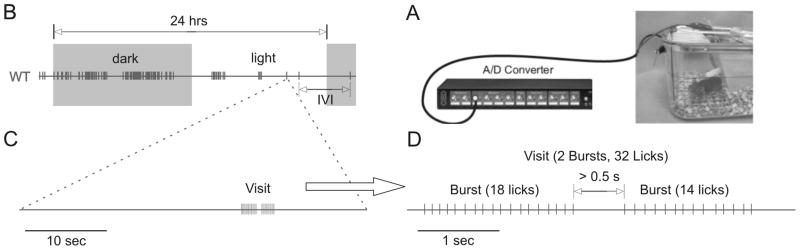
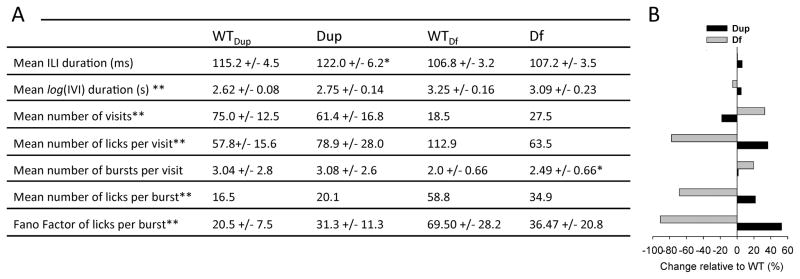
A quantitative long-term fluid consumption and fluid-licking assay was performed in two mouse models with either an ∼2 Mb genomic deletion, Df(11)17, or the reciprocal duplication copy number variation (CNV), Dp(11)17, analogous to the human genomic rearrangements causing either Smith-Magenis syndrome [SMS; OMIM #182290] or Potocki-Lupski syndrome [PTLS; OMIM #610883], respectively. Both mouse strains display distinct quantitative alterations in fluid consumption compared to their wild-type littermates; several of these changes are diametrically opposing between the two chromosome engineered mouse models. Mice with duplication versus deletion showed longer versus shorter intervals between visits to the waterspout, generated more versus less licks per visit and had higher versus lower variability in the number of licks per lick-burst as compared to their respective wild-type littermates. These findings suggest that copy number variation can affect long-term fluid consumption behavior in mice. Other behavioral differences were unique for either the duplication or deletion mutants; the deletion CNV resulted in increased variability of the licking rhythm, and the duplication CNV resulted in a significant slowing of the licking rhythm. Our findings document a readily quantitated complex behavioral response that can be directly and reciprocally influenced by a gene dosage effect.
我们在两种小鼠模型中进行了一项定量的长期液体消耗和舔舐实验,这两种模型分别携带约 2Mb 的基因组缺失(Df(11)17)或反向重复的拷贝数变异(CNV)(Dp(11)17),类似于导致史密斯-马根尼斯综合征(SMS;OMIM#182290)或波托基-卢普斯基综合征(PTLS;OMIM#610883)的人类基因组重排。与野生型同窝仔相比,这两种小鼠品系在液体消耗方面表现出明显的定量改变;在这两种经过基因工程改造的小鼠模型之间,有几个变化是截然相反的。与缺失相比,具有重复的小鼠在前往水嘴的间隔时间更长,每次访问的舔舐次数更多,每个舔舐爆发的舔舐次数的变异性更高,而与各自的野生型同窝仔相比。这些发现表明,拷贝数变异会影响小鼠的长期液体消耗行为。其他行为差异是重复或缺失突变体所特有的;缺失 CNV 导致舔舐节律的变异性增加,而重复 CNV 导致舔舐节律显著减慢。我们的研究结果记录了一种易于定量的复杂行为反应,它可以直接和相互地受到基因剂量效应的影响。