The Department of Pediatrics and Communicable Diseases, University of Michigan Health System, Ann Arbor, 48109, USA.
BMC Health Serv Res. 2012 Sep 20;12:327. doi: 10.1186/1472-6963-12-327.
From its inception, Medicaid was aimed at providing insurance coverage for low income children, elderly, and disabled. Since this time, children have become a smaller proportion of the US population and Medicaid has expanded to additional eligibility groups. We sought to evaluate relative growth in spending in the Medicaid program between children and adults from 1991-2005. We hypothesize that this shifting demographic will result in fewer resources being allocated to children in the Medicaid program.
We utilized retrospective enrollment and expenditure data for children, adults and the elderly from 1991 to 2005 for both Medicaid and Children's Health Insurance Program Medicaid expansion programs. Data were obtained from the Centers for Medicare and Medicaid Services using their Medicaid Statistical Information System.
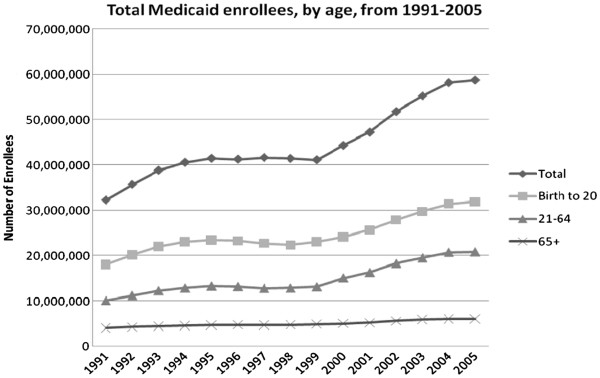
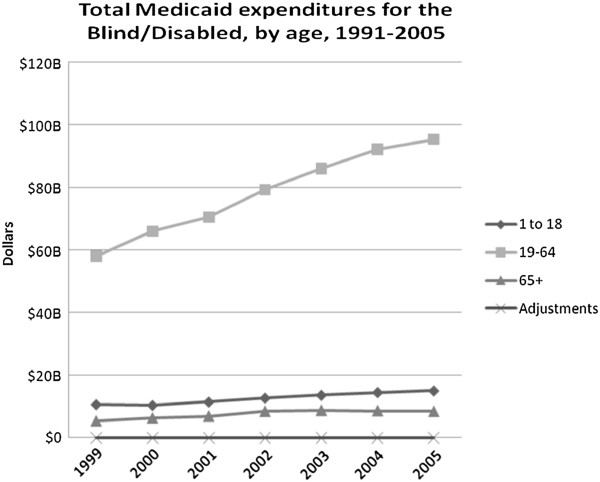
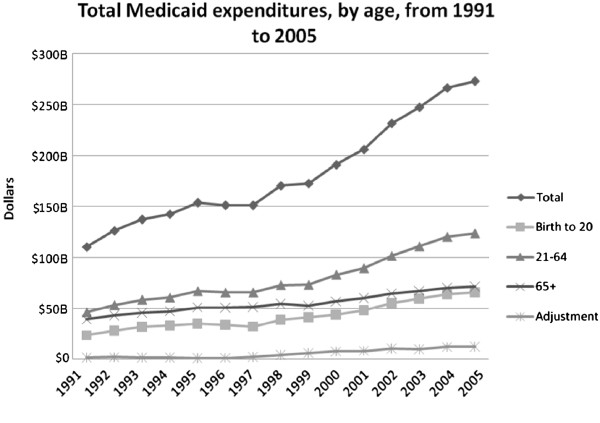
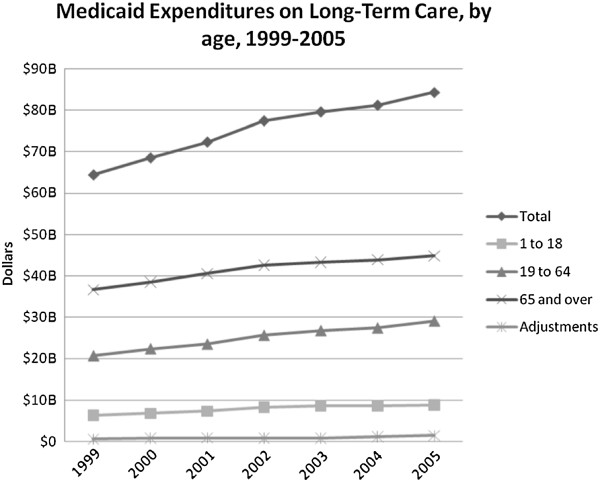
From 1991 to 2005, the number of enrollees increased by 83% to 58.7 million. This includes increases of 33% for children, 100% for adults and 50% for the elderly. Concurrently, total expenditures nationwide rose 150% to $273 billion. Expenditures for children increased from $23.4 to $65.7 billion, adults from $46.2 to $123.6 billion, and elderly from $39.2 to $71.3 billion. From 1999 to 2005, Medicaid spending on long-term care increased by 31% to $84.3 billion. Expenditures on the disabled grew by 61% to $119 billion. In total, the disabled account for 43% and long-term care 31%, of the total Medicaid budget.
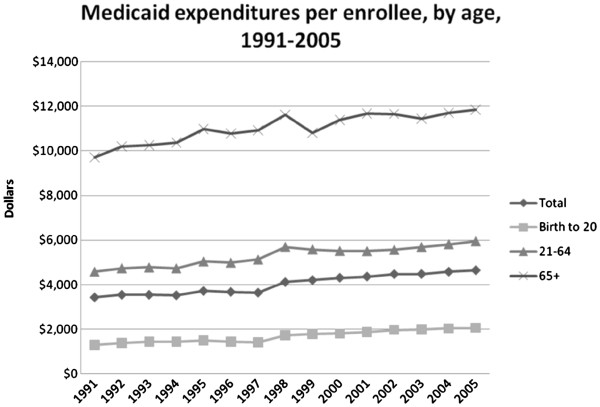
Our study did not find an absolute decrease in the overall resources being directed toward children. However, increased spending on adults on a per-capita and absolute basis, particularly disabled adults, is responsible for much of the growth in spending over the past 15 years. Medicaid expenditures have grown faster than inflation and overall national health expenditures. A national strategy is needed to ensure adequate coverage for Medicaid recipients while dealing with the ongoing constraints of state and federal budgets.
从一开始,医疗补助计划(Medicaid)的目标是为低收入儿童、老年人和残疾人提供保险覆盖。从那时起,儿童在美国人口中的比例已经下降,医疗补助计划也扩大到了其他符合条件的群体。我们试图评估 1991 年至 2005 年期间医疗补助计划中儿童和成年人支出的相对增长情况。我们假设这种人口结构的变化将导致医疗补助计划中分配给儿童的资源减少。
我们利用了 1991 年至 2005 年期间医疗补助计划和儿童健康保险计划(Children's Health Insurance Program) Medicaid 扩展计划中儿童、成年人和老年人的回溯性入组和支出数据。数据是从医疗保险和医疗补助服务中心(Centers for Medicare and Medicaid Services)的 Medicaid 统计信息系统中获取的。
从 1991 年到 2005 年,参保人数增加了 83%,达到 5870 万人。其中,儿童增加了 33%,成年人增加了 100%,老年人增加了 50%。与此同时,全国支出增长了 150%,达到 2730 亿美元。儿童支出从 234 亿美元增加到 657 亿美元,成年人从 462 亿美元增加到 1236 亿美元,老年人从 392 亿美元增加到 713 亿美元。从 1999 年到 2005 年,医疗补助计划对长期护理的支出增加了 31%,达到 843 亿美元。对残疾人的支出增长了 61%,达到 1190 亿美元。总的来说,残疾人占医疗补助计划总预算的 43%,长期护理占 31%。
我们的研究没有发现针对儿童的总体资源绝对减少。然而,成年人(尤其是残疾成年人)的人均和绝对支出增加,是过去 15 年支出增长的主要原因。医疗补助计划支出的增长速度超过了通货膨胀和整体国家卫生支出的增长速度。需要制定一项国家战略,以确保医疗补助计划受助人得到充分覆盖,同时应对州和联邦预算的持续限制。