Department of Anesthesiology, University of Michigan Medical School, Ann Arbor, Michigan, USA.
BMC Anesthesiol. 2012 Sep 20;12:23. doi: 10.1186/1471-2253-12-23.
Beach chair positioning during general anesthesia is associated with a high incidence of cerebral desaturation; poor neurological outcome is a growing concern. There are no published data pertaining to changes in cerebral oxygenation seen with increases in the inspired oxygen fraction or end-tidal carbon dioxide in patients anesthetized in the beach chair position. Furthermore, the effect anesthetic agents have has not been thoroughly investigated in this context. We plan to test the hypothesis that changes in inspired oxygen fraction or end-tidal carbon dioxide correlate to a significant change in regional cerebral oxygenation in anesthetized patients in beach chair position. We will also compare the effects that inhaled and intravenous anesthetics have on this process.
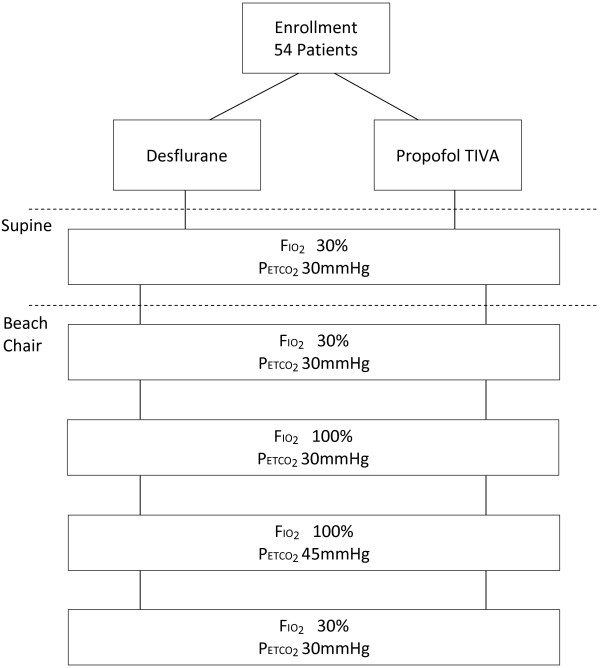
METHODS/DESIGN: This is a prospective within-group study of patients undergoing shoulder arthroscopy in the beach chair position which incorporates a randomized comparison between two anesthetics, approved by the Institutional Review Board of the University of Michigan, Ann Arbor. The primary outcome measure is the change in regional cerebral oxygenation due to sequential changes in oxygenation and ventilation. A sample size of 48 will have greater than 80% power to detect an absolute 4-5% difference in regional cerebral oxygenation caused by changes in ventilation strategy. The secondary outcome is the effect of anesthetic choice on cerebral desaturation in the beach chair position or response to changes in ventilation strategy. Fifty-four patients will be recruited, allowing for drop out, targeting 24 patients in each group randomized to an anesthetic. Regional cerebral oxygenation will be measured using the INVOS 5100C monitor (Covidien, Boulder, CO). Following induction of anesthesia, intubation and positioning, inspired oxygen fraction and minute ventilation will be sequentially adjusted. At each set point, regional cerebral oxygenation will be recorded and venous blood gas analysis performed. The overall statistical analysis will use a repeated measures analysis of variance with Tukey's HSD procedure for post hoc contrasts.
If simple maneuvers of ventilation or anesthetic technique can prevent cerebral hypoxia, patient outcome may be improved. This is the first study to investigate the effects of ventilation strategies on cerebral oxygenation in patients anesthetized in beach chair position.
NCT01535274.
全身麻醉期间沙滩椅体位与脑氧合不足的发生率较高有关;神经功能预后不良是一个日益受到关注的问题。目前尚无关于沙滩椅体位全身麻醉患者吸入氧分数或呼气末二氧化碳增加时脑氧合变化的相关数据。此外,在这种情况下,麻醉药物的影响尚未得到彻底研究。我们计划检验以下假设,即在沙滩椅体位全身麻醉患者中,吸入氧分数或呼气末二氧化碳的变化与脑区域性氧合的显著变化相关。我们还将比较吸入和静脉麻醉对这一过程的影响。
方法/设计:这是一项前瞻性的沙滩椅体位行肩关节镜手术患者的组内研究,包含了两种麻醉药物的随机比较,该研究已获得密歇根大学安娜堡分校机构审查委员会的批准。主要结局测量指标是由于氧合和通气的连续变化导致的区域性脑氧合的变化。样本量为 48 例将有超过 80%的效能来检测通气策略变化引起的区域性脑氧合绝对差异 4-5%。次要结局是麻醉选择对沙滩椅体位下脑缺氧的影响或对通气策略变化的反应。将招募 54 例患者,允许脱落,每组随机分配 24 例患者接受麻醉。使用 INVOS 5100C 监测仪(Covidien,博尔德,CO)测量区域性脑氧合。全身麻醉诱导、插管和体位固定后,将依次调整吸入氧分数和分钟通气量。在每个设定点,记录区域性脑氧合并进行静脉血气分析。总统计分析将使用重复测量方差分析,事后对比采用 Tukey 的 HSD 程序。
如果简单的通气操作或麻醉技术能够预防脑缺氧,患者的预后可能会得到改善。这是第一项研究沙滩椅体位全身麻醉患者通气策略对脑氧合影响的研究。
NCT01535274。