First Department of Geriatric Cardiology, Chinese PLA General Hospital, Beijing, Peoples Republic of China.
BMC Cardiovasc Disord. 2012 Sep 20;12:77. doi: 10.1186/1471-2261-12-77.
Effects of fish oil on systematic inflammation in chronic heart failure remain unclear. In this meta-analysis, we aimed to evaluate the influence of fish oil supplementation on circulating levels of inflammatory markers in patients with chronic heart failure.
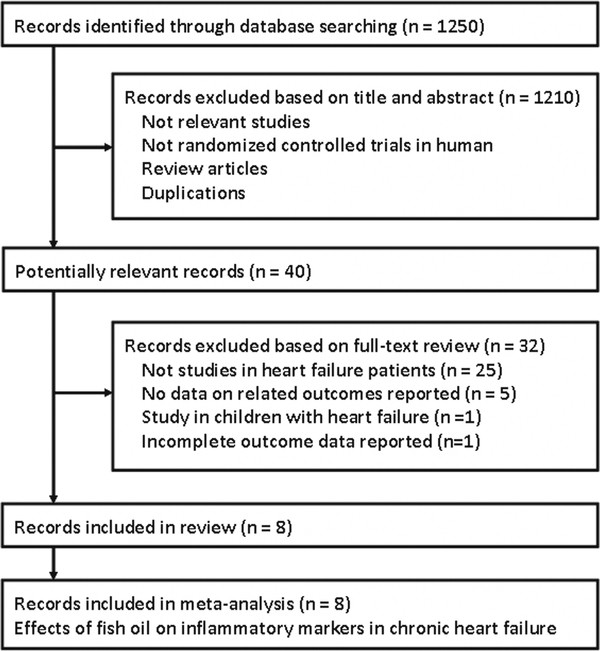
Human randomized controlled trials, which compared the effects of fish oil supplementation with placebo in patients with chronic heart failure, were identified by systematic search of Medline, Embase, Cochrane's library and references cited in related reviews and studies up to November 2011. Outcome measures comprised the changes of circulating inflammatory markers. Meta-analysis was performed with the fixed-effect model or random-effect model according to the heterogeneity.
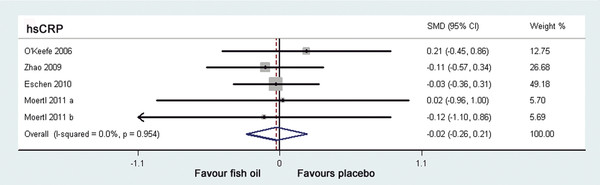
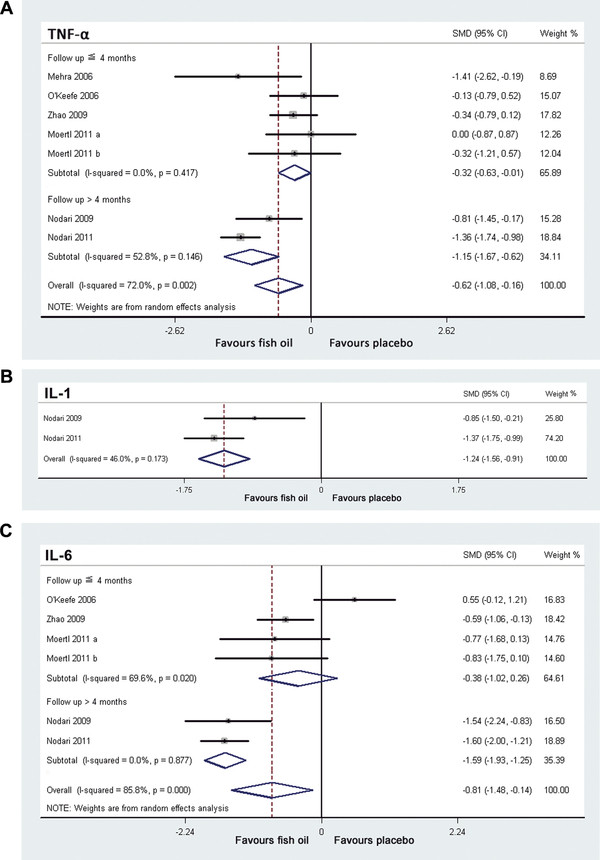
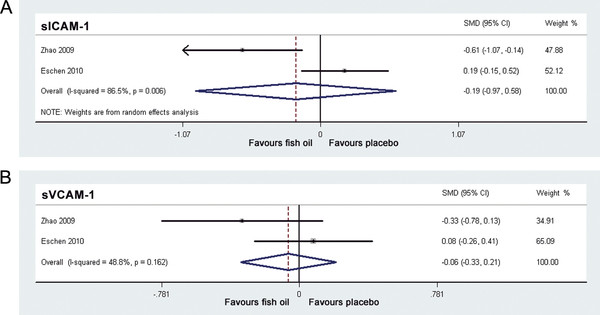
A total of seven trials with eight study arms were included. The pooled results indicated circulating levels of tumor necrosis factor α (SMD = -0.62, 95% CI -1.08 to -0.16, p = 0.009), interleukin 1 (SMD = -1.24, 95% CI -1.56 to -0.91, p < 0.001) and interleukin 6 (SMD = -0.81, 95% CI -1.48 to -0.14, p = 0.02) were significantly decreased after fish oil supplementation; however, high sensitivity C reactive protein, soluble intracellular adhesion molecular 1 and vascular cell adhesion molecular 1 were not significantly affected. Meta-regression and subgroup analysis results suggested the difference in dose of fish oil and follow-up duration might influence the effects of fish oil on tumor necrosis factor α and interleukin 6. Greater reduction of these two markers might be achieved in patients taking fish oil of a higher dose (over 1000 mg/day) or for a longer duration (over 4 months).
Limited evidence suggests anti-inflammation may be a potential mechanism underlying the beneficial effects of fish oil for chronic heart failure. Further large-scale and adequately powered clinical trials are needed to confirm these effects.
鱼油对慢性心力衰竭系统性炎症的影响尚不清楚。在这项荟萃分析中,我们旨在评估鱼油补充剂对慢性心力衰竭患者循环炎症标志物水平的影响。
通过系统搜索 Medline、Embase、Cochrane 图书馆以及相关综述和研究中的参考文献,确定了比较鱼油补充剂与安慰剂在慢性心力衰竭患者中的疗效的人类随机对照试验。结局指标包括循环炎症标志物的变化。根据异质性,采用固定效应模型或随机效应模型进行荟萃分析。
共纳入 7 项试验,共 8 个研究组。汇总结果表明,循环肿瘤坏死因子-α(SMD = -0.62,95%CI -1.08 至 -0.16,p = 0.009)、白细胞介素 1(SMD = -1.24,95%CI -1.56 至 -0.91,p < 0.001)和白细胞介素 6(SMD = -0.81,95%CI -1.48 至 -0.14,p = 0.02)水平显著降低;然而,高敏 C 反应蛋白、可溶性细胞间黏附分子 1 和血管细胞黏附分子 1水平无显著影响。Meta 回归和亚组分析结果表明,鱼油剂量和随访时间的差异可能影响鱼油对肿瘤坏死因子-α和白细胞介素 6 的作用。服用高剂量(超过 1000mg/天)或更长时间(超过 4 个月)鱼油的患者,这两种标志物的降低幅度可能更大。
有限的证据表明,抗炎可能是鱼油对慢性心力衰竭有益作用的潜在机制。需要进一步开展大规模、充分有力的临床试验来证实这些效果。