Department of Experimental Psychology & Psychopharmacology, Faculty of Social Sciences, Utrecht University, Utrecht, The Netherlands.
Transl Psychiatry. 2012 Sep 25;2(9):e162. doi: 10.1038/tp.2012.90.
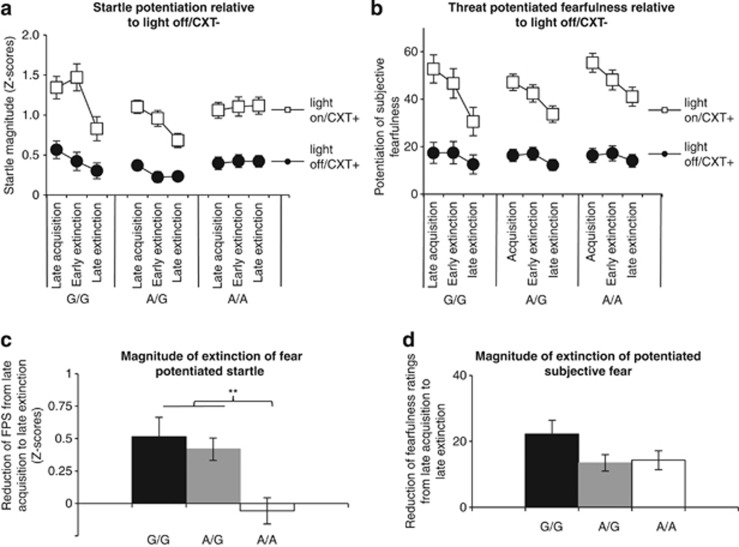
Failure to extinguish fear can lead to persevering anxiety and has been postulated as an important mechanism in the pathogenesis of human anxiety disorders. In animals, it is well documented that the endogenous cannabinoid system has a pivotal role in the successful extinction of fear, most importantly through the cannabinoid receptor 1. However, no human studies have reported a translation of this preclinical evidence yet. Healthy medication-free human subjects (N=150) underwent a fear conditioning and extinction procedure in a virtual reality environment. Fear potentiation of the eyeblink startle reflex was measured to assess fear-conditioned responding, and subjective fear ratings were collected. Participants were genotyped for two polymorphisms located within the promoter region (rs2180619) and the coding region (rs1049353) of cannabinoid receptor 1. As predicted from the preclinical literature, acquisition and expression of conditioned fear did not differ between genotypes. Crucially, whereas both homozygote (G/G, N=23) and heterozygote (A/G, N=68) G-allele carriers of rs2180619 displayed robust extinction of fear, extinction of fear-potentiated startle was absent in A/A homozygotes (N=51). Additionally, this resistance to extinguish fear left A/A carriers of rs2180619 with significantly higher levels of fear-potentiated startle at the end of the extinction training. No effects of rs1049353 genotype were observed regarding fear acquisition and extinction. These results suggest for the first time involvement of the human endocannabinoid system in fear extinction. Implications are that genetic variability in this system may underlie individual differences in anxiety, rendering cannabinoid receptor 1 a potential target for novel pharmacological treatments of anxiety disorders.
未能消除恐惧可能导致持续的焦虑,并被推测为人类焦虑障碍发病机制中的一个重要机制。在动物中,已有充分的文献证明内源性大麻素系统在成功消除恐惧中起着关键作用,最重要的是通过大麻素受体 1。然而,目前尚无人类研究报告将这一临床前证据转化为临床应用。健康、未服用药物的人类受试者(N=150)在虚拟现实环境中接受了恐惧条件反射和消退程序。通过测量眨眼反射的惊吓反射增强来评估恐惧条件反应,并收集主观恐惧评分。参与者的大麻素受体 1启动子区域(rs2180619)和编码区域(rs1049353)的两个多态性进行了基因分型。正如临床前文献所预测的那样,基因型之间的条件恐惧获得和表达没有差异。至关重要的是,rs2180619 的纯合子(G/G,N=23)和杂合子(A/G,N=68)G 等位基因携带者均表现出强烈的恐惧消退,而 A/A 纯合子(N=51)则没有恐惧增强的惊吓反射消退。此外,这种对恐惧的抵抗使 rs2180619 的 A/A 携带者在消退训练结束时具有显著更高水平的恐惧增强惊吓反射。rs1049353 基因型对恐惧获得和消退没有影响。这些结果首次表明人类内源性大麻素系统参与了恐惧消退。这意味着该系统的遗传变异可能是个体焦虑差异的基础,使大麻素受体 1 成为焦虑障碍新型药物治疗的潜在靶点。