National Institute of Epidemiology (NIE), Indian Council of Medical Research (ICMR), Chennai, TN, 600077, India.
Hum Resour Health. 2012 Sep 27;10:36. doi: 10.1186/1478-4491-10-36.
During 2001-2007, the National Institute of Epidemiology (NIE), Chennai, Tamil Nadu, India admitted 80 trainees in its two-year Field Epidemiology Training Programme (FETP). We evaluated the first seven years of the programme to identify strengths and weaknesses.
We identified core components of the programme and broke them down into input, process, output and outcome. We developed critical indicators to reflect the logic model. We reviewed documents including fieldwork reports, abstracts listed in proceedings and papers published in Medline-indexed journals. We conducted an anonymous online survey of the graduates to collect information on self-perceived competencies, learning activities, field assignments, supervision, curriculum, relevance to career goals, strengths and weaknesses.
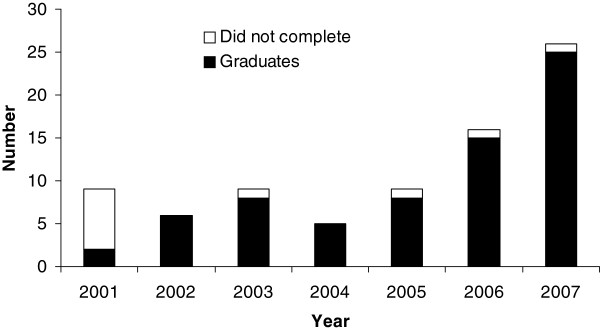
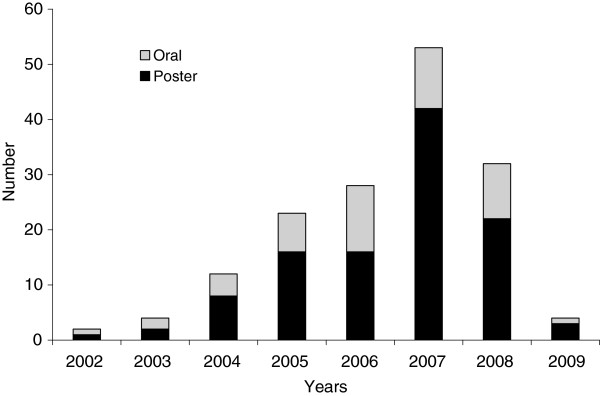
Of the 80 students recruited during 2001-2007, 69 (86%) acquired seven core competencies (epidemiology, surveillance, outbreaks, research, human subjects protection, communication and management) and graduated through completion of at least six field assignments. The faculty-to-student ratio ranged between 0.4 and 0.12 (expected: 0.25). The curriculum was continuously adapted with all resources available on-line. Fieldwork led to the production of 158 scientific communications presented at international meetings and to 29 manuscripts accepted in indexed, peer-reviewed journals. The online survey showed that while most graduates acquired competencies, unmet needs persisted in laboratory sciences, data analysis tools and faculty-to-student ratio.
NIE adapted the international FETP model to India. However, further efforts are required to scale up the programme and to develop career tracks for field epidemiologists in the country.
2001-2007 年期间,印度泰米尔纳德邦钦奈国家流行病学研究所(NIE)招收了 80 名参加为期两年的现场流行病学培训计划(FETP)的学员。我们评估了该计划的前七年,以确定其优势和劣势。
我们确定了计划的核心组成部分,并将其细分为投入、过程、产出和结果。我们制定了关键指标来反映逻辑模型。我们审查了文件,包括现场工作报告、会议论文集列出的摘要以及在 Medline 索引期刊上发表的论文。我们对毕业生进行了匿名在线调查,以收集有关自我感知能力、学习活动、现场任务、监督、课程、与职业目标的相关性、优势和劣势的信息。
在 2001-2007 年期间招收的 80 名学生中,有 69 名(86%)获得了 7 项核心能力(流行病学、监测、暴发、研究、人体受试者保护、沟通和管理),并通过完成至少 6 项现场任务毕业。师生比在 0.4 到 0.12 之间(预期为 0.25)。课程不断适应,所有资源都在线提供。现场工作导致产生了 158 项科学交流,在国际会议上发表,并在索引的同行评审期刊上发表了 29 篇手稿。在线调查显示,虽然大多数毕业生获得了能力,但实验室科学、数据分析工具和师生比方面仍存在未满足的需求。
NIE 对国际 FETP 模式进行了调整,以适应印度的情况。然而,仍需要进一步努力扩大该计划的规模,并为该国的现场流行病学家制定职业发展轨道。