Radiation Therapy Department, Oscar Lambret Comprehensive Center Lille, 3 rue Combemale, Lille cedex, 59020, France.
Radiat Oncol. 2012 Sep 27;7:164. doi: 10.1186/1748-717X-7-164.
The purpose of this study is to evaluate the feasibility, efficacy and toxicity of SBRT for treatment of unresectable hepatic or lung metastases regardless of their primary tumor site for patients who received prior systemic chemotherapy.
Between July 2007 and June 2010, 90 patients were treated with the CyberKnife® SBRT system for hepatic or pulmonary metastatic lesions. Medical records were retrospectively reviewed. The endpoints of this study were local control, overall survival (OS), disease-free survival (DFS), local relapse free-survival (LRFS), and treatment toxicity.
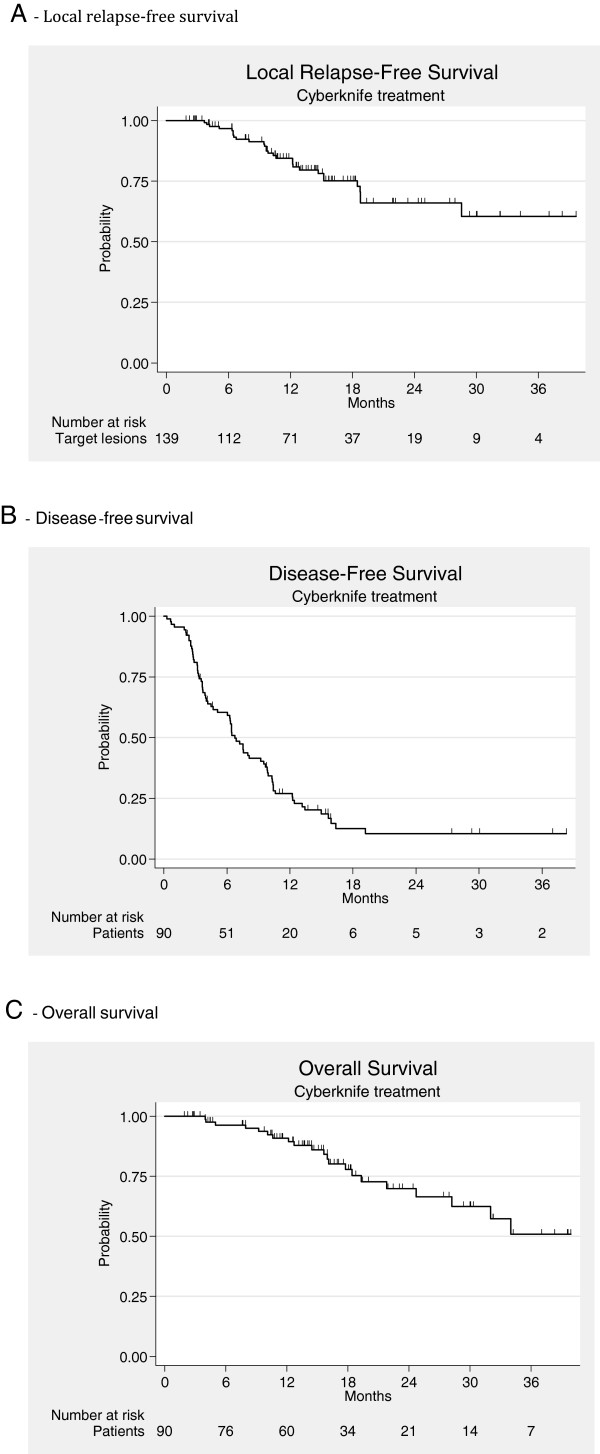
A total of 113 liver and 26 lung metastatic lesions in 52 men (58%) and 38 women (42%) were treated. Median follow-up was 17 months. Median age at treatment was 65 years (range, 23-84 years). Primary cancers were 63 GI, three lung, eight breast, four melanoma, three neuro-endocrine tumors, and three sarcomas. Median diameter of the lesions was 28 mm (range, 7-110 mm) for liver and 12.5 mm (range, 5-63.5 mm) for lung. Local control rates at 1 and 2 years were 84.5% and 66.1%, respectively. Two-year overall survival rate was 70% (95% CI: 55-81%). The 1 and 2-year disease-free survival rates were 27% (95% CI: 18-37%) and 10% (95% CI: 4-20%), respectively. Median duration of disease-free survival was 6.7 months (95% CI: 5.1-9.5 months). Observed toxicities included grade 1-3 acute toxicities. One grade 3 and no grade 4 toxicity were reported.
High-dose SBRT for metastatic lesions is both feasible and effective with high local control rates. Overall survival is comparable with other available techniques. Treatment is well tolerated with low toxicity rates. It could represent an interesting treatment option for oligometastatic patients not amenable to surgery, even when patients had been pre-treated with chemotherapy.
Stereotactic body radiotherapy (SBRT) has previously been successfully used in the treatment of metastatic lesions. It could be considered as a curative option for oligometastatic patients. This retrospective study involved 90 patients, designed to test potential effectiveness of SBRT in the treatment of oligometastases irrespective of primary. Results suggest SBRT could be an effective treatment extending patients' life span. This treatment appears to be more effective when used prior to multiple systemic treatment regimens.
本研究旨在评估立体定向放疗(SBRT)在治疗既往接受过系统化疗的不可切除肝或肺转移患者中的可行性、疗效和毒性,而不考虑其原发肿瘤部位。
2007 年 7 月至 2010 年 6 月期间,90 例患者采用 CyberKnife® SBRT 系统治疗肝或肺转移病灶。对病历进行回顾性分析。本研究的终点为局部控制率、总生存率(OS)、无疾病生存率(DFS)、局部无复发生存率(LRFS)和治疗毒性。
共治疗 52 例男性(58%)和 38 例女性(42%)的 113 个肝转移病灶和 26 个肺转移病灶。中位随访时间为 17 个月。治疗时的中位年龄为 65 岁(范围 23-84 岁)。原发癌为 63 例胃肠道癌、3 例肺癌、8 例乳腺癌、4 例黑色素瘤、3 例神经内分泌肿瘤和 3 例肉瘤。肝脏病变的中位直径为 28mm(范围 7-110mm),肺部病变为 12.5mm(范围 5-63.5mm)。1 年和 2 年局部控制率分别为 84.5%和 66.1%。2 年总生存率为 70%(95%CI:55-81%)。1 年和 2 年无疾病生存率分别为 27%(95%CI:18-37%)和 10%(95%CI:4-20%)。无疾病生存的中位时间为 6.7 个月(95%CI:5.1-9.5 个月)。观察到的毒性包括 1-3 级急性毒性。报告了 1 例 3 级和 0 例 4 级毒性。
对于转移性病变,高剂量 SBRT 既可行又有效,局部控制率高。总生存率与其他可用技术相当。治疗耐受性好,毒性发生率低。对于不能手术的寡转移患者,即使在接受化疗之前,它也可能是一种有趣的治疗选择。
立体定向体部放疗(SBRT)先前已成功应用于转移性病灶的治疗。对于寡转移患者,它可以被视为一种根治性治疗选择。这项回顾性研究共纳入 90 例患者,旨在测试 SBRT 在治疗寡转移患者中的潜在有效性,无论其原发灶如何。结果表明,SBRT 可能是一种有效的治疗方法,能延长患者的生存期。这种治疗方法在使用多种全身治疗方案之前似乎更有效。