Jawad M, Schoop R, Suter A, Klein P, Eccles R
Common Cold Centre and Healthcare, Cardiff University, Cardiff CF10 3XQ, UK.
Evid Based Complement Alternat Med. 2012;2012:841315. doi: 10.1155/2012/841315. Epub 2012 Sep 16.
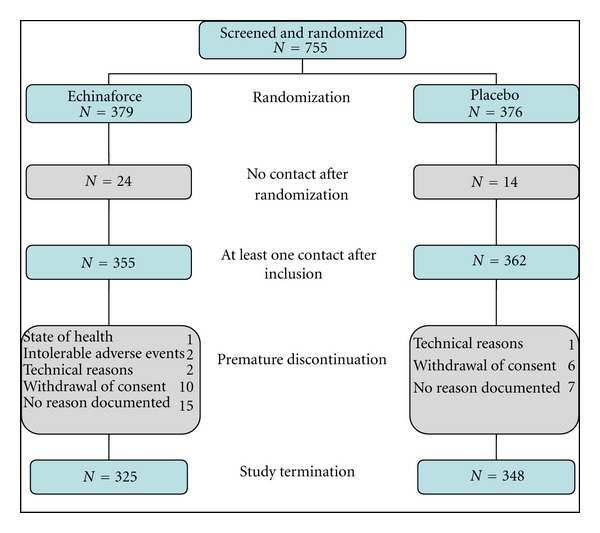
Objective. To investigate the safety (risk) and efficacy (benefit) of Echinacea purpurea extract in the prevention of common cold episodes in a large population over a 4-month period. Methods. 755 healthy subjects were allocated to receive either an alcohol extract from freshly harvested E. purpurea (95% herba and 5% root) or placebo. Participants were required to record adverse events and to rate cold-related issues in a diary throughout the investigation period. Nasal secretions were sampled at acute colds and screened for viruses. Results. A total of 293 adverse events occurred with Echinacea and 306 with placebo treatment. Nine and 10% of participants experienced adverse events, which were at least possibly related to the study drug (adverse drug reactions). Thus, the safety of Echinacea was noninferior to placebo. Echinacea reduced the total number of cold episodes, cumulated episode days within the group, and pain-killer medicated episodes. Echinacea inhibited virally confirmed colds and especially prevented enveloped virus infections (P < 0.05). Echinacea showed maximal effects on recurrent infections, and preventive effects increased with therapy compliance and adherence to the protocol. Conclusions. Compliant prophylactic intake of E. purpurea over a 4-month period appeared to provide a positive risk to benefit ratio.
目的。研究紫锥菊提取物在4个月期间预防大量人群感冒发作的安全性(风险)和有效性(益处)。方法。755名健康受试者被分配接受新鲜收获的紫锥菊酒精提取物(95%地上部分和5%根部)或安慰剂。在整个研究期间,参与者被要求记录不良事件,并在日记中对与感冒相关的问题进行评分。在急性感冒时采集鼻分泌物样本并进行病毒筛查。结果。紫锥菊组共发生293起不良事件,安慰剂组为306起。9%和10%的参与者经历了不良事件,这些事件至少可能与研究药物有关(药物不良反应)。因此,紫锥菊的安全性不劣于安慰剂。紫锥菊减少了感冒发作的总数、组内累计发作天数以及服用止痛药的发作次数。紫锥菊抑制了经病毒确认的感冒,尤其预防了包膜病毒感染(P<0.05)。紫锥菊对复发性感染显示出最大效果,预防效果随着治疗依从性和对方案的遵守情况而增加。结论。在4个月期间依从性预防性服用紫锥菊似乎提供了积极的风险效益比。