Department of Pharmacology, Physiology and Toxicology, Joan C, Edwards School of Medicine, Marshall University, 1700 3rd Ave, BBSC #435K, Huntington, WV 25755, USA.
BMC Genet. 2012 Oct 1;13:81. doi: 10.1186/1471-2156-13-81.
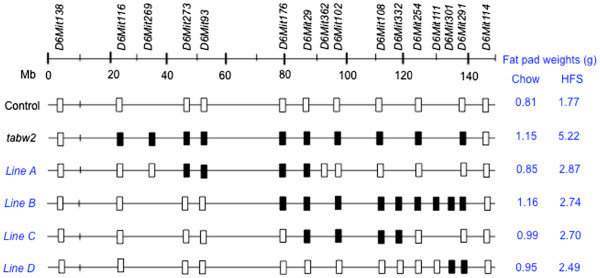
We previously established a congenic mouse strain with TALLYHO/Jng (TH) donor segment on chromosome 6 in a C57BL/6 (B6) background that harbors an obesity quantitative trait locus, tabw2. The B6.TH-tabw2 congenic mice developed increased adiposity that became exacerbated upon feeding a high fat-high sucrose (HFS) diet. To fine map the tabw2, in this study we generated and characterized subcongenic lines with smaller TH donor segments.
We fixed four subcongenic lines, with maximum size of donor segment retained in the lines ranging from 10.8 - 92.5 Mb. For mapping, all the subcongenic mice, along with B6.TH-tabw2 congenic and B6-homozygous control mice were fed either chow or HFS diets, and their post-mortem fat pads were weighed. Mice were also characterized for energy expenditure, respiratory exchange ratio, locomotor activity, and food intake. As previously reported, B6.TH-tabw2 congenic mice showed a significantly larger fat mass than controls on both diets. On chow, a subcongenic line retaining the distal region of the TH donor congenic interval exhibited significantly larger fat mass than B6-homozygous controls, and comparable that to B6.TH-tabw2 congenic mice. Two nested subcongenic lines within that region suggested that the effect of tabw2 on obesity could be attributed to at least two subloci. On HFS diets, on the other hand, all the subcongenic mice had significantly larger fat mass than controls without genotype differences, but none of them had fat mass as large as the original congenic mice. This possibly implicates that further genetic complexity involves in the effect of tabw2 on diet-induced obesity. Significantly reduced locomotor activity was exhibited in B6.TH-tabw2 congenic and subcongenic mice compared to controls when animals were fed HFS diets. B6.TH-tabw2 congenic mice, but not subcongenic mice, also had significantly increased food intake on HFS diets.
It appears that at least two subloci explaining the tabw2 effect under chow feeding map to the distal region of the congenic interval, whereas the diet-induced obesity mediated by tabw2 is attributed to more complex genetic mechanism.
我们之前在 C57BL/6(B6)背景下建立了一个带有 TALLYHO/Jng(TH)供体片段的同基因小鼠品系,该片段位于 6 号染色体上,携带肥胖数量性状基因座 tabw2。B6.TH-tabw2 同基因小鼠表现出脂肪量增加,而在高脂高蔗糖(HFS)饮食喂养下则加剧。为了精细定位 tabw2,在这项研究中,我们生成并表征了具有较小 TH 供体片段的亚同基因系。
我们固定了四个亚同基因系,其中保留的供体片段最大尺寸范围为 10.8-92.5Mb。为了作图,所有的亚同基因小鼠以及 B6.TH-tabw2 同基因和 B6 纯合对照小鼠均喂食标准饮食或 HFS 饮食,并测量其死后脂肪垫的重量。还对小鼠的能量消耗、呼吸交换率、运动活性和食物摄入进行了特征分析。正如之前报道的,B6.TH-tabw2 同基因小鼠在两种饮食下的脂肪量均显著大于对照。在标准饮食下,保留 TH 供体同基因区间远端区域的亚同基因系的脂肪量显著大于 B6 纯合对照,与 B6.TH-tabw2 同基因小鼠相当。该区域内的两个嵌套亚同基因系表明,tabw2 对肥胖的影响可能归因于至少两个亚位点。另一方面,在 HFS 饮食下,所有的亚同基因小鼠的脂肪量均显著大于对照,但没有一种的脂肪量与原始同基因小鼠一样大。这可能表明,tabw2 对饮食诱导肥胖的影响涉及到进一步的遗传复杂性。与对照相比,当动物喂食 HFS 饮食时,B6.TH-tabw2 同基因和亚同基因小鼠的运动活性显著降低。只有 B6.TH-tabw2 同基因小鼠而非亚同基因小鼠在 HFS 饮食下的食物摄入量显著增加。
似乎至少有两个亚位点解释了在标准饮食下 tabw2 的作用,这些亚位点位于同基因区间的远端,而 tabw2 介导的饮食诱导肥胖归因于更复杂的遗传机制。