Zentrum für Molekulare Biologie der Universität Heidelberg, DKFZ-ZMBH Allianz, Heidelberg, Germany.
PLoS Genet. 2012 Sep;8(9):e1002960. doi: 10.1371/journal.pgen.1002960. Epub 2012 Sep 20.
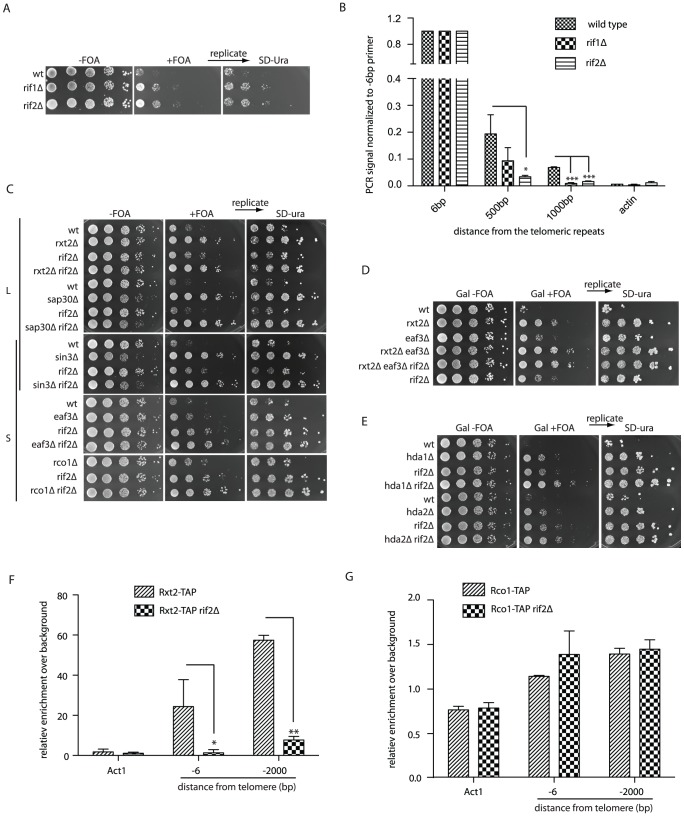
Using a genome-wide screening approach, we have established the genetic requirements for proper telomere structure in Saccharomyces cerevisiae. We uncovered 112 genes, many of which have not previously been implicated in telomere function, that are required to form a fold-back structure at chromosome ends. Among other biological processes, lysine deacetylation, through the Rpd3L, Rpd3S, and Hda1 complexes, emerged as being a critical regulator of telomere structure. The telomeric-bound protein, Rif2, was also found to promote a telomere fold-back through the recruitment of Rpd3L to telomeres. In the absence of Rpd3 function, telomeres have an increased susceptibility to nucleolytic degradation, telomere loss, and the initiation of premature senescence, suggesting that an Rpd3-mediated structure may have protective functions. Together these data reveal that multiple genetic pathways may directly or indirectly impinge on telomere structure, thus broadening the potential targets available to manipulate telomere function.
利用全基因组筛选方法,我们确定了酿酒酵母中端粒结构正常所需的遗传要求。我们发现了 112 个以前与端粒功能无关的基因,这些基因是在染色体末端形成回折结构所必需的。在其他生物过程中,赖氨酸去乙酰化通过 Rpd3L、Rpd3S 和 Hda1 复合物成为端粒结构的关键调节因子。还发现端粒结合蛋白 Rif2通过将 Rpd3L 募集到端粒上来促进端粒回折。在没有 Rpd3 功能的情况下,端粒更容易受到核酶降解、端粒丢失和过早衰老的影响,这表明 Rpd3 介导的结构可能具有保护功能。这些数据表明,多个遗传途径可能直接或间接地影响端粒结构,从而扩大了可用于操纵端粒功能的潜在靶点。