Institute for Cell and Molecular Biosciences, Newcastle University Medical School, Newcastle upon Tyne, United Kingdom.
PLoS Genet. 2011 Apr;7(4):e1001362. doi: 10.1371/journal.pgen.1001362. Epub 2011 Apr 7.
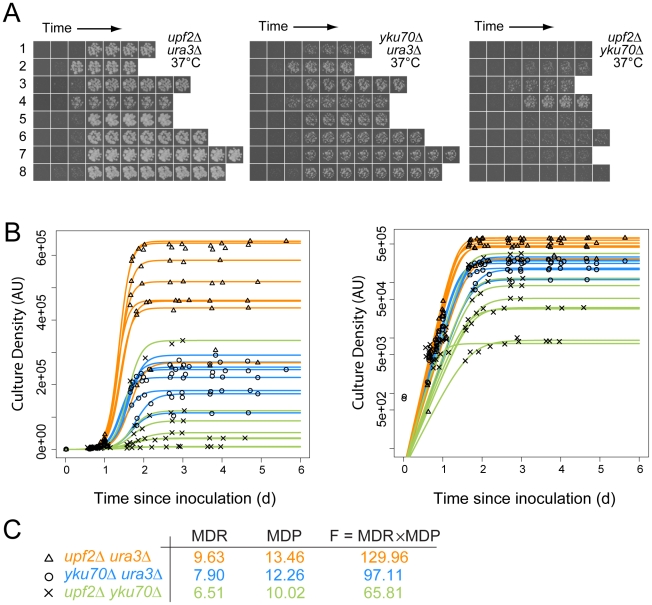
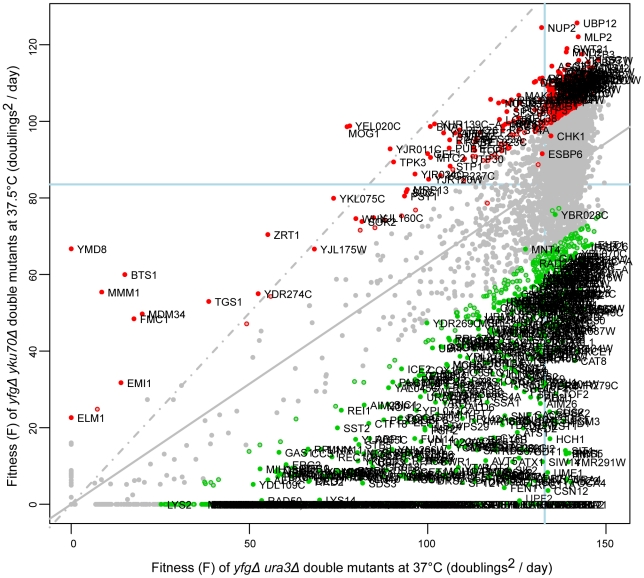
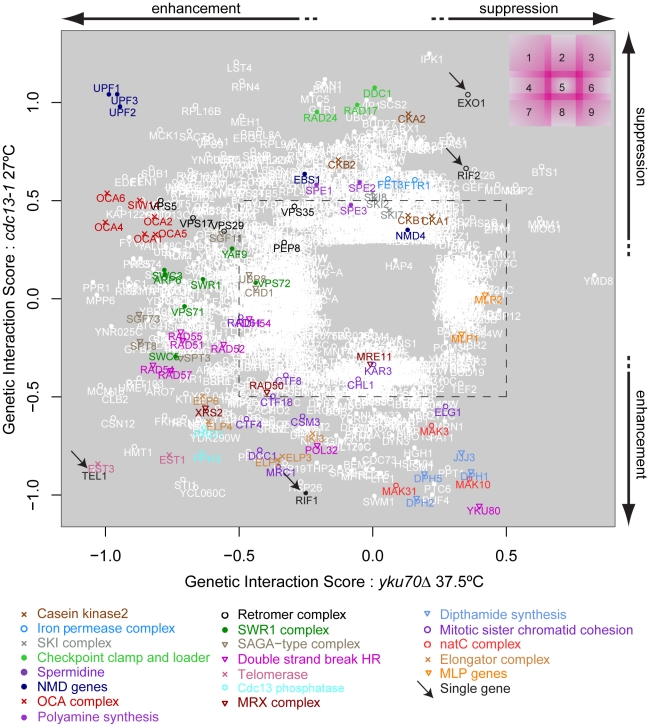
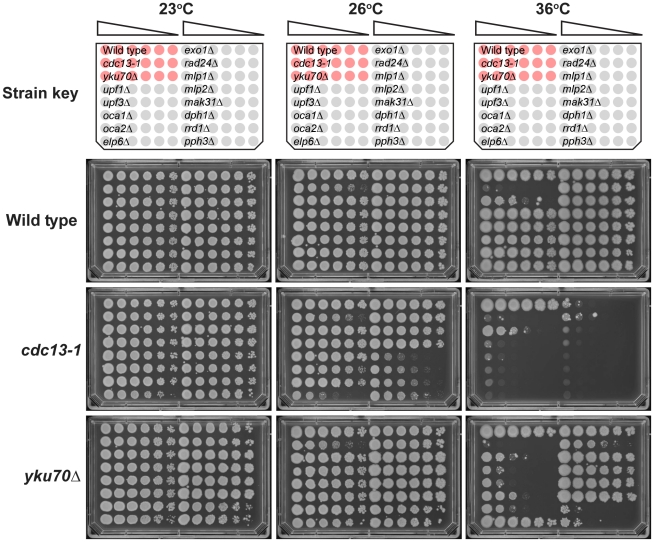
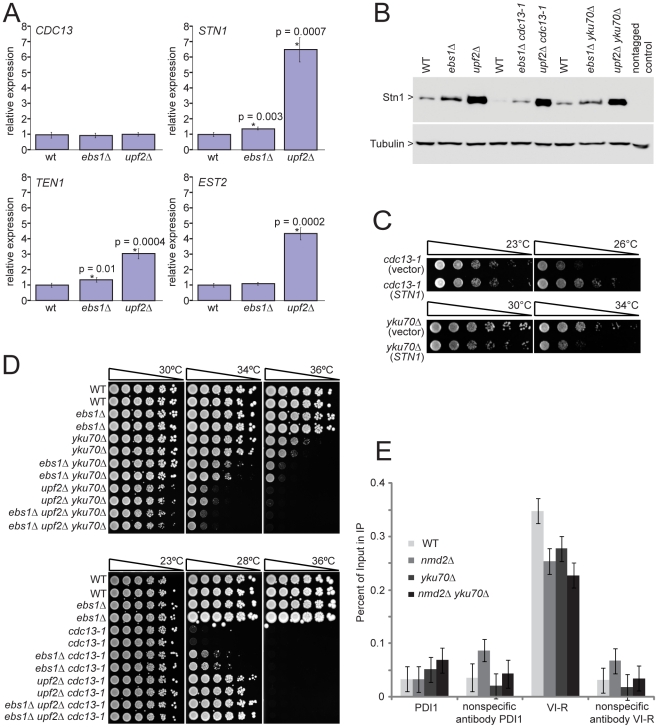
To better understand telomere biology in budding yeast, we have performed systematic suppressor/enhancer analyses on yeast strains containing a point mutation in the essential telomere capping gene CDC13 (cdc13-1) or containing a null mutation in the DNA damage response and telomere capping gene YKU70 (yku70Δ). We performed Quantitative Fitness Analysis (QFA) on thousands of yeast strains containing mutations affecting telomere-capping proteins in combination with a library of systematic gene deletion mutations. To perform QFA, we typically inoculate 384 separate cultures onto solid agar plates and monitor growth of each culture by photography over time. The data are fitted to a logistic population growth model; and growth parameters, such as maximum growth rate and maximum doubling potential, are deduced. QFA reveals that as many as 5% of systematic gene deletions, affecting numerous functional classes, strongly interact with telomere capping defects. We show that, while Cdc13 and Yku70 perform complementary roles in telomere capping, their genetic interaction profiles differ significantly. At least 19 different classes of functionally or physically related proteins can be identified as interacting with cdc13-1, yku70Δ, or both. Each specific genetic interaction informs the roles of individual gene products in telomere biology. One striking example is with genes of the nonsense-mediated RNA decay (NMD) pathway which, when disabled, suppress the conditional cdc13-1 mutation but enhance the null yku70Δ mutation. We show that the suppressing/enhancing role of the NMD pathway at uncapped telomeres is mediated through the levels of Stn1, an essential telomere capping protein, which interacts with Cdc13 and recruitment of telomerase to telomeres. We show that increased Stn1 levels affect growth of cells with telomere capping defects due to cdc13-1 and yku70Δ. QFA is a sensitive, high-throughput method that will also be useful to understand other aspects of microbial cell biology.
为了更好地了解芽殖酵母中的端粒生物学,我们对含有必需端粒封端基因 CDC13(cdc13-1)点突变的酵母菌株或含有 DNA 损伤反应和端粒封端基因 YKU70(yku70Δ)缺失突变的酵母菌株进行了系统的抑制子/增强子分析。我们在数千个含有影响端粒封端蛋白的突变的酵母菌株中进行了定量适应性分析(QFA),同时还进行了系统基因缺失突变的文库。为了进行 QFA,我们通常将 384 个单独的培养物接种到固体琼脂平板上,并通过随时间拍摄照片来监测每个培养物的生长情况。数据拟合到逻辑人口增长模型中;并推导出最大生长率和最大倍增潜力等生长参数。QFA 表明,多达 5%的系统基因缺失,影响众多功能类别,与端粒封端缺陷强烈相互作用。我们表明,虽然 Cdc13 和 Yku70 在端粒封端中发挥互补作用,但它们的遗传相互作用谱有很大的不同。至少可以确定 19 种不同功能或物理相关的蛋白质类作为与 cdc13-1、yku70Δ 或两者都相互作用的蛋白。每个特定的遗传相互作用都说明了单个基因产物在端粒生物学中的作用。一个引人注目的例子是与无意义介导的 RNA 降解(NMD)途径的基因,当该途径失活时,它会抑制条件性 cdc13-1 突变,但增强了无效的 yku70Δ 突变。我们表明,NMD 途径在无端粒的端粒上的抑制/增强作用是通过必需的端粒封端蛋白 Stn1 的水平介导的,Stn1 与 Cdc13 相互作用,并招募端粒酶到端粒。我们表明,Stn1 水平的增加会影响因 cdc13-1 和 yku70Δ 而导致端粒封端缺陷的细胞的生长。QFA 是一种敏感的高通量方法,也将有助于理解其他微生物细胞生物学方面。