Department of Biology, San Francisco State University, San Francisco, California, United States of America.
PLoS One. 2012;7(9):e44729. doi: 10.1371/journal.pone.0044729. Epub 2012 Sep 19.
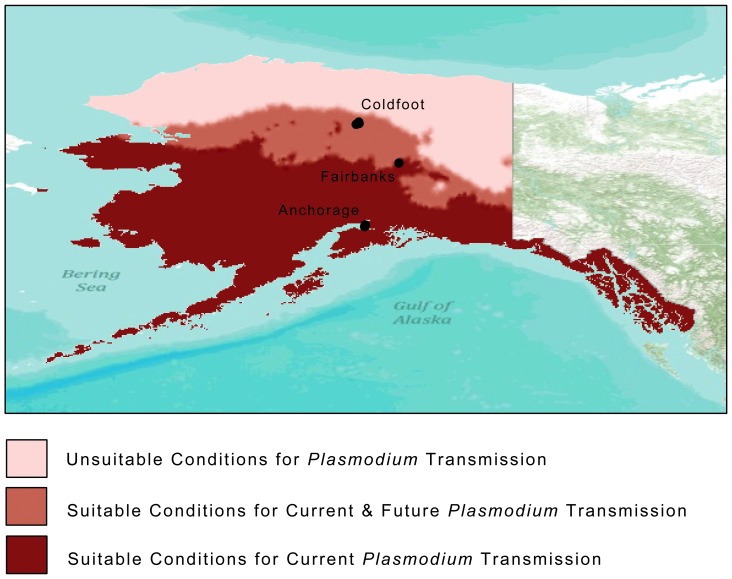
The unprecedented rate of change in the Arctic climate is expected to have major impacts on the emergence of infectious diseases and host susceptibility to these diseases. It is predicted that malaria parasites will spread to both higher altitudes and latitudes with global warming. Here we show for the first time that avian Plasmodium transmission occurs in the North American Arctic. Over a latitudinal gradient in Alaska, from 61°N to 67°N, we collected blood samples of resident and migratory bird species. We found both residents and hatch year birds infected with Plasmodium as far north as 64°N, providing clear evidence that malaria transmission occurs in these climates. Based on our empirical data, we make the first projections of the habitat suitability for Plasmodium under a future-warming scenario in Alaska. These findings raise new concerns about the spread of malaria to naïve host populations.
北极地区气候前所未有的变化速度预计将对传染病的出现和宿主对这些疾病的易感性产生重大影响。据预测,随着全球变暖,疟疾寄生虫将传播到更高的海拔和纬度。在这里,我们首次表明,鸟类疟原虫的传播发生在北美的北极地区。在阿拉斯加从北纬 61°到 67°的纬度梯度上,我们收集了留鸟和候鸟的血液样本。我们发现,在最北达北纬 64°的地方,既有居民也有幼鸟感染了疟原虫,这明确表明疟疾在这些气候条件下传播。基于我们的实证数据,我们首次对阿拉斯加未来变暖情景下疟原虫的栖息地适宜性进行了预测。这些发现引发了对疟疾向新宿主种群传播的新担忧。