Department of Thoracic Surgery, Changhai Hospital, The Second Military Medical University, Shanghai, China.
PLoS One. 2012;7(9):e44764. doi: 10.1371/journal.pone.0044764. Epub 2012 Sep 27.
The prognostic significance of survivin for survival of patients with esophageal squamous cell carcinoma (ESCC) remains controversial. Thus, meta-analysis of the literatures was performed in order to demonstrate its expression impact on ESCC clinicopathological features and prognosis.
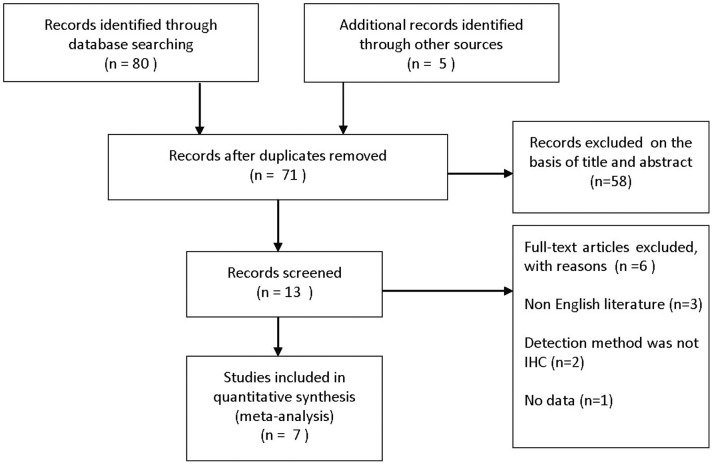
Relevant literatures were searched using PubMed, EMBASE and Medline Databases. Revman5.0 software was used to pool eligible studies and summary hazard ratio (HR). Correlation between survivin expression and clinicopathological features of ESCC was analyzed.
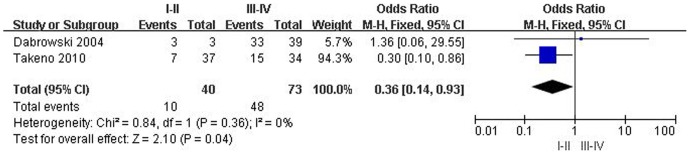
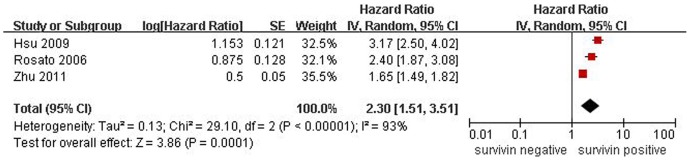
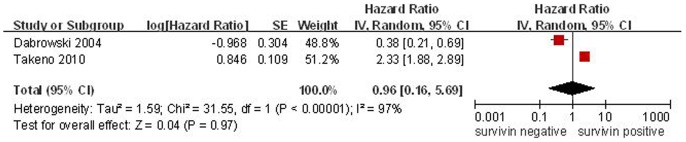
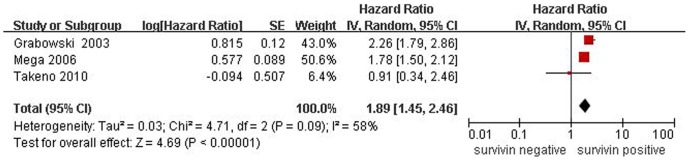
Final analysis of 523 patients from 7 eligible studies was performed. Combined HR of survivin location in nuclei suggested that survivin expression has an unfavorable impact on ESCC patients' survival (n = 277 in 3 studies; HR = 1.89, 95% CI: 1.45-2.96; Z = 4.69; P<0.0001). Nevertheless, combined HR of survivin location in cytoplasm displayed that survivin expression has no significance for prognosis of ESCC patients (n = 113 in 2 studies; HR = 0.96, 95% CI: 0.96-5.69; Z = 0.04; P = 0.97); Combined odds ratio (OR) of survivin location in cytoplasm indicated that survivin expression is associated with ESCC advanced stage (n = 113 in 2 studies; OR = 0.36, 95% CI: 0.14-0.93; Z = 2.10; P = 0.04). Whereas, combined OR of survivin location in nuclei exhibited that survivin over-expression has no correlation with cell differentiation grade, lymph node status, depth of invasion, stage, and metastasis of ESCC.
This study showed that survivin expression detected by immunohistochemistry seems to be associated with a worse prognosis of ESCC patients. Survivin subcellular location may be an important factor impacting on ESCC development. Larger prospective studies should be performed to evaluate the status of survivin in predicting prognosis of patients with ESCC.
生存素对食管鳞状细胞癌(ESCC)患者生存的预后意义仍存在争议。因此,进行了文献的荟萃分析,以证明其表达对 ESCC 临床病理特征和预后的影响。
使用 PubMed、EMBASE 和 Medline 数据库检索相关文献。使用 Revman5.0 软件汇总合格研究并总结风险比(HR)。分析生存素表达与 ESCC 临床病理特征的相关性。
对 7 项合格研究中的 523 名患者进行了最终分析。细胞核中生存素位置的联合 HR 表明,生存素表达对 ESCC 患者的生存有不利影响(3 项研究中 277 例;HR=1.89,95%CI:1.45-2.96;Z=4.69;P<0.0001)。然而,细胞质中生存素位置的联合 HR 显示,生存素表达对 ESCC 患者的预后无意义(2 项研究中 113 例;HR=0.96,95%CI:0.96-5.69;Z=0.04;P=0.97);细胞质中生存素位置的联合优势比(OR)表明,生存素表达与 ESCC 晚期相关(2 项研究中 113 例;OR=0.36,95%CI:0.14-0.93;Z=2.10;P=0.04)。然而,细胞核中生存素位置的联合 OR 显示,生存素过表达与 ESCC 的细胞分化程度、淋巴结状态、浸润深度、分期和转移无关。
本研究表明,免疫组织化学检测到的生存素表达似乎与 ESCC 患者的预后较差相关。生存素亚细胞定位可能是影响 ESCC 发生的重要因素。应进行更大规模的前瞻性研究,以评估生存素在预测 ESCC 患者预后中的地位。