University of Würzburg, Institute for Hygiene and Microbiology, Würzburg, Germany.
PLoS One. 2012;7(9):e45132. doi: 10.1371/journal.pone.0045132. Epub 2012 Sep 20.
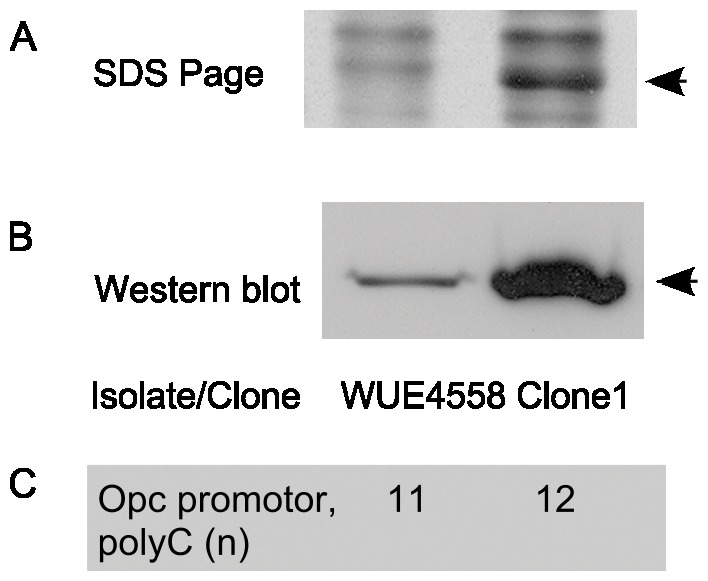
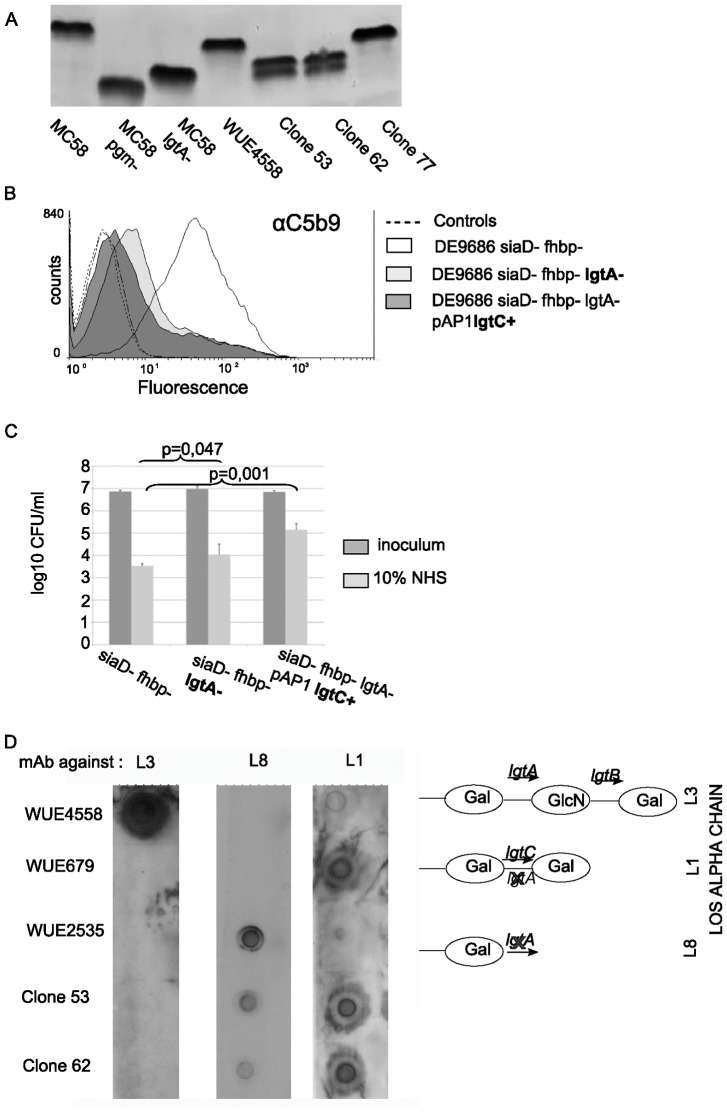
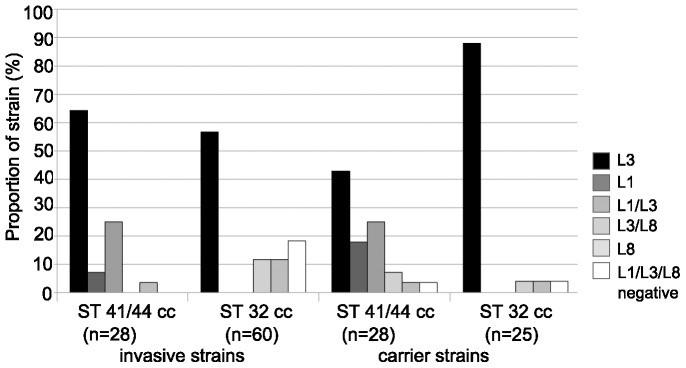
Neisseria meningitidis employs polysaccharides and outer membrane proteins to cope with human serum complement attack. To screen for factors influencing serum resistance, an assay was developed based on a colorimetric serum bactericidal assay. The screening used a genetically modified sequence type (ST)-41/44 clonal complex (cc) strain lacking LPS sialylation, polysaccharide capsule, the factor H binding protein (fHbp) and MutS, a protein of the DNA repair mechanism. After killing of >99.9% of the bacterial cells by serum treatment, the colorimetric assay was used to screen 1000 colonies, of which 35 showed enhanced serum resistance. Three mutant classes were identified. In the first class of mutants, enhanced expression of Opc was identified. Opc expression was associated with vitronectin binding and reduced membrane attack complex deposition confirming recent observations. Lipopolysaccharide (LPS) immunotype switch from immunotype L3 to L8/L1 by lgtA and lgtC phase variation represented the second class. Isogenic mutant analysis demonstrated that in ST-41/44 cc strains the L8/L1 immunotype was more serum resistant than the L3 immunotype. Consecutive analysis revealed that the immunotypes L8 and L1 were frequently observed in ST-41/44 cc isolates from both carriage and disease. Immunotype switch to L8/L1 is therefore suggested to contribute to the adaptive capacity of this meningococcal lineage. The third mutant class displayed a pilE allelic exchange associated with enhanced autoaggregation. The mutation of the C terminal hypervariable region D of PilE included a residue previously associated with increased pilus bundle formation. We suggest that autoaggregation reduced the surface area accessible to serum complement and protected from killing. The study highlights the ability of meningococci to adapt to environmental stress by phase variation and intrachromosomal recombination affecting subcapsular antigens.
脑膜炎奈瑟菌利用多糖和外膜蛋白来应对人体血清补体的攻击。为了筛选影响血清抗性的因素,开发了一种基于比色血清杀菌试验的检测方法。该筛选使用了一种遗传修饰的序列型 (ST)-41/44 克隆复合体 (cc) 菌株,该菌株缺乏 LPS 唾液酸化、多糖荚膜、因子 H 结合蛋白 (fHbp) 和 MutS,MutS 是一种 DNA 修复机制的蛋白质。在血清处理杀死>99.9%的细菌细胞后,使用比色法筛选了 1000 个菌落,其中 35 个表现出增强的血清抗性。鉴定出了 3 种突变类。在第一类突变体中,鉴定出 Opc 的表达增强。Opc 表达与 vitronectin 结合和减少膜攻击复合物沉积有关,这证实了最近的观察结果。脂多糖 (LPS) 通过 lgtA 和 lgtC 阶段变异从免疫型 L3 到 L8/L1 的免疫型转换代表了第二类。同基因突变分析表明,在 ST-41/44 cc 菌株中,L8/L1 免疫型比 L3 免疫型更具血清抗性。连续分析显示,L8 和 L1 免疫型在来自带菌和疾病的 ST-41/44 cc 分离株中经常观察到。因此,免疫型转换被认为有助于该脑膜炎奈瑟菌谱系的适应性。第三类突变体显示出与自动聚集增强相关的 pilE 等位基因交换。PilE 的 C 末端超变区 D 的突变包括一个以前与增加菌毛束形成相关的残基。我们认为,自动聚集减少了可用于血清补体的表面积,并受到保护而免受杀伤。该研究强调了脑膜炎奈瑟菌通过影响荚膜下抗原的相位变异和染色体内重组来适应环境压力的能力。