Division of Urology, Kaohsiung Chang Gung Memorial Hospital and Chang Gung University College of Medicine, Kaohsiung, Taiwan.
PLoS One. 2012;7(9):e45578. doi: 10.1371/journal.pone.0045578. Epub 2012 Sep 19.
To study the role of sensory dysfunction of bladder mucosa in bladder oversensitivity of rats with metabolic syndrome.
Female Wistar rats were fed a fructose-rich diet (60%) or a normal diet for 3 months. Based on cystometry, the fructose-fed rats (FFRs) were divided into a group with normal detrusor function or detrusor overactivity (DO). Acidic adenosine triphosphate (ATP) solution (5mM, pH 3.3) was used to elicit reflex micturition. Cystometric parameters were evaluated before and after drug administration. Functional proteins of the bladder mucosa were assessed by western blotting.
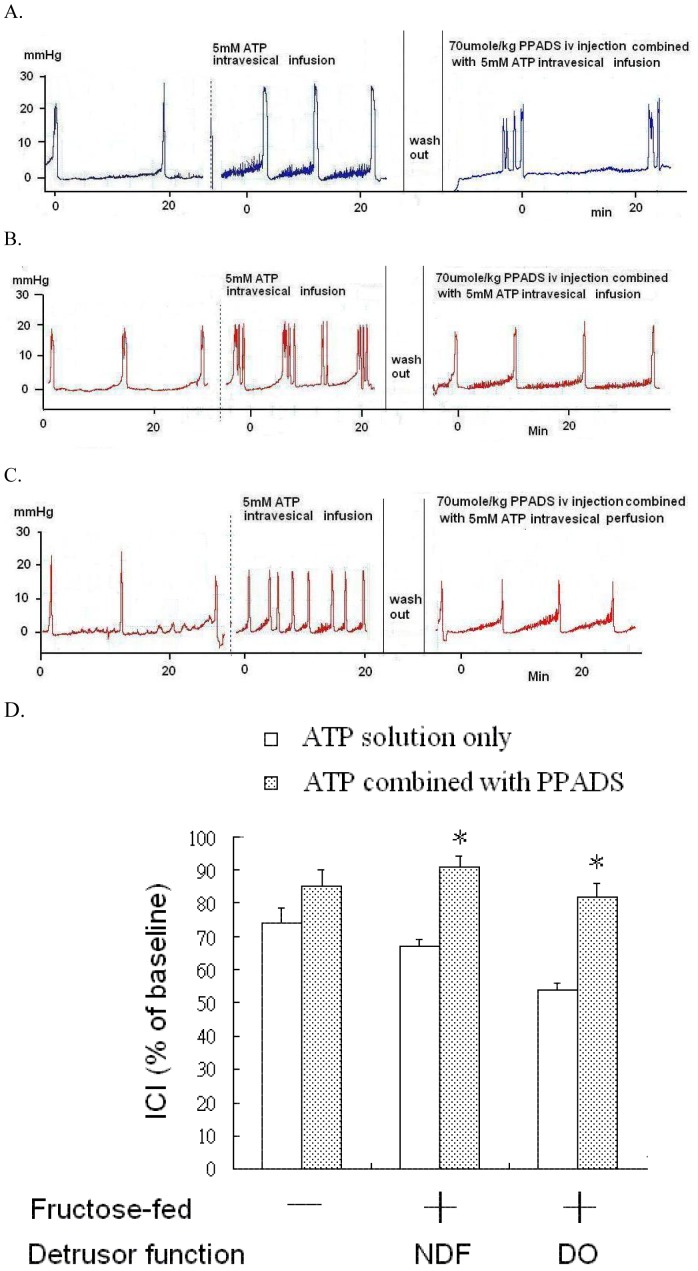
Compared to the controls, intravesical acidic ATP solution instillation induced a significant increase in provoked phasic contractions in both FFR groups and a significant decrease in the mean functional bladder capacity of group DO. Pretreatment with capsaicin for C-fiber desentization, intravesical liposome for mucosal protection, or intravenous pyridoxal 5-phosphate 6-azophenyl-2',4'-disulfonic acid for antagonized purinergic receptors can interfere with the urodynamic effects of intravesical ATP in FFRs and controls. Over-expression of TRPV1, P2X(3), and iNOS proteins, and down-regulation of eNOS proteins were observed in the bladder mucosa of both fructose-fed groups.
Alterations of sensory receptors and enzymes in the bladder mucosa, including over-expression of TRPV1, P2X(3), and iNOS proteins, can precipitate the emergence of bladder phasic contractions and oversensitivity through the activation of C-afferents during acidic ATP solution stimulation in FFRs. The down-regulation of eNOS protein in the bladder mucosa of FFRs may lead to a failure to suppress bladder oversensitivity and phasic contractions. Sensory dysfunction of bladder mucosa and DO causing by metabolic syndrome are easier to elicit bladder oversensitivity to certain urothelium stimuli.
研究代谢综合征大鼠膀胱黏膜感觉功能障碍在膀胱过度敏感中的作用。
雌性 Wistar 大鼠给予富含果糖的饮食(60%)或正常饮食 3 个月。根据膀胱测压,将果糖喂养的大鼠(FFR)分为逼尿肌功能正常或逼尿肌过度活动(DO)组。用酸性三磷酸腺苷(ATP)溶液(5mM,pH3.3)诱发反射性排尿。给药前后评估膀胱测压参数。采用 Western blot 法检测膀胱黏膜功能蛋白。
与对照组相比,膀胱内酸性 ATP 溶液灌注可引起两组 FFR 诱发的阵发性收缩明显增加,DO 组平均功能性膀胱容量明显降低。辣椒素预处理 C 纤维脱敏、膀胱内脂质体保护或静脉注射吡哆醛 5-磷酸 6-重氮苯-2',4'-二磺酸拮抗嘌呤能受体可干扰 FFR 和对照组膀胱内 ATP 的尿动力学作用。在两组果糖喂养大鼠的膀胱黏膜中观察到 TRPV1、P2X(3)和 iNOS 蛋白过表达,eNOS 蛋白下调。
膀胱黏膜感觉受体和酶的改变,包括 TRPV1、P2X(3)和 iNOS 蛋白过表达,可通过酸性 ATP 溶液刺激时 C 传入纤维的激活,引发膀胱阵发性收缩和过度敏感,在 FFR 中出现。FFR 膀胱黏膜中 eNOS 蛋白下调可能导致膀胱过度敏感和阵发性收缩抑制失败。代谢综合征引起的膀胱黏膜感觉功能障碍和 DO 更容易引起膀胱对某些尿路上皮刺激的过度敏感。