Department of Microbiology and Immunology, Western University, London, Ontario, Canada.
PLoS One. 2012;7(9):e45952. doi: 10.1371/journal.pone.0045952. Epub 2012 Sep 24.
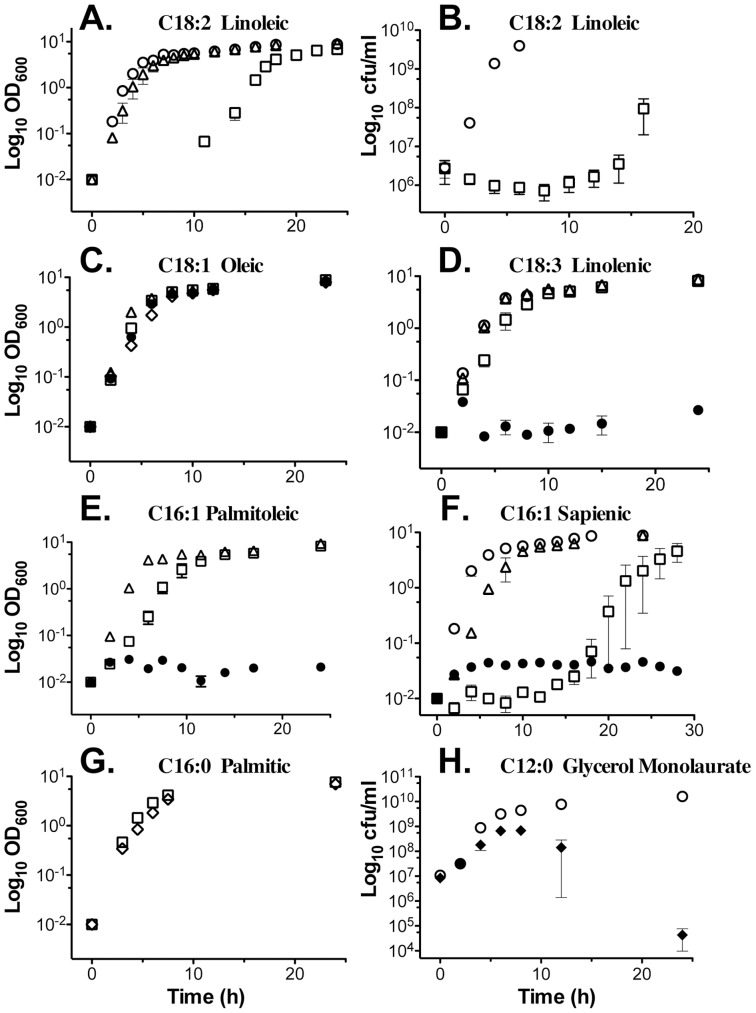
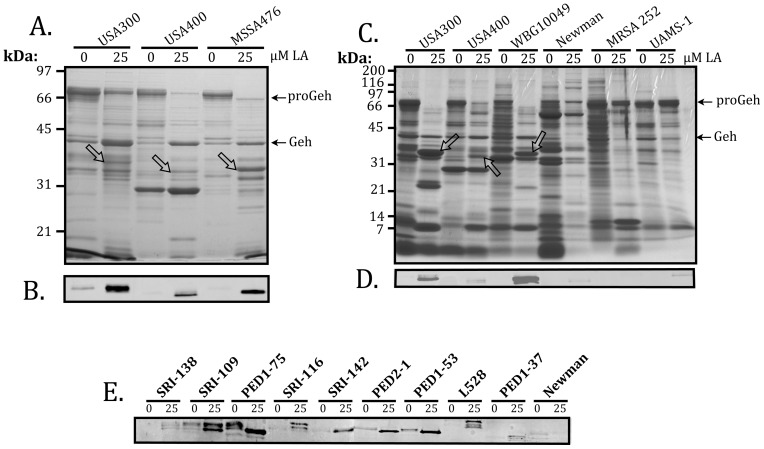
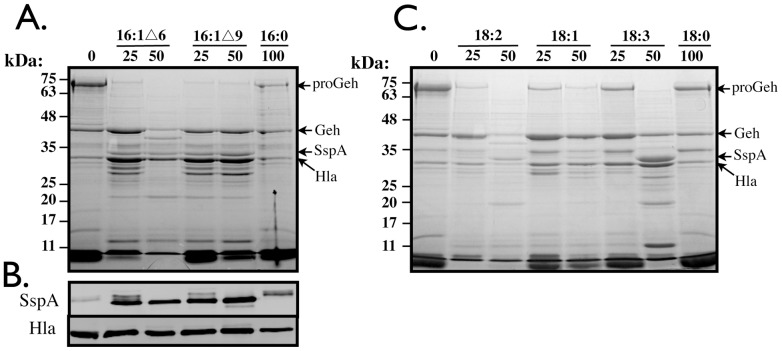
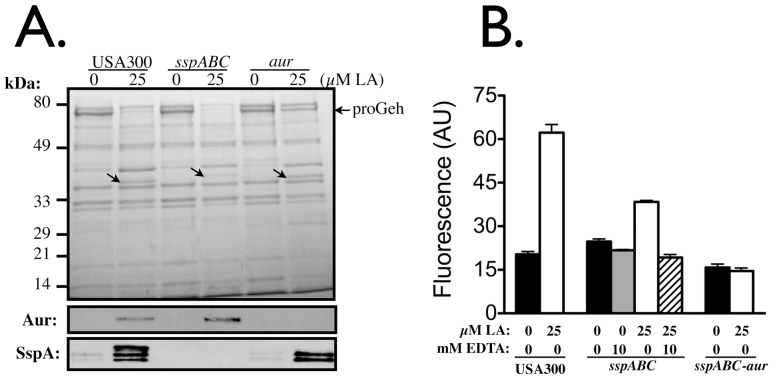
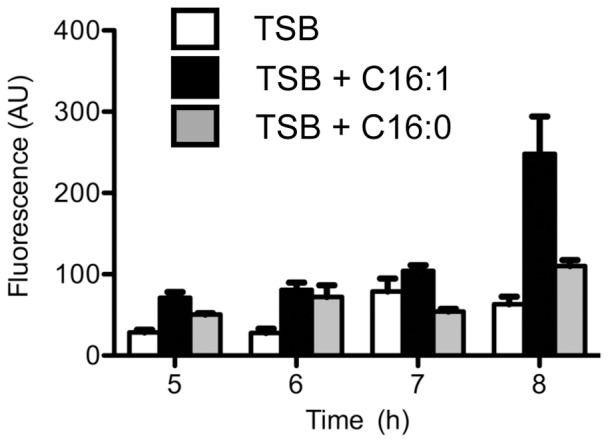
Community acquired methicillin resistant Staphylococcus aureus (CA-MRSA), and the USA300 strain of CA-MRSA in particular, are known for their rapid community transmission, and propensity to cause aggressive skin and soft tissue infections. To assess factors that contribute to these hallmark traits of CA-MRSA, we evaluated how growth of USA300 and production of secreted virulence factors was influenced on exposure to physiologic levels of unsaturated free fatty acids that would be encountered on the skin or anterior nares, which represent the first sites of contact with healthy human hosts. There was a sharp threshold between sub-inhibitory and inhibitory concentrations, such that 100 µM sapienic acid (C16∶1) and linoleic acid (C18∶1) were sufficient to prevent growth after 24 h incubation, while 25 µM allowed unrestricted growth, and 50 µM caused an approximate 10-12 h lag, followed by unimpeded exponential growth. Conversely, saturated palmitic or stearic acids did not affect growth at 100 µM. Although growth was not affected by 25 µM sapienic or linoleic acid, these and other unsaturated C16 and C18 fatty acids, but not their saturated counterparts, promoted robust production of secreted proteases comprising the Staphylococcal proteolytic cascade. This trait was also manifested to varying degrees in other CA-MRSA, and in genetically diverse methicillin susceptible S. aureus strains. Therefore, induction of the Staphylococcal proteolytic cascade by unsaturated fatty acids is another feature that should now be evaluated as a potential contributing factor in the aggressive nature of skin and soft tissue infections caused by USA300, and as a general virulence mechanism of S. aureus.
社区获得性耐甲氧西林金黄色葡萄球菌(CA-MRSA),特别是 USA300 型 CA-MRSA,以其快速的社区传播和引起侵袭性皮肤和软组织感染的倾向而闻名。为了评估导致 CA-MRSA 这些标志性特征的因素,我们评估了 USA300 的生长和分泌毒力因子的产生如何受到暴露于皮肤或前鼻腔中遇到的生理水平不饱和游离脂肪酸的影响,这些部位是与健康人体宿主首次接触的部位。在亚抑菌和抑菌浓度之间存在一个明显的阈值,即 100µM 萨比恩酸(C16∶1)和亚油酸(C18∶1)足以在 24 小时孵育后阻止生长,而 25µM 允许不受限制的生长,而 50µM 导致大约 10-12 小时的滞后,随后不受阻碍的指数生长。相反,100µM 的饱和棕榈酸或硬脂酸不会影响生长。虽然 25µM 的萨比恩酸或亚油酸不会影响生长,但这些和其他不饱和 C16 和 C18 脂肪酸,而不是它们的饱和对应物,促进了包括葡萄球菌蛋白水解级联在内的分泌蛋白酶的大量产生。这种特性在其他 CA-MRSA 和遗传上多样化的耐甲氧西林金黄色葡萄球菌菌株中也表现出不同程度的表现。因此,不饱和脂肪酸诱导葡萄球菌蛋白水解级联的产生是另一个特征,现在应该作为 USA300 引起的侵袭性皮肤和软组织感染的潜在致病因素以及金黄色葡萄球菌的一般毒力机制进行评估。