Department of Biomedical Engineering, University of Virginia, Charlottesville, Virginia, United States of America.
PLoS One. 2012;7(9):e46312. doi: 10.1371/journal.pone.0046312. Epub 2012 Sep 24.
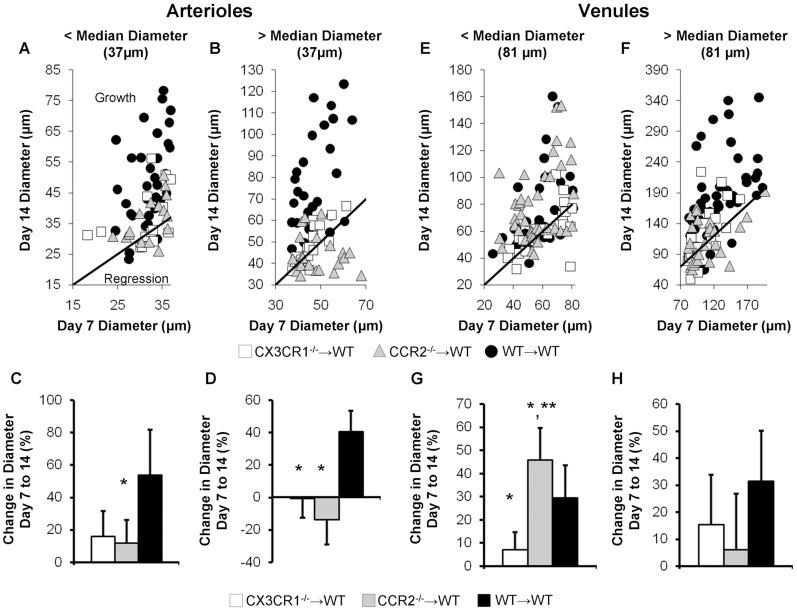
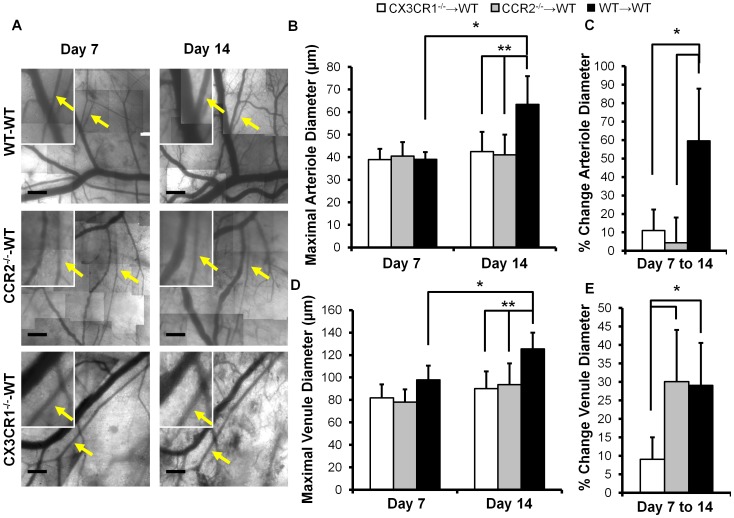
The chemokine receptors CCR2 and CX3CR1 are critical for the recruitment of "inflammatory" and "resident" monocytes, respectively, subpopulations that differentially affect vascular remodeling in atherosclerosis. Here, we tested the hypothesis that bone marrow-derived cell (BMC)-specific CCR2 and CX3CR1 differentially control venular and arteriolar remodeling. Venular and arteriolar lumenal remodeling were observed by intravital microscopy in mice with either CCR2 or CX3CR1 deficient BMCs after implantation of a dorsal skinfold window chamber, a model in which arterioles and venules lumenally enlarge in wild-type (WT) mice. Arteriolar remodeling was abolished in mice with either CCR2 or CX3CR1-deficient BMCs. In contrast, the loss of CX3CR1 from BMCs, but not CCR2, significantly reduced small venule remodeling compared to WT controls. We conclude that microvascular remodeling is differentially regulated by BMC-expressed chemokine receptors. Both CCR2 and CX3CR1 regulate arteriole growth; however, only BMC-expressed CX3CR1 impacts small venule growth. These findings may provide a basis for additional investigations aimed at determining how patterns of monocyte subpopulation recruitment spatially influence microvascular remodeling.
趋化因子受体 CCR2 和 CX3CR1 分别对“炎症”和“常驻”单核细胞的募集至关重要,这两种亚群分别影响动脉粥样硬化中的血管重塑。在这里,我们检验了这样一个假设,即骨髓来源的细胞(BMC)特异性 CCR2 和 CX3CR1 可差异化地控制小静脉和小动脉的重塑。在植入背部皮肤窗室后,通过活体显微镜观察到 CCR2 或 CX3CR1 缺乏 BMC 的小鼠中的小静脉和小动脉管腔重塑,在该模型中,小动脉和小静脉管腔在野生型(WT)小鼠中扩大。在 CCR2 或 CX3CR1 缺乏 BMC 的小鼠中,小动脉重塑被消除。相比之下,与 WT 对照组相比,BMC 中缺失 CX3CR1 而非 CCR2 显著降低了小静脉重塑。我们得出的结论是,微血管重塑受到 BMC 表达的趋化因子受体的差异化调节。CCR2 和 CX3CR1 均调节小动脉生长;然而,只有 BMC 表达的 CX3CR1 影响小静脉生长。这些发现可能为进一步研究旨在确定单核细胞亚群募集的模式如何在空间上影响微血管重塑提供了基础。