Emory University, 1518 Clifton Road, CNR 7035, Atlanta, GA 30322, USA.
Soc Sci Med. 2013 Oct;95:6-15. doi: 10.1016/j.socscimed.2012.09.011. Epub 2012 Sep 17.
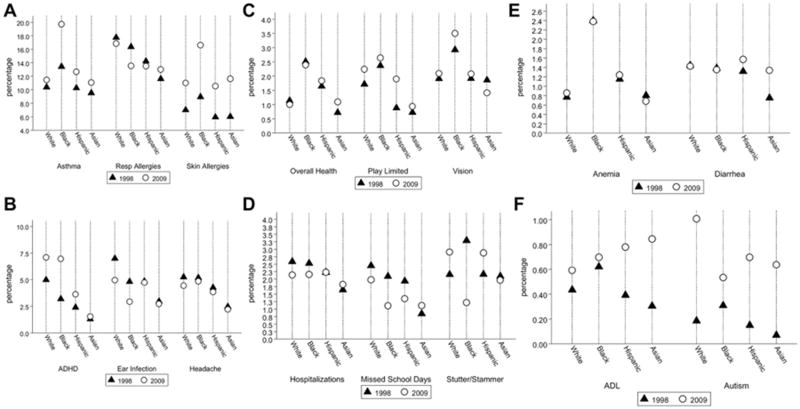
In the United States, race and ethnicity are considered key social determinants of health because of their enduring association with social and economic opportunities and resources. An important policy and research concern is whether the U.S. is making progress toward reducing racial/ethnic inequalities in health. While race/ethnic disparities in infant and adult outcomes are well documented, less is known about patterns and trends by race/ethnicity among children. Our objective was to determine the patterns of and progress toward reducing racial/ethnic disparities in child health. Using nationally representative data from 1998 to 2009, we assessed 17 indicators of child health, including overall health status, disability, measures of specific illnesses, and indicators of the social and economic consequences of illnesses. We examined disparities across five race/ethnic groups (non-Hispanic white, non-Hispanic black, Hispanic, non-Hispanic Asian, and non-Hispanic other). We found important racial/ethnic disparities across nearly all of the indicators of health we examined, adjusting for socioeconomic status, nativity, and access to health care. Importantly, we found little evidence that racial/ethnic disparities in child health have changed over time. In fact, for certain illnesses such as asthma, black-white disparities grew significantly larger over time. In general, black children had the highest reported prevalence across the health indicators and Asian children had the lowest reported prevalence. Hispanic children tended to be more similar to whites compared to the other race/ethnic groups, but there was considerable variability in their relative standing.
在美国,种族和民族被认为是健康的重要社会决定因素,因为它们与社会和经济机会和资源有着持久的联系。一个重要的政策和研究关注点是,美国是否在减少健康方面的种族/民族不平等方面取得了进展。虽然婴儿和成人结局的种族/民族差异已有充分记录,但对于儿童中种族/民族差异的模式和趋势知之甚少。我们的目标是确定减少儿童健康方面种族/民族差异的模式和进展。我们使用了 1998 年至 2009 年的全国代表性数据,评估了 17 项儿童健康指标,包括整体健康状况、残疾、特定疾病的衡量指标以及疾病社会经济后果的指标。我们研究了五个种族/民族群体(非西班牙裔白人、非西班牙裔黑人、西班牙裔、非西班牙裔亚洲人和非西班牙裔其他人)之间的差异。我们发现,在我们检查的几乎所有健康指标中,都存在重要的种族/民族差异,这些差异调整了社会经济地位、出生地和获得医疗保健的机会。重要的是,我们发现几乎没有证据表明儿童健康方面的种族/民族差异随着时间的推移而发生变化。事实上,对于某些疾病,如哮喘,黑人和白人之间的差距随着时间的推移显著扩大。一般来说,黑人儿童在所有健康指标中的报告患病率最高,而亚洲儿童的报告患病率最低。与其他种族/民族群体相比,西班牙裔儿童往往更接近白人,但他们的相对地位存在很大差异。