Department of Epidemiology, University of Washington, Box 357236, Seattle, WA 98195-7236, USA.
Prev Chronic Dis. 2012;9:E152. doi: 10.5888/pcd9.120001.
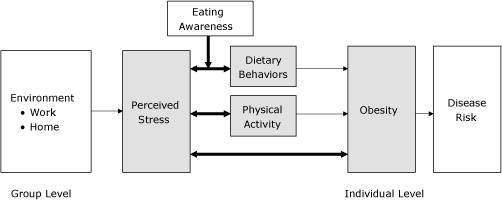
Stress in numerous contexts may affect the risk for obesity through biobehavioral processes. Acute stress has been associated with diet and physical activity in some studies; the relationship between everyday stress and such behavior is not clear. The objective of this study was to examine associations between perceived stress, dietary behavior, physical activity, eating awareness, self-efficacy, and body mass index (BMI) among healthy working adults. Secondary objectives were to explore whether eating awareness modified the relationship between perceived stress and dietary behavior and perceived stress and BMI.
Promoting Activity and Changes in Eating (PACE) was a group-randomized worksite intervention to prevent weight gain in the Seattle metropolitan area from 2005 through 2007. A subset of 621 participants at 33 worksites provided complete information on perceived stress at baseline. Linear mixed models evaluated cross-sectional associations.
The mean (standard deviation [SD]) Perceived Stress Scale-10 score among all participants was 12.7 (6.4), and the mean (SD) BMI was 29.2 kg/m2 (6.3 kg/m2). Higher levels of perceived stress were associated with lower levels of eating awareness, physical activity, and walking. Among participants who had low levels of eating awareness, higher levels of perceived stress were associated with fewer servings of fruit and vegetables and greater consumption of fast food meals.
Dietary and physical activity behaviors of workers may be associated with average levels of perceived stress. Longitudinal studies are needed, however, to support inclusion of stress management or mindfulness techniques in workplace obesity prevention efforts.
在许多情况下,压力可能通过生物行为过程影响肥胖的风险。一些研究表明,急性压力与饮食和体力活动有关;而日常压力与这些行为之间的关系尚不清楚。本研究旨在探讨健康工作成年人感知压力、饮食行为、体力活动、饮食意识、自我效能感和体重指数(BMI)之间的关系。次要目的是探讨饮食意识是否改变了感知压力与饮食行为和感知压力与 BMI 之间的关系。
促进活动和饮食变化(PACE)是 2005 年至 2007 年在西雅图大都市区进行的一项针对工作场所的预防体重增加的群组随机干预措施。在 33 个工作场所中的 621 名参与者提供了基线时感知压力的完整信息。线性混合模型评估了横断面相关性。
所有参与者的感知压力量表-10 平均(标准偏差[SD])得分为 12.7(6.4),平均(SD)BMI 为 29.2kg/m2(6.3kg/m2)。感知压力水平较高与饮食意识、体力活动和步行水平较低有关。在饮食意识水平较低的参与者中,感知压力水平较高与水果和蔬菜的摄入量减少以及快餐用餐量增加有关。
工人的饮食和体力活动行为可能与平均感知压力水平有关。然而,需要进行纵向研究,以支持将压力管理或正念技术纳入工作场所肥胖预防工作中。