Department of Genomic Mathematics, University of Bonn, 53127, Germany.
Bioinformatics. 2012 Dec 1;28(23):3027-33. doi: 10.1093/bioinformatics/bts568. Epub 2012 Oct 8.
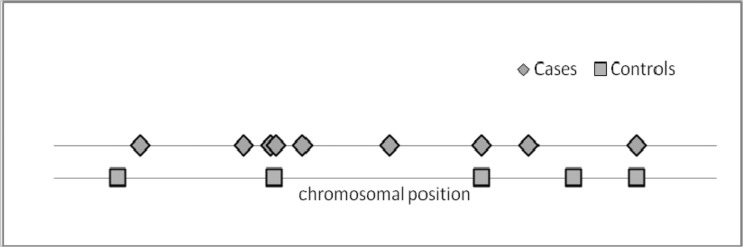
For the analysis of rare variants in sequence data, numerous approaches have been suggested. Fixed and flexible threshold approaches collapse the rare variant information of a genomic region into a test statistic with reduced dimensionality. Alternatively, the rare variant information can be combined in statistical frameworks that are based on suitable regression models, machine learning, etc. Although the existing approaches provide powerful tests that can incorporate information on allele frequencies and prior biological knowledge, differences in the spatial clustering of rare variants between cases and controls cannot be incorporated. Based on the assumption that deleterious variants and protective variants cluster or occur in different parts of the genomic region of interest, we propose a testing strategy for rare variants that builds on spatial cluster methodology and that guides the identification of the biological relevant segments of the region. Our approach does not require any assumption about the directions of the genetic effects.
In simulation studies, we assess the power of the clustering approach and compare it with existing methodology. Our simulation results suggest that the clustering approach for rare variants is well powered, even in situations that are ideal for standard methods. The efficiency of our spatial clustering approach is not affected by the presence of rare variants that have opposite effect size directions. An application to a sequencing study for non-syndromic cleft lip with or without cleft palate (NSCL/P) demonstrates its practical relevance. The proposed testing strategy is applied to a genomic region on chromosome 15q13.3 that was implicated in NSCL/P etiology in a previous genome-wide association study, and its results are compared with standard approaches.
Source code and documentation for the implementation in R will be provided online. Currently, the R-implementation only supports genotype data. We currently are working on an extension for VCF files.
为了分析序列数据中的稀有变异,已经提出了许多方法。固定和灵活的阈值方法将基因组区域的稀有变异信息折叠为具有降维的检验统计量。或者,可以将稀有变异信息组合到基于合适回归模型、机器学习等的统计框架中。尽管现有的方法提供了强大的测试,可以整合等位基因频率和先前的生物学知识信息,但病例和对照之间稀有变异的空间聚类差异无法整合。基于有害变异和保护变异在感兴趣的基因组区域中聚类或发生在不同部分的假设,我们提出了一种基于空间聚类方法的稀有变异测试策略,该策略指导识别该区域的生物学相关片段。我们的方法不需要对遗传效应的方向做出任何假设。
在模拟研究中,我们评估了聚类方法的功效,并将其与现有方法进行了比较。我们的模拟结果表明,即使在标准方法理想的情况下,稀有变异的聚类方法也具有很好的功效。我们的空间聚类方法的效率不受具有相反效应大小方向的稀有变异的存在的影响。对非综合征性唇裂伴或不伴腭裂(NSCL/P)的测序研究的应用证明了其实际意义。所提出的测试策略应用于先前全基因组关联研究中暗示与 NSCL/P 病因学相关的 15q13.3 染色体上的基因组区域,并将其结果与标准方法进行了比较。
将在网上提供 R 中实现的源代码和文档。目前,R 实现仅支持基因型数据。我们目前正在扩展 VCF 文件。