Université Bordeaux Segalen, F-33000 Bordeaux, France.
BMJ. 2012 Sep 27;345:e6231. doi: 10.1136/bmj.e6231.
To evaluate the association between use of benzodiazepines and incident dementia.
Prospective, population based study.
PAQUID study, France.
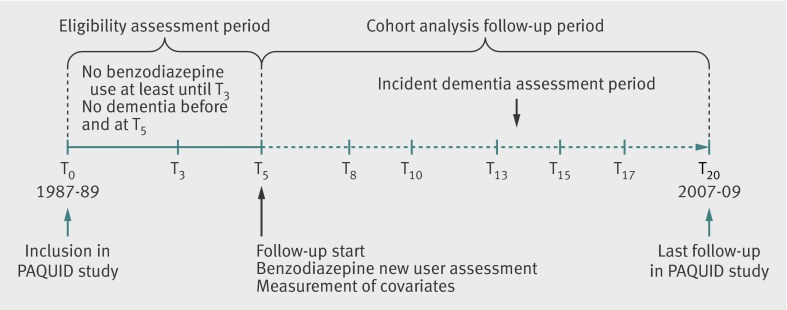
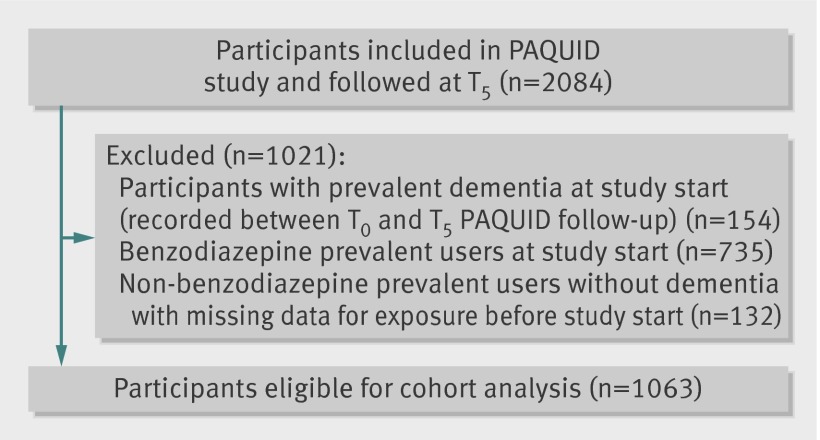
1063 men and women (mean age 78.2 years) who were free of dementia and did not start taking benzodiazepines until at least the third year of follow-up.
Incident dementia, confirmed by a neurologist.
During a 15 year follow-up, 253 incident cases of dementia were confirmed. New use of benzodiazepines was associated with an increased risk of dementia (multivariable adjusted hazard ratio 1.60, 95% confidence interval 1.08 to 2.38). Sensitivity analysis considering the existence of depressive symptoms showed a similar association (hazard ratio 1.62, 1.08 to 2.43). A secondary analysis pooled cohorts of participants who started benzodiazepines during follow-up and evaluated the association with incident dementia. The pooled hazard ratio across the five cohorts of new benzodiazepine users was 1.46 (1.10 to 1.94). Results of a complementary nested case-control study showed that ever use of benzodiazepines was associated with an approximately 50% increase in the risk of dementia (adjusted odds ratio 1.55, 1.24 to 1.95) compared with never users. The results were similar in past users (odds ratio 1.56, 1.23 to 1.98) and recent users (1.48, 0.83 to 2.63) but reached significance only for past users.
In this prospective population based study, new use of benzodiazepines was associated with increased risk of dementia. The result was robust in pooled analyses across cohorts of new users of benzodiazepines throughout the study and in a complementary case-control study. Considering the extent to which benzodiazepines are prescribed and the number of potential adverse effects of this drug class in the general population, indiscriminate widespread use should be cautioned against.
评估使用苯二氮䓬类药物与痴呆发病的相关性。
前瞻性、基于人群的研究。
法国 PAQUID 研究。
1063 名男性和女性(平均年龄 78.2 岁),在随访至少第 3 年之前,他们没有痴呆且没有开始服用苯二氮䓬类药物。
痴呆的发病情况,通过神经科医生确认。
在 15 年的随访期间,共确诊 253 例痴呆病例。新使用苯二氮䓬类药物与痴呆风险增加相关(多变量校正后危险比 1.60,95%置信区间 1.08 至 2.38)。考虑到抑郁症状的存在,进行敏感性分析后也得到了相似的关联(危险比 1.62,1.08 至 2.43)。一项二次分析汇集了在随访期间开始使用苯二氮䓬类药物的参与者队列,并评估了与痴呆发病的相关性。在五个新使用苯二氮䓬类药物的队列中,合并的危险比为 1.46(1.10 至 1.94)。一项补充的嵌套病例对照研究的结果表明,与从不使用者相比,苯二氮䓬类药物的使用与痴呆风险增加约 50%相关(调整后的比值比 1.55,1.24 至 1.95)。过去使用者(比值比 1.56,1.23 至 1.98)和最近使用者(1.48,0.83 至 2.63)的结果相似,但仅在过去使用者中具有统计学意义。
在这项前瞻性、基于人群的研究中,新使用苯二氮䓬类药物与痴呆风险增加相关。在整个研究过程中,在新使用苯二氮䓬类药物的队列的汇总分析中以及在补充的病例对照研究中,结果均稳健。考虑到苯二氮䓬类药物的使用程度以及该药物类别在普通人群中的潜在不良影响的数量,应谨慎避免不加区分的广泛使用。