Institute of Crop Science and Resource Conservation - Soil Science and Soil Ecology, University of Bonn, Bonn, Germany.
PLoS One. 2012;7(9):e45397. doi: 10.1371/journal.pone.0045397. Epub 2012 Sep 25.
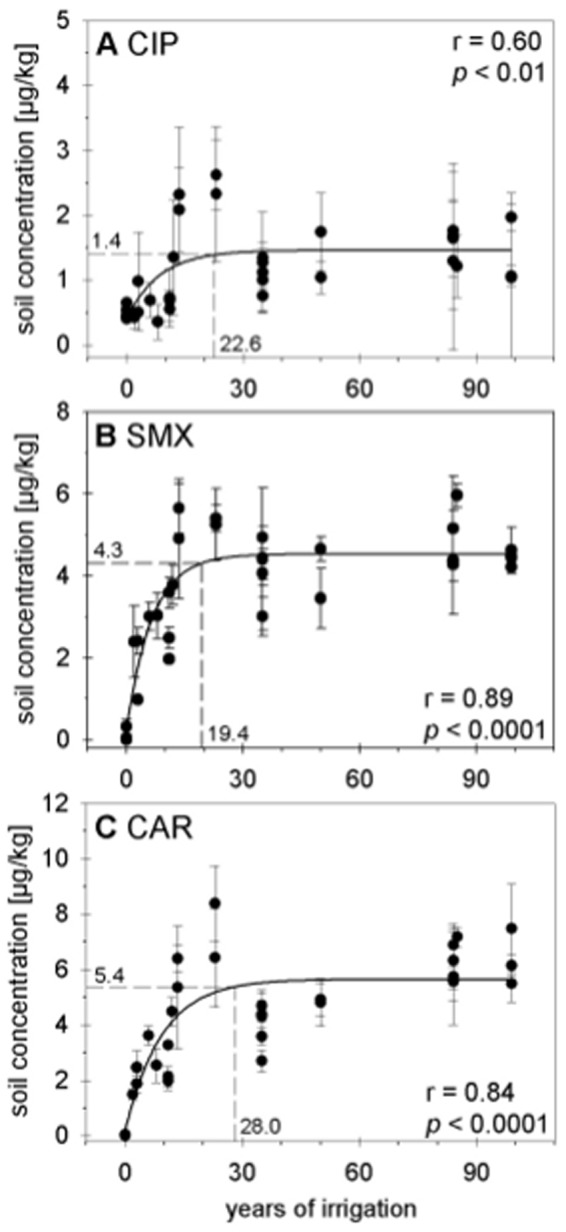
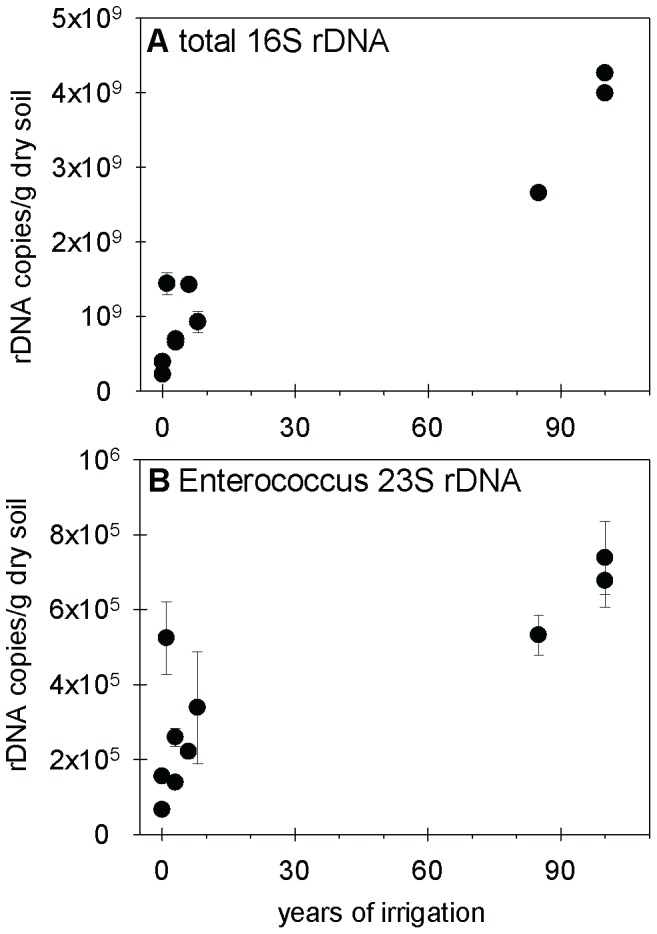
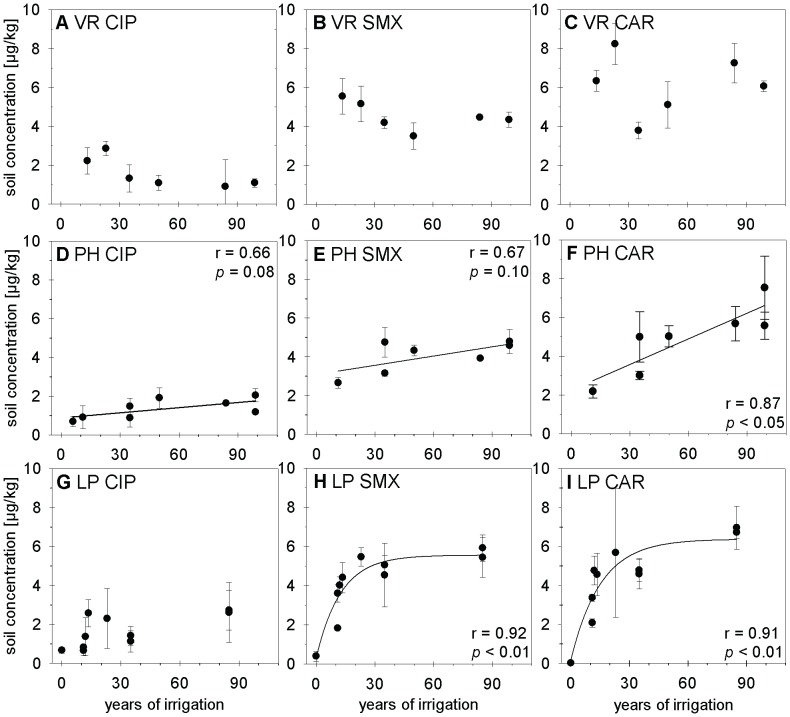
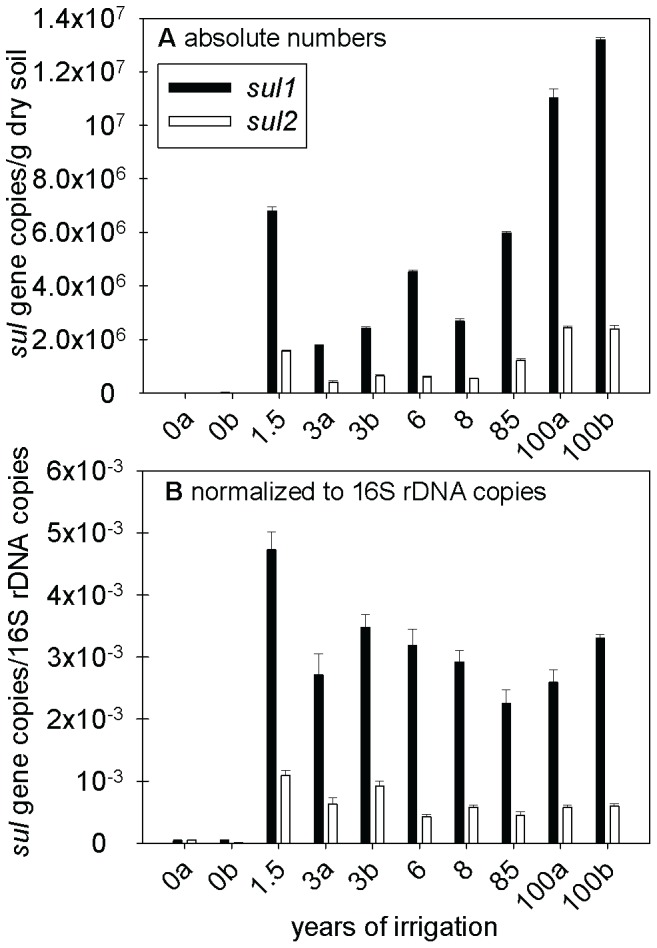
Irrigation with wastewater releases pharmaceuticals, pathogenic bacteria, and resistance genes, but little is known about the accumulation of these contaminants in the environment when wastewater is applied for decades. We sampled a chronosequence of soils that were variously irrigated with wastewater from zero up to 100 years in the Mezquital Valley, Mexico, and investigated the accumulation of ciprofloxacin, enrofloxacin, sulfamethoxazole, trimethoprim, clarithromycin, carbamazepine, bezafibrate, naproxen, diclofenac, as well as the occurrence of Enterococcus spp., and sul and qnr resistance genes. Total concentrations of ciprofloxacin, sulfamethoxazole, and carbamazepine increased with irrigation duration reaching 95% of their upper limit of 1.4 µg/kg (ciprofloxacin), 4.3 µg/kg (sulfamethoxazole), and 5.4 µg/kg (carbamazepine) in soils irrigated for 19-28 years. Accumulation was soil-type-specific, with largest accumulation rates in Leptosols and no time-trend in Vertisols. Acidic pharmaceuticals (diclofenac, naproxen, bezafibrate) were not retained and thus did not accumulate in soils. We did not detect qnrA genes, but qnrS and qnrB genes were found in two of the irrigated soils. Relative concentrations of sul1 genes in irrigated soils were two orders of magnitude larger (3.15 × 10(-3) ± 0.22 × 10(-3) copies/16S rDNA) than in non-irrigated soils (4.35 × 10(-5)± 1.00 × 10(-5) copies/16S rDNA), while those of sul2 exceeded the ones in non-irrigated soils still by a factor of 22 (6.61 × 10(-4) ± 0.59 × 10(-4) versus 2.99 × 10(-5) ± 0.26 × 10(-5) copies/16S rDNA). Absolute numbers of sul genes continued to increase with prolonging irrigation together with Enterococcus spp. 23S rDNA and total 16S rDNA contents. Increasing total concentrations of antibiotics in soil are not accompanied by increasing relative abundances of resistance genes. Nevertheless, wastewater irrigation enlarges the absolute concentration of resistance genes in soils due to a long-term increase in total microbial biomass.
污水灌溉会释放出药物、病原菌和耐药基因,但对于污水灌溉数十年来这些污染物在环境中的积累情况知之甚少。我们在墨西哥梅斯基特山谷采集了一系列不同年限的土壤样本,这些土壤的灌溉年限从 0 年到 100 年不等,研究了环丙沙星、恩诺沙星、磺胺甲恶唑、甲氧苄啶、克拉霉素、卡马西平、苯扎贝特、萘普生、双氯芬酸以及肠球菌属、sul 和 qnr 耐药基因的积累情况。在灌溉年限为 19-28 年的土壤中,环丙沙星、磺胺甲恶唑和卡马西平的总浓度随着灌溉时间的增加而增加,分别达到其上限值的 95%(环丙沙星)、4.3μg/kg(磺胺甲恶唑)和 5.4μg/kg(卡马西平)。积累具有土壤类型特异性,在 Leptosols 中积累速度最大,而在 Vertisols 中则没有时间趋势。酸性药物(双氯芬酸、萘普生、苯扎贝特)未被保留,因此不会在土壤中积累。我们没有检测到 qnrA 基因,但在两个灌溉土壤中发现了 qnrS 和 qnrB 基因。与非灌溉土壤相比,sul1 基因在灌溉土壤中的相对浓度高两个数量级(3.15×10(-3)±0.22×10(-3) 拷贝/16S rDNA),而 sul2 基因的相对浓度仍高 22 倍(6.61×10(-4)±0.59×10(-4) 拷贝/16S rDNA)。sul 基因的绝对数量随着灌溉时间的延长以及肠球菌属 23S rDNA 和总 16S rDNA 含量的增加而继续增加。土壤中抗生素总浓度的增加并没有伴随着耐药基因相对丰度的增加。然而,由于总微生物生物量的长期增加,污水灌溉会使土壤中耐药基因的绝对浓度增大。