Institut de Veille Sanitaire, Département des maladies infectieuses, St Maurice, France.
BMC Infect Dis. 2012 Oct 10;12:251. doi: 10.1186/1471-2334-12-251.
Nearly all HIV infections in children worldwide are acquired through mother-to-child transmission (MTCT) during pregnancy, labour, delivery or breastfeeding. The objective of our study was to estimate the number and rate of new HIV diagnoses in children less than 13 years of age in mainland France from 2003-2006.
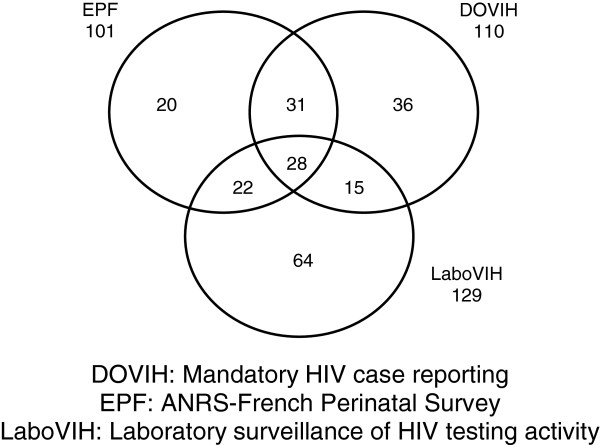
We performed a capture-recapture analysis based on three sources of information: the mandatory HIV case reporting (DOVIH), the French Perinatal Cohort (ANRS-EPF) and a laboratory-based surveillance of HIV (LaboVIH). The missing values of a variable of heterogeneous catchability were estimated through multiple imputation. Log-linear modelling provided estimates of the number of new HIV infections in children, taking into account dependencies between sources and variables of heterogeneous catchability.
The three sources observed 216 new HIV diagnoses after record-linkage. The number of new HIV diagnoses in children was estimated at 387 (95%CI [271-503]) from 2003-2006, among whom 60% were born abroad. The estimated rate of new HIV diagnoses in children in mainland France was 9.1 per million in 2006 and was 38 times higher in children born abroad than in those born in France. The estimated completeness of the three sources combined was 55.8% (95% CI [42.9 - 79.7]) and varied according to the source; the completeness of DOVIH (28.4%) and ANRS-EPF (26.1%) were lower than that of LaboVIH (33.3%).
Our study provided, for the first time, an estimated annual rate of new HIV diagnoses in children under 13 years old in mainland France. A more systematic HIV screening of pregnant women that is repeated during pregnancy among women likely to engage in risky behaviour is needed to optimise the prevention of MTCT. HIV screening for children who migrate from countries with high HIV prevalence to France could be recommended to facilitate early diagnosis and treatment.
全世界几乎所有儿童的 HIV 感染都是在妊娠、分娩、生产或母乳喂养期间通过母婴传播(MTCT)获得的。我们的研究目的是估计 2003-2006 年法国本土 13 岁以下儿童新的 HIV 诊断数量和速度。
我们基于三个信息来源进行了捕获-再捕获分析:强制性 HIV 病例报告(DOVIH)、法国围产期队列(ANRS-EPF)和基于实验室的 HIV 监测(LaboVIH)。通过多次插补估计了异质捕获变量的缺失值。对数线性模型考虑了来源和异质捕获变量之间的依赖性,从而提供了儿童新 HIV 感染数量的估计值。
三个来源在记录链接后观察到 216 例新的 HIV 诊断。估计 2003-2006 年期间,儿童新 HIV 感染数量为 387 例(95%CI[271-503]),其中 60%为国外出生。法国本土儿童新 HIV 诊断率估计为 2006 年每百万 9.1 例,国外出生儿童比法国出生儿童高 38 倍。三个来源联合的估计完整性为 55.8%(95%CI[42.9-79.7]),且因来源而异;DOVIH(28.4%)和 ANRS-EPF(26.1%)的完整性低于 LaboVIH(33.3%)。
我们的研究首次提供了法国本土 13 岁以下儿童新的 HIV 诊断年发生率的估计值。需要对可能从事高危行为的孕妇进行更系统的 HIV 筛查,并在妊娠期间反复筛查,以优化 MTCT 的预防。可以建议对从 HIV 高发国家移民到法国的儿童进行 HIV 筛查,以促进早期诊断和治疗。