Vijayaraghavan Pavithra M, Chandy Sara, Selvaraj Kavitha, Pulimood Susanne, Abraham Asha M
Department of Clinical Virology, Christian Medical College, Dr. Ida Scudder Road, Vellore, Tamil Nadu, India.
J Glob Infect Dis. 2012 Jul;4(3):153-61. doi: 10.4103/0974-777X.100572.
Hand, foot, and mouth disease (HFMD) remains a common problem in India, yet its etiology is largely unknown as diagnosis is based on clinical characteristics. There are very few laboratory-based molecular studies on HFMD outbreaks.
The aim of this study was to characterize HFMD-related isolates by molecular techniques.
Between 2005 and 2008, during two documented HFMD outbreaks, 30 suspected HFMD cases presented at the Outpatient Unit of the Department of Dermatology, Christian Medical College (CMC), Vellore. Seventy-eight clinical specimens (swabs from throat, mouth, rectum, anus, buttocks, tongue, forearm, sole, and foot) were received from these patients at the Department of Clinical Virology, CMC, for routine diagnosis of hand, foot, and mouth disease.
Samples from these patients were cultured in Vero and rhabdomyosarcoma (RD) cell lines. Isolates producing enterovirus-like cytopathogenic effect (CPE) in cell culture were identified by a nested reverse transcription-based polymerase chain reaction (RT-PCR) and sequenced. The nucleotide sequences were analyzed using the BioEdit sequence program. Homology searches were performed using the Basic Local Alignment Search Tool (BLAST) algorithm.
The statistical analysis was performed using Epi Info version 6.04b and Microsoft Excel 2002 (Microsoft Office XP).
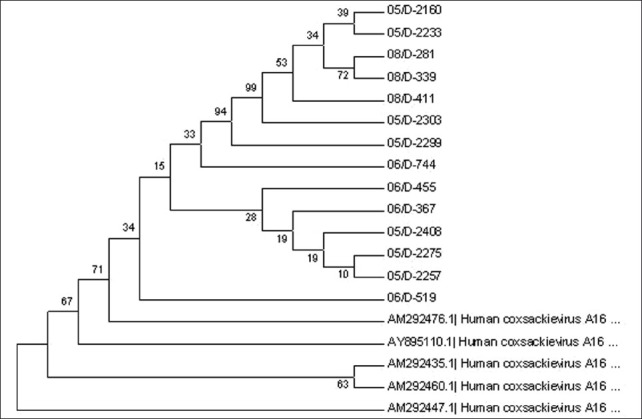
Of the 30 suspected HFMD cases, only 17 (57%) were laboratory confirmed and Coxsackievirus A16 (CVA16) was identified as the etiological agent in all these cases.
Coxsackievirus A16 (CVA16) was identified as the virus that caused the HFMD outbreaks in Vellore between 2005 and 2008. Early confirmation of HFMD helps to initiate control measures to interrupt virus transmission. In the laboratory, classical diagnostic methods, culture and serological tests are being replaced by molecular techniques. Routine surveillance systems will help understand the epidemiology of HFMD in India.
手足口病(HFMD)在印度仍然是一个常见问题,然而由于诊断基于临床特征,其病因在很大程度上尚不清楚。关于手足口病暴发的基于实验室的分子研究非常少。
本研究的目的是通过分子技术对手足口病相关分离株进行特征分析。
在2005年至2008年期间,在两次有记录的手足口病暴发期间,30例疑似手足口病病例出现在维洛尔基督教医学院(CMC)皮肤科门诊。在CMC临床病毒学系从这些患者处接收了78份临床标本(来自咽喉、口腔、直肠、肛门、臀部、舌头、前臂、脚底和足部的拭子),用于手足口病的常规诊断。
将这些患者的样本在Vero细胞系和横纹肌肉瘤(RD)细胞系中培养。通过巢式逆转录聚合酶链反应(RT-PCR)鉴定在细胞培养中产生肠道病毒样细胞病变效应(CPE)的分离株并进行测序。使用BioEdit序列程序分析核苷酸序列。使用基本局部比对搜索工具(BLAST)算法进行同源性搜索。
使用Epi Info 6.04b版和Microsoft Excel 2002(Microsoft Office XP)进行统计分析。
在30例疑似手足口病病例中,只有17例(57%)得到实验室确诊,并且在所有这些病例中柯萨奇病毒A16(CVA16)被确定为病原体。
柯萨奇病毒A16(CVA16)被确定为2005年至2008年期间在维洛尔导致手足口病暴发的病毒。手足口病的早期确诊有助于启动控制措施以中断病毒传播。在实验室中,经典诊断方法、培养和血清学检测正被分子技术所取代。常规监测系统将有助于了解印度手足口病的流行病学情况。