Aziz Hassan A, Lasenna Charlotte E, Vigoda Michael, Fernandes Cristina, Feuer William, Aziz-Sultan Mohammed Ali, Murray Timothy G
Bascom Palmer Eye Institute, Miami, FL, USA.
Clin Ophthalmol. 2012;6:1601-6. doi: 10.2147/OPTH.S33094. Epub 2012 Oct 4.
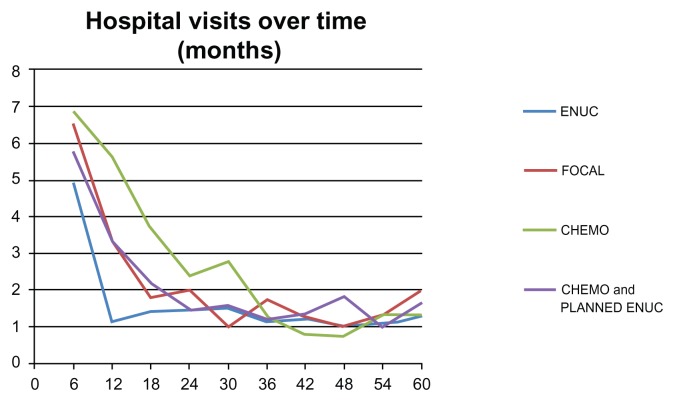
To follow the treatment history of patients with retinoblastoma to identify the trends in the number of hospital visits over time and the direct cost of medical care as determined by age at diagnosis and selected primary treatment modality.
An Institutional Review Board (IRB) approved consecutive retrospective case series.
Records from the Bascom Palmer Eye Institute were reviewed to identify 115 eligible patients (176 eyes) with retinoblastoma who underwent treatment at the Ocular Oncology Service between 1995 and 2010 and were available for extended follow-up evaluation.
Bilateral disease was present in 53% (N = 61) of all patients, and 79% (N = 90) of patients were diagnosed in the first six months of life. Chemotherapy was used to treat 75% (N = 86) of all patients and 95% (N = 36) of patients diagnosed in the first six months of life. 100% (N = 4) of patients presenting between the age of five and nine were enucleated. Per episode of care, the lowest-cost treatment strategy was enucleation, followed by focal laser therapy, systemic chemotherapy with planned enucleation, systemic chemotherapy, and lastly, intra-arterial melphalan chemotherapy.
Age at diagnosis is directly associated with the type of treatment chosen for retinoblastoma. The burden of retinoblastoma treatment on children and families is significant. The direct medical cost of intra-arterial chemotherapy per episode of care is comparable to systemic chemotherapy, but current strategies utilizing multiple planned episodes of intra-arterial chemotherapy are significantly more costly and may be associated with less systemic side effects and similar favorable outcomes. At the Bascom Palmer Eye Institute, intra-arterial chemotherapy has quickly become the treatment of choice for globe conserving therapy of retinoblastoma.
追踪视网膜母细胞瘤患者的治疗史,以确定随时间推移的医院就诊次数趋势以及根据诊断时年龄和所选主要治疗方式确定的医疗直接费用。
经机构审查委员会(IRB)批准的连续回顾性病例系列。
回顾了巴斯科姆·帕尔默眼科研究所的记录,以确定1995年至2010年间在眼肿瘤服务中心接受治疗且可进行延长随访评估的115例符合条件的视网膜母细胞瘤患者(176只眼)。
所有患者中53%(N = 61)为双侧疾病,79%(N = 90)的患者在出生后的前六个月被诊断出。75%(N = 86)的所有患者以及95%(N = 36)在出生后前六个月被诊断出的患者接受了化疗。5至9岁之间就诊的患者中有100%(N = 4)接受了眼球摘除术。每次护理期间,成本最低的治疗策略是眼球摘除术,其次是局部激光治疗、计划性眼球摘除术的全身化疗、全身化疗,最后是动脉内美法仑化疗。
诊断时的年龄与视网膜母细胞瘤所选治疗类型直接相关。视网膜母细胞瘤治疗给儿童和家庭带来的负担很重。每次护理期间动脉内化疗的直接医疗费用与全身化疗相当,但目前采用多次计划性动脉内化疗的策略成本要高得多,并可能伴有较少的全身副作用且有类似的良好效果。在巴斯科姆·帕尔默眼科研究所,动脉内化疗已迅速成为视网膜母细胞瘤眼球保留治疗的首选方法。