• 文献检索
  • 文档翻译
  • 深度研究
  • 学术资讯
  • Suppr Zotero 插件Zotero 插件
  • 邀请有礼
  • 套餐&价格
  • 历史记录
应用&插件
Suppr Zotero 插件Zotero 插件浏览器插件Mac 客户端Windows 客户端微信小程序
定价
高级版会员购买积分包购买API积分包
服务
文献检索文档翻译深度研究API 文档MCP 服务
关于我们
关于 Suppr公司介绍联系我们用户协议隐私条款
关注我们

Suppr 超能文献

核心技术专利:CN118964589B侵权必究
粤ICP备2023148730 号-1Suppr @ 2026

文献检索

告别复杂PubMed语法,用中文像聊天一样搜索,搜遍4000万医学文献。AI智能推荐,让科研检索更轻松。

立即免费搜索

文件翻译

保留排版,准确专业,支持PDF/Word/PPT等文件格式,支持 12+语言互译。

免费翻译文档

深度研究

AI帮你快速写综述,25分钟生成高质量综述,智能提取关键信息,辅助科研写作。

立即免费体验

全同胞家系中数量性状基因座定位的模型选择。

Model selection for quantitative trait loci mapping in a full-sib family.

机构信息

Key Laboratory of Forest Genetics and Biotechnology of the Ministry of Education, Nanjing Forestry University, Nanjing, China.

出版信息

Genet Mol Biol. 2012 Jul;35(3):622-31. doi: 10.1590/S1415-47572012005000044. Epub 2012 Jul 13.

DOI:10.1590/S1415-47572012005000044
PMID:23055802
原文链接:https://pmc.ncbi.nlm.nih.gov/articles/PMC3459413/
Abstract

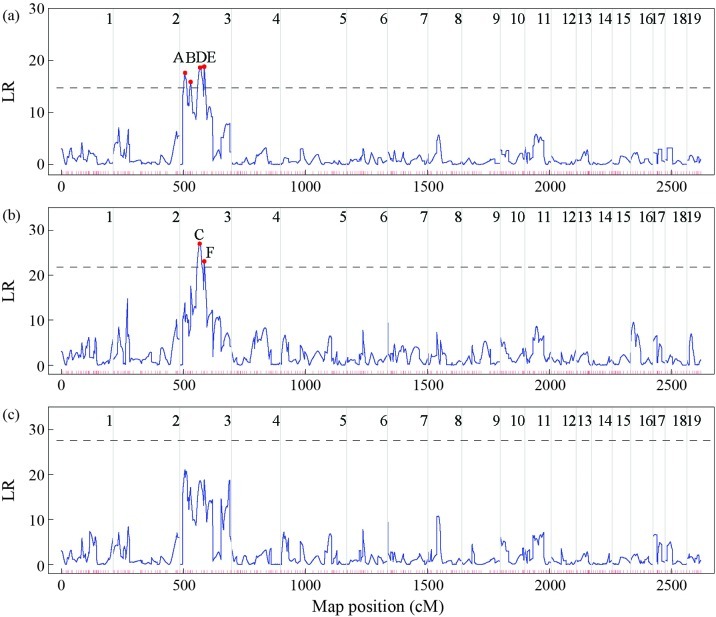
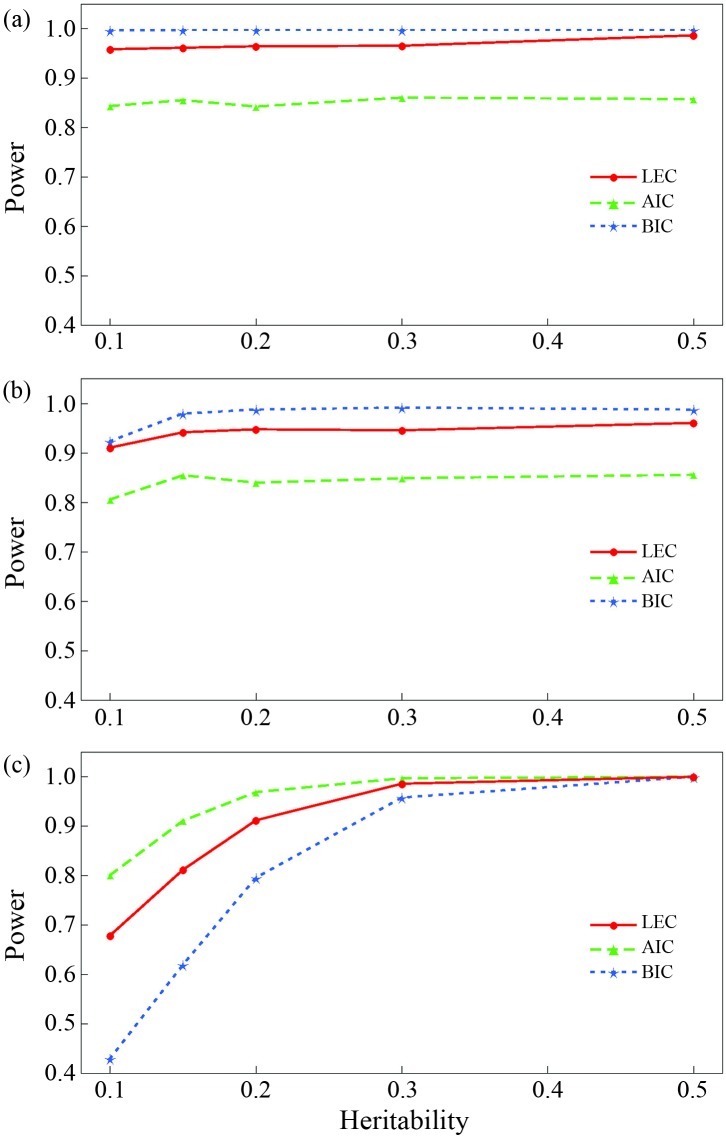
Statistical methods for mapping quantitative trait loci (QTLs) in full-sib forest trees, in which the number of alleles and linkage phase can vary from locus to locus, are still not well established. Previous studies assumed that the QTL segregation pattern was fixed throughout the genome in a full-sib family, despite the fact that this pattern can vary among regions of the genome. In this paper, we propose a method for selecting the appropriate model for QTL mapping based on the segregation of different types of markers and QTLs in a full-sib family. The QTL segregation patterns were classified into three types: test cross (1:1 segregation), F(2) cross (1:2:1 segregation) and full cross (1:1:1:1 segregation). Akaike's information criterion (AIC), the Bayesian information criterion (BIC) and the Laplace-empirical criterion (LEC) were used to select the most likely QTL segregation pattern. Simulations were used to evaluate the power of these criteria and the precision of parameter estimates. A Windows-based software was developed to run the selected QTL mapping method. A real example is presented to illustrate QTL mapping in forest trees based on an integrated linkage map with various segregation markers. The implications of this method for accurate QTL mapping in outbred species are discussed.

摘要

在全同胞林木中定位数量性状基因座(QTL)的统计方法仍然不够完善,因为其等位基因数量和连锁相位在不同位点可能会有所不同。先前的研究假设 QTL 分离模式在全同胞家系的整个基因组中是固定的,尽管实际上这种模式可能在基因组的不同区域中有所不同。在本文中,我们提出了一种基于全同胞家系中不同类型标记和 QTL 的分离来选择合适的 QTL 作图模型的方法。QTL 分离模式分为三种类型:测交(1:1 分离)、F2 杂交(1:2:1 分离)和全同胞杂交(1:1:1:1 分离)。采用赤池信息量准则(AIC)、贝叶斯信息量准则(BIC)和拉普拉斯经验准则(LEC)来选择最可能的 QTL 分离模式。模拟用于评估这些标准的功效和参数估计的精度。开发了一个基于 Windows 的软件来运行所选的 QTL 作图方法。用一个带有各种分离标记的综合连锁图谱,提出了一个真实的例子来说明林木中的 QTL 作图。讨论了这种方法对异交物种中准确 QTL 作图的意义。
https://cdn.ncbi.nlm.nih.gov/pmc/blobs/d83b/3459413/ef0f3455beb3/gmb-35-3-622-gfig2.jpg
https://cdn.ncbi.nlm.nih.gov/pmc/blobs/d83b/3459413/6e76a279a260/gmb-35-3-622-gfig1.jpg
https://cdn.ncbi.nlm.nih.gov/pmc/blobs/d83b/3459413/ef0f3455beb3/gmb-35-3-622-gfig2.jpg
https://cdn.ncbi.nlm.nih.gov/pmc/blobs/d83b/3459413/6e76a279a260/gmb-35-3-622-gfig1.jpg
https://cdn.ncbi.nlm.nih.gov/pmc/blobs/d83b/3459413/ef0f3455beb3/gmb-35-3-622-gfig2.jpg

相似文献

1
Model selection for quantitative trait loci mapping in a full-sib family.全同胞家系中数量性状基因座定位的模型选择。
Genet Mol Biol. 2012 Jul;35(3):622-31. doi: 10.1590/S1415-47572012005000044. Epub 2012 Jul 13.
2
MVQTLCIM: composite interval mapping of multivariate traits in a hybrid F population of outbred species.MVQTLCIM:远交物种杂交F群体中多变量性状的复合区间作图
BMC Bioinformatics. 2017 Nov 23;18(1):515. doi: 10.1186/s12859-017-1908-1.
3
Fine-mapping of quantitative trait loci in half-sib families using current recombinations.利用当前重组对半同胞家系中的数量性状位点进行精细定位。
Genet Res. 2000 Aug;76(1):87-104. doi: 10.1017/s0016672300004638.
4
3FunMap: full-sib family functional mapping of dynamic traits.3FunMap:全同胞家系动态性状的功能作图。
Bioinformatics. 2011 Jul 15;27(14):2006-8. doi: 10.1093/bioinformatics/btr306. Epub 2011 May 17.
5
Bayesian mapping of quantitative trait loci for multiple complex traits with the use of variance components.使用方差成分对多个复杂性状的数量性状位点进行贝叶斯定位。
Am J Hum Genet. 2007 Aug;81(2):304-20. doi: 10.1086/519495. Epub 2007 Jul 3.
6
Maximum likelihood mapping of quantitative trait loci using full-sib families.利用全同胞家系对数量性状基因座进行最大似然定位
Genetics. 1992 Dec;132(4):1211-22. doi: 10.1093/genetics/132.4.1211.
7
QTL mapping for fruit quality in Citrus using DArTseq markers.利用DArTseq标记对柑橘果实品质进行QTL定位。
BMC Genomics. 2017 Apr 12;18(1):289. doi: 10.1186/s12864-017-3629-2.
8
Quantitative trait loci influencing forking defects in an outbred pedigree of loblolly pine.影响火炬松一个远交系谱中分叉缺陷的数量性状基因座。
BMC Genet. 2016 Oct 18;17(1):138. doi: 10.1186/s12863-016-0446-6.
9
Power of quantitative trait locus mapping for polygenic binary traits using generalized and regression interval mapping in multi-family half-sib designs.在多家族半同胞设计中使用广义和回归区间映射对多基因二元性状进行数量性状基因座定位的功效。
Genet Res. 2000 Dec;76(3):305-17. doi: 10.1017/s001667230000481x.
10
A likelihood approach for mapping growth trajectories using dominant markers in a phase-unknown full-sib family.一种在阶段未知的全同胞家系中使用显性标记绘制生长轨迹的似然方法。
Theor Appl Genet. 2004 Feb;108(4):699-705. doi: 10.1007/s00122-003-1484-9. Epub 2003 Oct 28.

引用本文的文献

1
Multivariate linear mixed model enhanced the power of identifying genome-wide association to poplar tree heights in a randomized complete block design.多元线性混合模型提高了在随机完全区组设计中鉴定杨树树高全基因组关联的功效。
G3 (Bethesda). 2021 Feb 9;11(2). doi: 10.1093/g3journal/jkaa053.
2
MVQTLCIM: composite interval mapping of multivariate traits in a hybrid F population of outbred species.MVQTLCIM:远交物种杂交F群体中多变量性状的复合区间作图
BMC Bioinformatics. 2017 Nov 23;18(1):515. doi: 10.1186/s12859-017-1908-1.
3
QTL associated with resistance to cassava brown streak and cassava mosaic diseases in a bi-parental cross of two Tanzanian farmer varieties, Namikonga and Albert.

本文引用的文献

1
Estimating the locations and the sizes of the effects of quantitative trait loci using flanking markers.利用侧翼标记估计数量性状基因座的位置和效应大小。
Theor Appl Genet. 1992 Dec;85(4):480-8. doi: 10.1007/BF00222330.
2
Genomic analysis in maritime pine (Pinus pinaster). Comparison of two RAPD maps using selfed and open-pollinated seeds of the same individual.海洋松(Pinus pinaster)的基因组分析。使用同一个体的自交和开放授粉种子的两个 RAPD 图谱比较。
Theor Appl Genet. 1995 Jun;90(7-8):1028-34. doi: 10.1007/BF00222917.
3
Joint mapping of quantitative trait Loci for multiple binary characters.
在两个坦桑尼亚农民品种Namikonga和Albert的双亲子代杂交中,与木薯褐色条纹病和木薯花叶病抗性相关的数量性状基因座
Theor Appl Genet. 2017 Oct;130(10):2069-2090. doi: 10.1007/s00122-017-2943-z. Epub 2017 Jul 13.
4
Construction of High-Density Linkage Maps of Populus deltoides × P. simonii Using Restriction-Site Associated DNA Sequencing.利用限制性位点关联DNA测序构建美洲黑杨×小叶杨的高密度连锁图谱
PLoS One. 2016 Mar 10;11(3):e0150692. doi: 10.1371/journal.pone.0150692. eCollection 2016.
多个二元性状数量性状基因座的联合定位
Genetics. 2005 Feb;169(2):1045-59. doi: 10.1534/genetics.103.019406. Epub 2004 Oct 16.
4
A multilocus likelihood approach to joint modeling of linkage, parental diplotype and gene order in a full-sib family.一种用于全同胞家系中连锁、亲本双倍型和基因顺序联合建模的多位点似然方法。
BMC Genet. 2004 Jul 26;5:20. doi: 10.1186/1471-2156-5-20.
5
A general statistical framework for mapping quantitative trait loci in nonmodel systems: issue for characterizing linkage phases.非模式系统中定位数量性状基因座的通用统计框架:连锁相表征问题
Genetics. 2003 Oct;165(2):901-13. doi: 10.1093/genetics/165.2.901.
6
Genetic maps for Pinus elliottii var. elliottii and P. caribaea var. hondurensis using AFLP and microsatellite markers.利用AFLP和微卫星标记构建湿地松和洪都拉斯加勒比松的遗传图谱。
Theor Appl Genet. 2003 May;106(8):1409-19. doi: 10.1007/s00122-002-1185-9. Epub 2003 Feb 8.
7
Moderate-density molecular maps of Eucalyptus urophylla S. T. Blake and E. tereticornis Smith genomes based on RAPD markers.基于随机扩增多态性DNA(RAPD)标记的尾叶桉和细叶桉基因组中等密度分子图谱。
Genetica. 2003 May;118(1):59-67. doi: 10.1023/a:1022966018079.
8
Molecular linkage maps of the Populus genome.杨树基因组的分子连锁图谱。
Genome. 2002 Jun;45(3):541-55. doi: 10.1139/g02-013.
9
Simultaneous maximum likelihood estimation of linkage and linkage phases in outcrossing species.异交物种中连锁和连锁相的同时最大似然估计。
Theor Popul Biol. 2002 May;61(3):349-63. doi: 10.1006/tpbi.2002.1577.
10
Mapping and analysis of quantitative trait loci in experimental populations.实验群体中数量性状位点的定位与分析。
Nat Rev Genet. 2002 Jan;3(1):43-52. doi: 10.1038/nrg703.