Institute of Biomedical Engineering, Faculty of Medicine, Prince of Songkla University, Songkhla 90110, Thailand.
Comput Math Methods Med. 2012;2012:407805. doi: 10.1155/2012/407805. Epub 2012 Sep 26.
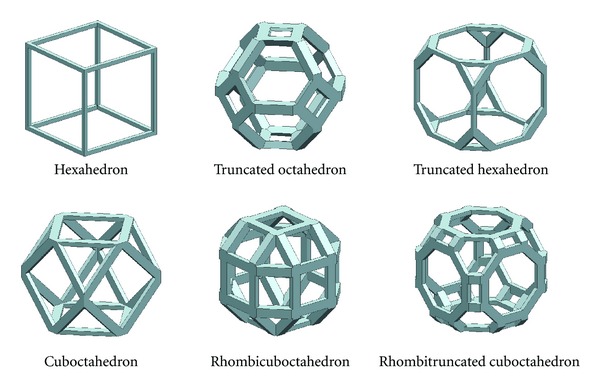
Tissue engineering scaffold is a biological substitute that aims to restore, to maintain, or to improve tissue functions. Currently available manufacturing technology, that is, additive manufacturing is essentially applied to fabricate the scaffold according to the predefined computer aided design (CAD) model. To develop scaffold CAD libraries, the polyhedrons could be used in the scaffold libraries development. In this present study, one hundred and nineteen polyhedron models were evaluated according to the established criteria. The proposed criteria included considerations on geometry, manufacturing feasibility, and mechanical strength of these polyhedrons. CAD and finite element (FE) method were employed as tools in evaluation. The result of evaluation revealed that the close-cellular scaffold included truncated octahedron, rhombicuboctahedron, and rhombitruncated cuboctahedron. In addition, the suitable polyhedrons for using as open-cellular scaffold libraries included hexahedron, truncated octahedron, truncated hexahedron, cuboctahedron, rhombicuboctahedron, and rhombitruncated cuboctahedron. However, not all pore size to beam thickness ratios (PO:BT) were good for making the open-cellular scaffold. The PO:BT ratio of each library, generating the enclosed pore inside the scaffold, was excluded to avoid the impossibility of material removal after the fabrication. The close-cellular libraries presented the constant porosity which is irrespective to the different pore sizes. The relationship between PO:BT ratio and porosity of open-cellular scaffold libraries was displayed in the form of Logistic Power function. The possibility of merging two different types of libraries to produce the composite structure was geometrically evaluated in terms of the intersection index and was mechanically evaluated by means of FE analysis to observe the stress level. The couples of polyhedrons presenting low intersection index and high stress level were excluded. Good couples for producing the reinforced scaffold were hexahedron-truncated hexahedron and cuboctahedron-rhombitruncated cuboctahedron.
组织工程支架是一种旨在恢复、维持或改善组织功能的生物替代品。目前可用的制造技术,即增材制造,本质上是根据预定义的计算机辅助设计 (CAD) 模型来制造支架。为了开发支架 CAD 库,可以在支架库开发中使用多面体。在本研究中,根据既定标准评估了 119 个多面体模型。提出的标准包括对这些多面体的几何形状、制造可行性和机械强度的考虑。CAD 和有限元 (FE) 方法被用作评估工具。评估结果表明,密孔支架包括截角八面体、菱形十二面体和菱形截角十二面体。此外,适合用作开式细胞支架库的多面体包括六面体、截角八面体、截角六面体、十二面体、菱形十二面体和菱形截角十二面体。然而,并非所有孔径与梁厚比 (PO:BT) 都适合制作开式细胞支架。生成支架内封闭孔的每个库的 PO:BT 比被排除在外,以避免制造后材料去除的可能性。密孔库具有恒定的孔隙率,与不同的孔径无关。开式细胞支架库的 PO:BT 比与孔隙率之间的关系以 Logistic 幂函数的形式显示。通过交集指数从几何角度评估两种不同类型的库合并以产生复合结构的可能性,并通过 FE 分析观察应力水平进行机械评估。排除交集指数低和应力水平高的多面体组合。用于生产增强支架的良好组合是六面体-截角六面体和十二面体-菱形截角十二面体。