Hara Kenji, Hellem Endre, Yamada Shuntaro, Sariibrahimoglu Kemal, Mølster Anders, Gjerdet Nils R, Hellem Sølve, Mustafa Kamal, Yassin Mohammed A
Centre of Translational Oral Research (TOR) - Tissue Engineering Group, Department of Clinical Dentistry, University of Bergen, Bergen, Norway.
Department of Oral and Maxillofacial Surgery, Fujieda Heisei Memorial Hospital, Japan.
Mater Today Bio. 2022 Mar 7;14:100237. doi: 10.1016/j.mtbio.2022.100237. eCollection 2022 Mar.
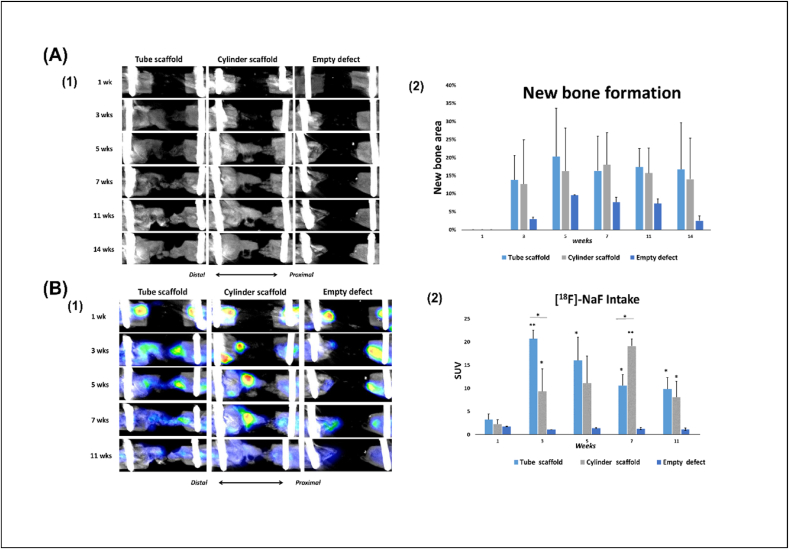
Three-dimensional printing (3D printing) is a promising technique for producing scaffolds for bone tissue engineering applications. Porous scaffolds can be printed directly, and the design, shape and porosity can be controlled. 3D synthetic biodegradable polymeric scaffolds intended for in situ bone regeneration must meet stringent criteria, primarily appropriate mechanical properties, good 3D design, adequate biocompatibility and the ability to enhance bone formation. In this study, healing of critical-sized (5 mm) femur defects of rats was enhanced by implanting two different designs of 3D printed poly(l-lactide-co-ε-caprolactone) (poly(LA-co-CL)) scaffolds seeded with rat bone marrow mesenchymal stem cells (rBMSC), which had been pre-differentiated into cartilage-forming chondrocytes. Depending on the design, the scaffolds had an interconnected porous structure of 300-500 μm and porosity of 50-65%. According to a computational simulation, the internal force distribution was consistent with scaffold designs and comparable between the two designs. Moreover, the defects treated with 3D-printed scaffolds seeded with chondrocyte-like cells exhibited significantly increased bone formation up to 15 weeks compared with empty defects. In all experimental animals, bone metabolic activity was monitored by positron emission tomography 1, 3, 5, 7, 11 and 14 weeks after surgery. This demonstrated a time-dependent relationship between scaffold design and metabolic activity. This confirmed that successful regeneration was highly reproducible. The and data indicated that the experimental setups had promising outcomes and could facilitate new bone formation through endochondral ossification.
三维打印(3D打印)是一种很有前景的技术,可用于制造用于骨组织工程应用的支架。多孔支架可以直接打印,其设计、形状和孔隙率均可控制。用于原位骨再生的3D合成可生物降解聚合物支架必须满足严格的标准,主要包括合适的机械性能、良好的三维设计、足够的生物相容性以及促进骨形成的能力。在本研究中,通过植入两种不同设计的3D打印聚(L-丙交酯-共-ε-己内酯)(聚(LA-co-CL))支架,增强了大鼠临界尺寸(5毫米)股骨缺损的愈合,这些支架接种了已预分化为软骨形成软骨细胞的大鼠骨髓间充质干细胞(rBMSC)。根据设计不同,支架具有300-500μm的相互连接的多孔结构,孔隙率为50-65%。根据计算模拟,内力分布与支架设计一致,两种设计之间具有可比性。此外,与空白缺损相比,用接种软骨样细胞的3D打印支架治疗的缺损在长达15周的时间里骨形成显著增加。在所有实验动物中,术后1、3、5、7、11和14周通过正电子发射断层扫描监测骨代谢活性。这证明了支架设计与代谢活性之间存在时间依赖性关系。这证实了成功的再生具有高度可重复性。 和 数据表明,实验设置具有良好的结果,并且可以通过软骨内骨化促进新骨形成。